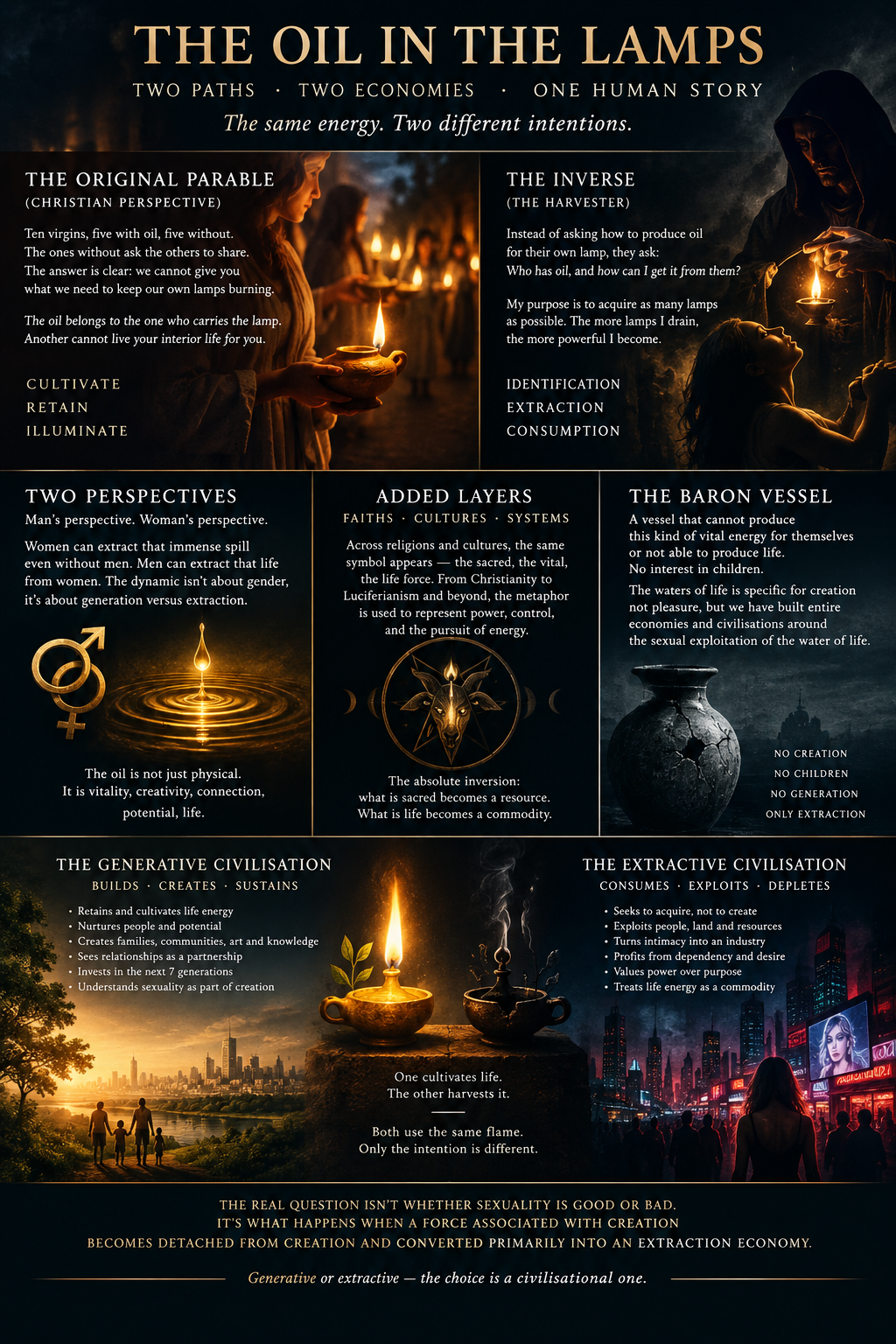
The Inverted Lamp
A study in extraction, the inability to refuse, and the ethics of taking oil
Central Proposition and Method
Central proposition: the ethical boundary is crossed when another being’s existence is converted from something to be respected into something to be consumed, particularly where meaningful refusal is unavailable.
Not an accusation. This study is not aimed at any individual, group, culture, religion, sex or institution. The examples are included because coercion, exploitation and loss of autonomy occur in the world. The purpose is not to identify villains but to examine the structure that lets one living being become a resource for another.
Pattern is not participation. A pattern existing does not establish that any particular person takes part in it. The framework examines behaviour and relationships, not identities.
Cultural context matters. A practice that shocks a modern Western observer may be longstanding and socially normalised elsewhere, and tribal and traditional societies are not one uniform category. Unfamiliarity does not make a practice exploitative. But social normalisation is not the same as individual consent, so the test stays the same in every setting: who has agency, who has authority, who benefits, and who can genuinely say no?
The larger question: what conditions allow extraction to become normalised, justified or invisible?
1. The Lamp the Right Way Up
The inversion only makes sense against the original. In Matthew 25:1–13, ten bridesmaids wait for the bridegroom. Five bring spare oil and five do not. When the lamps of the unprepared run dry, they ask the others to share and are refused: there is not enough for both. They go to buy oil elsewhere and the door is shut when they return.
| Symbol | Meaning |
|---|---|
| Lamp | The individual vessel: a person, their body, their life. |
| Oil | The sustaining inner resource: vitality, the water of life. Cultivated, not simply received. |
| Flame | Living purpose, consciousness, readiness. |
| Keeping oil | Retention and self-containment: holding enough of yourself to carry the flame. |
| Borrowing at the critical moment | Trying to obtain accumulated inner resource that was never cultivated in yourself. |
The prepared five are not being cruel. Self-containment is responsibility, not selfishness: nobody can live your interior life for you. The working principle is that vitality generated within can be shared, but cannot be sustainably extracted. That principle is what the inverted lamp breaks.
2. The Inversion
Invert the whole moral architecture. Imagine a lamp that does not exist to light its own path. Its purpose is to find other lamps, draw off their oil, and feed it into its own flame.
Upright lamp: how do I keep my lamp burning?
Inverted lamp: how many lamps can I drain while mine stays lit?
Extreme inversion: the more lamps I extinguish, the brighter I burn.
Relationship changes shape. Creation, sharing and continuation become identification, extraction and consumption. Communion becomes consumption.
The Harvester
The Harvester is the archetype of the inverted lamp: someone whose relationship with another person is organised around what can be taken from them. That may be attention, sexuality, labour, money, status, emotional energy, creativity, validation, or simply the feeling of being alive. Sex is one powerful form of exchange, not the definition. The Harvester does not necessarily hate the people harvested. They may barely perceive them, which is arguably worse.
A note on the “Luciferian” lens
Used only in the broad literary and philosophical sense of radical self-exaltation and autonomy, not as a claim about any real tradition, it yields two versions. The first is self-generation: I will make my own fire and depend on no one’s flame. That is closer to the parable than it looks, since it also refuses to outsource inner resources. The second is the inverted lamp proper: I will make myself the destination toward which other people’s fire is directed. Self-determination becomes self-aggrandising extraction.
3. The Spectrum: How a Lamp Inverts
| Stage | Stance |
|---|---|
| 1. Self-generation | I create my own oil. |
| 2. Self-retention | I preserve enough to remain myself. |
| 3. Voluntary exchange | I can share oil without destroying either lamp, and so can you. |
| 4. Dependency | I need your oil for a season, and you remain free to give or refuse. Not exploitation in itself. |
| 5. Extraction | I take your oil without respecting your agency. |
| 6. Coerced or persuaded extraction | You cannot freely refuse me, or I convince you that giving me your oil is the purpose of your lamp. |
The decisive variable is consent. Dependency is not exploitation: someone can lean on another person and keep genuine agency. The transition that matters is not I need your oil. It is:
I need your oil + you cannot freely refuse + I benefit from that inability.
Stage six is the true inversion. The victim’s existence has been turned inside out: their lamp no longer exists for them but to supply someone else’s fire. The wise person keeps enough oil for their own lamp. The exploiter persuades everyone else that their oil belongs in his. Power, dependency, institutions, religious authority and economics can all be read through this stage, without assuming any particular group behaves this way.
Reciprocity is not the test
Unequal giving is not extraction. Someone can give enormously without being exploited if the giving is freely chosen, and someone can receive enormously without being exploitative if the relationship stays consensual and reciprocal in whatever form suits it. Extraction is defined by taking without respecting the other’s agency, which guards against treating every unequal relationship as pathological.
The drift: extraction without a decision
Nobody has to wake up and decide to harvest someone. Dependency can accumulate: need → dependence → entitlement → expectation → normalisation → extraction. Eventually the person may no longer perceive what they are doing as taking. That is more disturbing than deliberate extraction, because the extractor may sincerely believe the relationship is normal. It also keeps the Harvester an analytical tool rather than a villain archetype.
4. Where the Inversion Begins: The Barren Vessel
Why does a lamp invert? One proposed origin is the “barren vessel”: a lamp that experiences itself as unable or unwilling to generate, to reciprocate, to attach, to create. Read literally as biological infertility, the image fails, because childlessness, infertility or sexual inactivity do not make anyone a harvester.
Barren does not mean infertile. Barren means non-generative within the metaphor: disconnected from one’s own capacity to create.
The real variable is participation in creation, not reproduction. Creation is wider than children: art, knowledge, care, safety, community, friendship, infrastructure, teaching, another person’s chance to flourish. Someone can create life without creating a child, and someone with children can live almost entirely by extraction.
The sharper distinction is generative versus extractive, not fertile versus barren, and not man versus woman.
The proposed pathway is:
lack → disconnection → extraction → habituation → emotional detachment.
A person who repeatedly experiences others as sources of something they cannot generate can drift into transaction, until the final question arrives: why should their experience matter if the resource is available to me? That is where extraction detaches from empathy. This is a hypothesis about one route, not a claim that lack inevitably leads there.
5. The Light Withheld From One Vessel
The inverted lamp does not have to be total. Empathy is not uniform: a person can be affectionate, generous and protective toward dozens of people and cold or exploitative toward one. The lamp may be full and lighting everyone else’s world while the light is kept from a single vessel. Several mechanisms can produce that, and this study does not claim to know which applies in a given case:
- Objectification: the person stops being experienced as a full individual.
- Resentment: accumulated grievance changes how their behaviour is read.
- Attachment rupture: vulnerability becomes associated with threat or pain.
- Power dynamics: the relationship becomes about control rather than mutuality.
- Compartmentalisation: real care elsewhere, walled off from one relationship.
- Extraction: the person is valued only for what they provide.
- Defensive disconnection: distance as protection from vulnerability.
The disturbing question is not what if someone cannot love? but what happens when someone capable of profound love selectively withdraws recognition of one person’s humanity?
6. The Inverted Lamp Can Look Like Love
Extraction is not always violent, and the most sophisticated form is not force. A Harvester may never say give me your oil. They may create circumstances where giving becomes morally obligatory, until the victim believes extraction is love. This is false generosity: gifts, sacrifices and care offered so that a debt exists to be collected.
Some familiar sentences belong to this territory: you are the only one who understands me; if you loved me you would; after everything I have done for you; this is what family does; you owe me. None of them proves exploitation on its own. Within this framework they become questions worth asking:
Is affection being exchanged freely, or is affection being used to secure access to another person’s oil?
7. The Inverted Lamp at Civilisation Scale
Sexual energy sits where creation and consumption are easiest to pull apart. It can produce children, intimacy and bonding, but also pleasure, status, money, attention, entertainment and labour. Whole industries and civilisations are built on the second list.
The useful question is not whether sexuality is good or bad. It is: what happens when a force associated with creation is detached from creation and converted into an extraction economy?
A generative civilisation asks what can we bring into existence together? An extractive civilisation asks what can I obtain from you? From outside the two can look alike for a long time, because they run on different metaphors of the lamp. The same person can take part in both systems at different points in life. This may be the paper’s widest claim, because the distinction applies almost everywhere:
| Domain | Generative question | Extractive question |
|---|---|---|
| Ecology | What can the ecosystem regenerate? | What can we take out? |
| Technology | What capacity can it create for people? | How much attention, data or labour can it capture? |
| Economics | What can we collectively produce? | What can I capture from others’ production? |
| Education | How do we develop this person’s capacity? | How much can we obtain from their labour? |
| Relationships | How do we help each other flourish? | What can I obtain from this person? |
8. The Inverted Lamp in Human Institutions
The inverted lamp does not require an individual Harvester. Sometimes the harvesting function is distributed across a family, community, institution or economic system.
The resource being taken can change:
Body → sexuality → marriage → labour → reproduction → obedience → status → wealth.
The underlying structure can nevertheless remain recognisable:
- Someone possesses something another wants.
- The person providing it has limited ability to refuse.
- Authority or social expectation legitimises the arrangement.
- The extraction becomes normalised.
- Eventually the person being used can disappear behind the function they perform.
This gives the metaphor a way of examining practices that have existed across different societies without assuming that all of them are identical, or that unfamiliarity itself makes something exploitative.
Bodily extraction
Practices involving permanent or significant alteration of another person’s body raise the question: whose lamp is the body?
Female genital mutilation/cutting is particularly relevant to the framework where it is imposed upon a person who cannot meaningfully consent, because the individual’s body is being altered according to a social, familial or cultural requirement. The metaphor is not concerned with declaring an entire culture a Harvester. It asks whether the individual vessel has been permitted to retain authority over itself.
Historical practices such as foot binding can be examined through a similar lens: the body becomes a carrier of social expectations, and the person’s physical existence becomes part of maintaining a wider social structure.
Marriage as transfer of the lamp
Marriage is a more complicated case because it can be genuinely reciprocal and freely chosen. The inversion occurs when the relationship becomes something possessed by other people rather than something entered by the people within it.
Child marriage and forced marriage raise questions about age, capacity, authority and meaningful refusal. A parent or guardian may legitimately protect a child, but protection does not become ownership. The child’s future cannot simply become another family’s resource, an economic arrangement, a political alliance or a mechanism for preserving social status.
Polygyny requires the same distinction. The existence of multiple spouses is not itself proof of extraction. The relevant question is whether the people involved possess meaningful agency, reciprocity and the ability to refuse or leave.
Labour as oil
The lamp can also represent labour. A person’s time, physical strength, skill and productive capacity are forms of oil. Employment can involve perfectly legitimate exchange: labour is voluntarily given and compensation is received.
The inversion occurs when the ability to refuse is removed. Slavery, forced labour and trafficking represent an extreme form of the metaphor: the person’s productive capacity becomes somebody else’s fuel. The individual is no longer recognised primarily as a person who possesses labour. They are treated as labour that happens to possess a body.
Sexuality as oil
Sexuality is perhaps the most intimate form of the metaphor because it involves the body, vulnerability, reproduction, pleasure and attachment simultaneously. But the study must distinguish sexuality from sexual extraction.
Consensual adult sexuality can be reciprocal, and consensual adult sex work is not synonymous with sexual exploitation. Exploitation occurs where meaningful choice is removed through force, coercion, trafficking, dependency, deception or other forms of control. The relevant question remains the same: is the person’s sexuality something they are freely sharing, or something another person believes they are entitled to harvest?
The child as vessel
Children make the question particularly stark because authority is unavoidable. A child necessarily depends upon adults for protection, food, shelter, education and guidance. That dependency creates legitimate authority, but it also creates the possibility of exploitation. The ethical responsibility runs in one direction:
The adult’s authority exists to protect the child’s lamp, not to use it as fuel.
That principle connects child marriage, forced labour, sexual exploitation and other forms of abuse without pretending that they are otherwise identical.
When the Harvester becomes a system
The most important extension may be this: the Harvester does not always have to be a person. Sometimes an entire arrangement can function as the Harvester.
- A family may depend upon a child’s obedience.
- A community may depend upon conformity.
- An economic structure may depend upon cheap labour.
- A marriage system may depend upon a person’s inability to refuse.
- An institution may depend upon the unquestioning loyalty of its members.
The individual Harvester can therefore disappear. There may be nobody standing over the lamp saying give me your oil. Instead, everyone may simply understand that this is what the lamp is for. The question changes from who is harvesting? to what system is being kept illuminated, and whose oil is paying for the light?
Who decided what this lamp exists for?
9. The Hard Edge: Those Who Cannot Refuse
The darkest cases of the inverted lamp share one structure, and it is not sexuality as such. It is access to someone who cannot meaningfully refuse.
Mutual relationship: two parties recognise each other’s autonomy, set boundaries, can say no, and can leave.
Inverted relationship: one party benefits from an asymmetry that stops the other from exercising that autonomy.
Children cannot give informed consent to adult sexual access, and apparent willingness or affection does not change that; the responsibility rests entirely on the adult. Animals cannot consent either. An animal is not a literal replacement source of human life-energy, but it can be exploited as a substitute for intimacy, control or gratification, and it is a wrong precisely because the other party cannot refuse or understand. Dependents, captives and the coerced sit in the same position.
When the protector becomes the gatekeeper
It worsens when the person meant to guard someone’s agency is the one overriding it. Forced marriage is the clear case. A parent has real authority to protect, guide and decide many things for a child, but that authority does not make the child’s future relationships the parent’s property or let the parent manufacture consent on their behalf.
- I need something; my lamp needs oil.
- You have something I want: affection, labour, sexuality, status, obedience, money.
- You cannot freely refuse me.
- Someone with authority legitimises the arrangement: a parent, institution or community.
- The victim’s autonomy disappears behind the relationship.
Two questions cut through it: who gave you the right to take the oil? and who gave you the right to decide that another person’s lamp exists to keep yours burning? They apply wherever authority, dependency and extraction get confused with care.
10. Consent Is Not Compliance
Someone can comply because they are frightened, economically dependent, socially constrained, manipulated, young, captive or under someone’s authority. Compliance is not consent, and separating the two keeps the child, animal, forced-marriage and dependency examples distinct instead of blurring them together.
| Concept | The question it asks |
|---|---|
| Compliance | Did they do it? |
| Consent | Were they genuinely free to choose it? |
| Informed consent | Did they understand what they were agreeing to, and did they have the capacity to decide? |
A child’s compliance or affection is not informed consent. An animal cannot give it. A person under coercion, captivity or total dependence may comply while being unable to consent. Each case fails a different part of the test, which is why the framework treats them separately even though they share one structure.
11. Faithfulness: To Whom, and to What?
The counter to the inverted lamp is faithfulness, and several distinct loyalties can be confused:
- To yourself: keeping your own lamp lit without consuming anyone else.
- To another human being: treating their autonomy as mattering independently of what they give you.
- To a child or dependent: protecting rather than extracting.
- To an animal: honouring that it cannot consent, and so cannot be made a supply.
- To the relationship itself: preserving reciprocity rather than treating the other party as fuel.
- To God, in the biblical frame: receiving the oil as something entrusted, not assuming everything around you exists to refill your lamp.
The test: if my lamp can only stay lit by continually taking from something else, is it my lamp being sustained, or have I built a system of dependency and extraction around it?
Or: do I love the other being as another being, or do I love what I can obtain from their inability to refuse me?
12. Studying the Inversion Without Going Numb
This material is disturbing, and a common response is to disconnect. Distance can help: with the reaction dialled down, the structure shows. power → dependency → inability to refuse → authority → extraction → justification.
But distance is not absence. Losing the anger does not have to mean losing the principle the anger was defending. The check is whether you can look at something disturbing without needing your emotional reaction to tell you what you think of it, while still knowing it is wrong. If the distance starts to feel like nothing matters, that is numbness rather than clarity, and worth noticing.
13. Limits of the Metaphor
- Not gendered. The early framing of women extracting from men and men from women is set aside. Extraction and generation are roles anyone can occupy, and one person can occupy both.
- Symbolic, not literal. Oil stands for vitality. Nothing here claims a measurable life-energy passes between bodies.
- Not a diagnosis. The Harvester is an archetype for thinking, not a label for real individuals or groups, and the mechanisms are possibilities, not findings.
- Not Western moralism. The test is agency, refusal and who benefits, not whether a practice looks strange to an outsider.
- Not all sharing is extraction. Mutual exchange is healthy. The line is crossed when refusal is impossible, punished or engineered away.
14. The Final Question
If I removed everything this person provides me, would I still recognise their existence as valuable in itself?
If the answer is yes, there is still a person beyond the resource. If the answer is no, the lamp has probably become an object. That is where the study lands: the opposite of extraction is not simply generosity. It is recognition, the recognition that the other lamp has its own flame, its own oil, its own direction, and its own right not to become fuel for yours.