Learning Module · Social Systems & Structures
How Closed Systems Operate — and Why They Fail
A structured analysis of exclusionary logic, unspoken contracts, and the conditions that lead closed groups to undermine themselves.
The Ring-Fence: What Is a Closed System?
A closed system — sometimes called a ring-fenced group — is any social, professional, or institutional circle that deliberately restricts the flow of resources, opportunity, and access to its own members. These systems exist across religion, ethnicity, culture, class, and ideology.
What makes a closed system distinctive is not its stated purpose (community, faith, tradition) but its operational logic: opportunity circulates internally, and the rules of access are almost never written down.
Key Insight
Closed systems are not conspiracy — they are a predictable result of how trust and social capital behave in tight-knit groups. The outcome is exclusionary even when the intent is simply “looking after our own.”
Common examples of ring-fenced circles
- Religious communities — preferential hiring, social introductions, and financial networks shared among members
- Ethnic and cultural networks — business referrals, housing, and employment routed through heritage ties
- Professional guilds and institutions — credentials, contacts, and clients controlled by credentialed insiders
- Ideological subcultures — access to platforms, recognition, and collaboration filtered by alignment
The Trust Shortcut
The Referral Engine
The Echo Chamber
The Social Glass Ceiling
Reflect
Can you identify a closed system you have encountered — professionally, socially, or culturally? What were the visible signs of its boundary?
✓ SavedThe Unspoken Contract
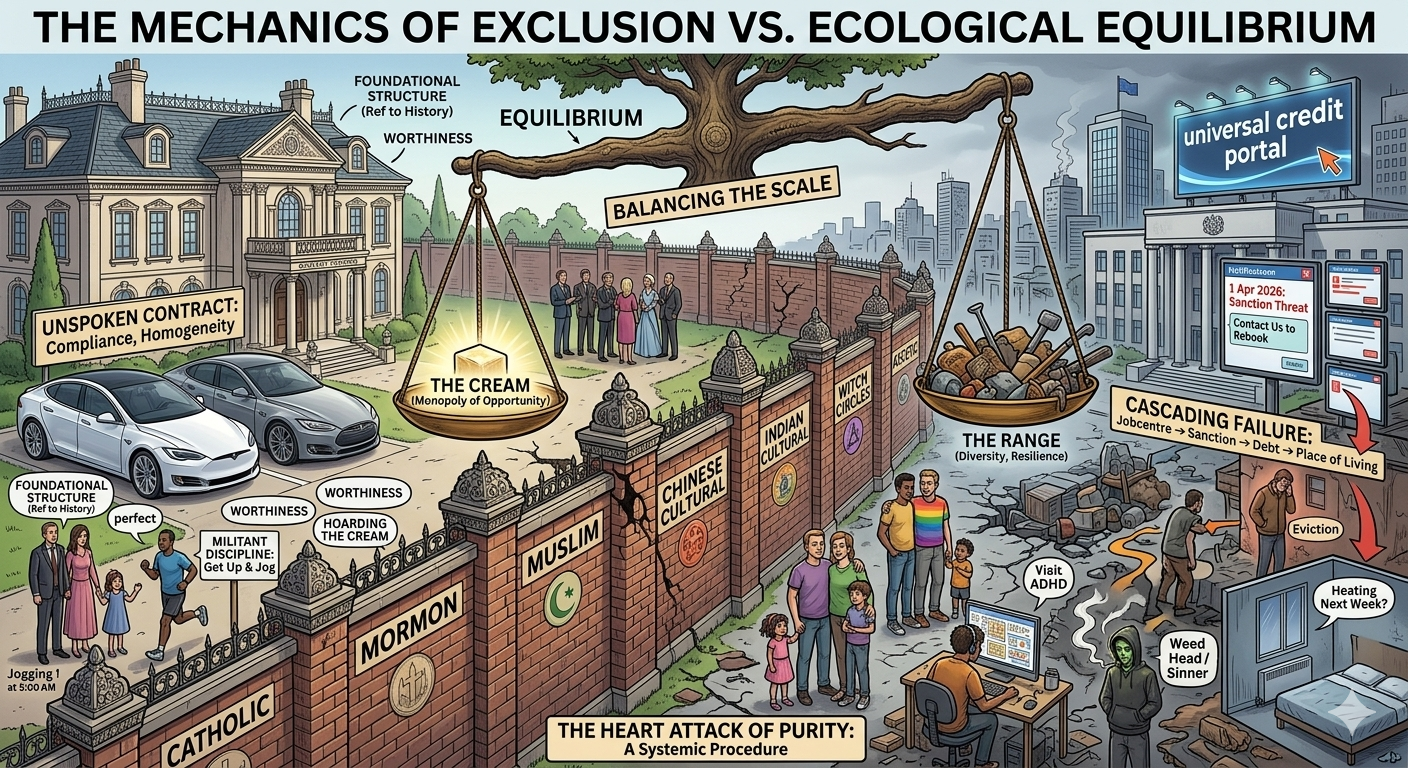
Every closed system runs on what might be called an unspoken contract — a set of expectations that are morally and socially obligatory, yet never formally stated, never legally binding, and never officially enforced.
This is precisely what makes it so effective. A written contract can be contested. An unspoken one cannot. Because it exists only in behaviour, atmosphere, and the subtle signals of inclusion and exclusion, it is almost impossible to challenge through formal channels.
Warning
The unspoken nature of the contract does not reduce its power — it amplifies it. There is no document to dispute, no clause to negotiate. The consequences are real; the mechanism is invisible.
How the unspoken contract is enforced
Non-verbal cues, selective warmth, and micro-exclusions (not being included in a casual conversation, a social invitation, or a passing introduction) signal that a person is “out of sync” with group expectations. No confrontation is needed — the message is delivered through omission.
A person is not removed — the opportunities simply stop arriving. No one is fired; the informal invitations and referrals just cease. The “door” does not slam; it simply stops opening. This creates plausible deniability for those enforcing the exclusion.
Once a person accepts help, a job lead, or social support from within the circle, they incur an unspoken obligation. They have “accepted the cream” — and with it, an implicit agreement to conform to the group’s standards. Deviation after this point feels like a betrayal, not just of the group, but of the individual’s own social standing.
Because the contract is unspoken, the group can sincerely deny its existence. “We don’t discriminate — it’s just networking.” “We’re not excluding anyone — we simply prefer people who share our values.” This makes external accountability almost impossible and allows the system to persist legally and ethically unchallenged.
Knowledge Check · 1 of 3
Why is an unspoken social contract more difficult to challenge than a written one?
Referring to History as a Defence Mechanism
When closed systems face criticism, one of their most reliable responses is to refer to history — to frame their exclusionary practices not as choices but as foundational necessities. The argument takes a predictable form:
The Core Argument Pattern
“This is not exclusion — this is how communities have always operated. It is the structure upon which civilisation is built.”
By invoking historical precedent, the group achieves several things simultaneously:
- Naturalisation — the system is made to appear inevitable rather than constructed
- Moral legitimacy — what has “always existed” is implicitly framed as what “should” exist
- Deflection — criticism is reframed as an attack on heritage, tradition, or civilisation itself
- Legal protection — framing exclusion as cultural or religious practice shields it under freedom-of-association law
The selective reading of history
The crucial flaw in this defence is that it relies on selective curation. Historical precedents are chosen to support the boundary while the same history’s record of catastrophic failures — wars, collapses, and systemic crises born from precisely this kind of insularity — is quietly omitted.
Critical Perspective
The same historical record that shows “stability through unity” also shows the violent consequences of homogeneity taken to its extreme. A complete reading of history is at least as much an argument for integration as it is for preservation of boundaries.
Reflect
When you hear the phrase “this is how things have always been done,” what questions would help you evaluate whether this is a genuine observation or a rhetorical defence?
✓ SavedCascading Failure: When Rigid Systems Break Down
A cascading failure occurs when the breakdown of one component in a system triggers sequential failures in connected components. Rigid, closed systems are highly susceptible to this because they lack the redundancy and flexibility that comes from diversity.
The cascade: a single point of failure in a rigid system propagates outward, amplifying at each stage
Why closed systems are cascade-prone
A closed system that has filtered for conformity has, by design, eliminated the diversity that provides resilience. When environments shift — economically, socially, technologically — the group has no internal mechanism to adapt, because adaptation requires the very “rough edges” it spent years excluding.
The Purity Filter reduces the talent pool
By excluding individuals who don’t conform to strict behavioural, ideological, or lifestyle standards, the system narrows its human capital base progressively over time.
Monoculture replaces diversity
Leadership, innovation, and problem-solving become dominated by a single profile of person — one with identical blind spots, risk tolerances, and assumptions.
External disruption finds no internal resistance
When the environment changes — a market shift, a demographic change, a technological disruption — the group has no diverse perspectives capable of recognising and responding to it.
The cascade expands beyond the fence
Eventually the consequences of systemic fragility are not contained by the ring-fence. They propagate outward into the wider ecosystem — affecting those who were previously excluded as well as those who were protected.
Knowledge Check · 2 of 3
What does a “purity filter” do to the long-term resilience of a closed system?
The Equilibrium Model: A Different Architecture
The alternative to a closed system is not chaos — it is an ecosystem model. Where the ring-fenced system operates on extraction and exclusion, the ecosystem model operates on flow and interdependence.
A healthy ecosystem is characterised not by the dominance of any single element but by the relationships between elements. Resources move. Skills are distributed. Contribution — not conformity — becomes the basis for access.
Core Principle
Equilibrium is not equality of outcome — it is equality of access to the conditions required for contribution. It does not flatten hierarchy; it makes the basis of hierarchy legible and achievable rather than hidden and inherited.
Closed System vs. Ecosystem: A Structural Comparison
| Dimension | Closed System | Ecosystem Model |
|---|---|---|
| Access to opportunity | Filtered by conformity to unspoken contract | Filtered by contribution and demonstrated capability |
| Resource flow | Circular — internal to the group | Open — across boundaries and skill sets |
| Diversity | Minimised by design (purity filter) | Valued as a source of resilience |
| Failure response | Cascading — no internal adaptive capacity | Distributed — multiple pathways for recovery |
| Integration pace | Resisted — seen as a threat to identity | Slow and deliberate — but directionally positive |
| Long-term sustainability | Fragile — dependent on external workforce it excludes | Adaptive — self-correcting through feedback loops |
Why integration is slow
Transitioning from a closed-system architecture to an ecosystem model is not a simple policy change — it is a cultural and structural process that takes generations. The barriers are not primarily legal; they are embedded in the unspoken contracts, referral networks, and trust structures that have accumulated over time.
- Trust takes time to transfer — the informal shortcuts that benefit in-group members don’t dissolve instantly when formal policies change
- Legacy networks persist — the referral engines already in motion continue to favour those already connected
- Cultural identity is intertwined with exclusion — for many, the boundary is the identity; removing it feels like dissolution
- Structural inertia — institutions built around closed-system logic require active redesign to allow flow in multiple directions
Knowledge Check · 3 of 3
Which of the following best describes why integration into open systems happens slowly, even when there is goodwill?
Apply This
Practical steps for evaluating any group or institution you encounter
- Map the access criteria. What does a person actually need to receive opportunity or support from this group? Are those criteria stated, or must they be inferred from observation?
- Trace the resource flow. Where do jobs, referrals, social connections, and financial support tend to travel? Do they circulate internally or move across boundaries?
- Listen for historical justification. When the group explains its structure, does it rely on “this is how things have always been” — and if so, which parts of history are being cited and which are omitted?
- Assess the diversity of failure tolerance. Does the group have mechanisms to survive the loss of conformity? Are “rough edges” tolerated or systematically removed?
- Identify the unspoken debts. What obligations accrue when someone accepts help from within the circle? Are those obligations acknowledged or left implicit?
Final Reflection
Thinking about a system you are part of — professional, social, or institutional — what would shift if opportunity within that system were allocated on contribution rather than conformity? What would be gained, and what tension might arise?
✓ Saved