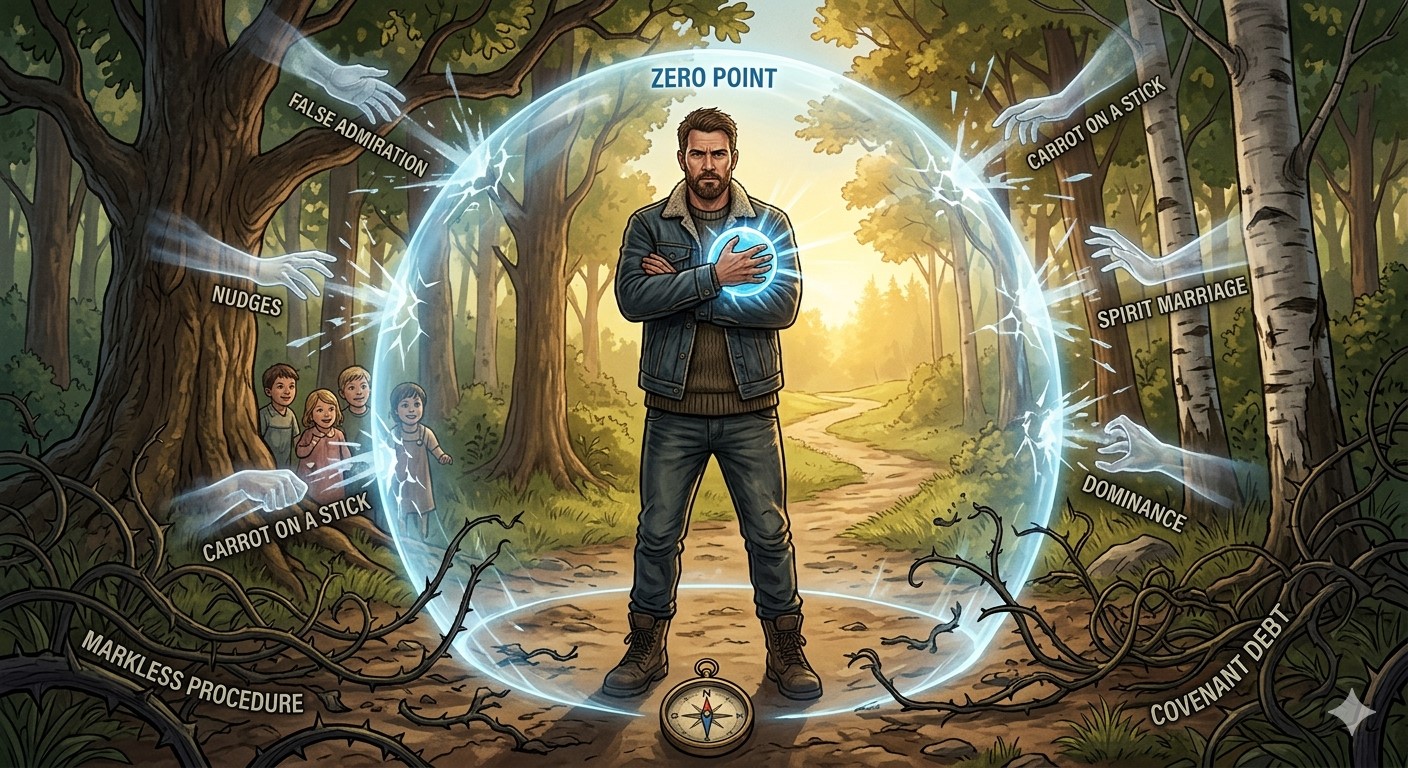
Sovereignty, Boundaries & Personal Power
Ten principles for understanding power dynamics, protecting your energy, and choosing how — and whether — you engage with systems designed to keep you small.
Begin the GuideTen Principles
These aren’t abstract theories. They’re patterns that show up in relationships, institutions, and daily life — and practical teachings for navigating them without losing yourself.
The Zero-Sum Mindset vs. Integrative Thinking
- If one side wins, the other must lose
- Extreme starting positions, refusal to move
- Leverage and domination replace mutual benefit
- Performing rigidity in public, negotiating privately
- Identify when the game itself is rigged
- Look for win-win possibilities — they often exist
- Walk away when the rules require you to lose
- Refuse to play on terms set by your opponent
Think of a recurring conflict or negotiation in your life — work, family, or otherwise. Now ask: Is the goal here to find something that genuinely works for both sides, or is one side trying to extract something the other cannot afford to give?
The ability to recognise zero-sum framing — and choose not to enter it — is one of the most important skills a person can develop. You cannot win a rigged game by playing harder. You win by refusing to sit down.
The Two-Level Game
- Public: moral language, unyielding positions, performance
- Private: technical deals, flexibility, actual decisions
- The gap between what’s said and what’s done
- Using representatives to maintain deniability
- You don’t have to accept the gap as normal
- Demand consistency between words and actions
- Ask for physical, visible proof over abstract promises
- Face-to-face honesty over shadow arrangements
In a current relationship or situation, is there a significant gap between what someone says publicly and what they actually do?
Energy and Boundaries
- Emotional labour without reciprocity
- Manufactured crises that keep you reactive
- Guilt that makes your choices responsible for others’ outcomes
- Being used as a container for someone else’s unprocessed pain
- You have a right to recognise extraction patterns
- Saying no to carrying others’ pain isn’t cruelty
- If someone’s actions are hidden, they don’t affect you — they return to them
- Seek relationships where energy genuinely flows both ways
After a conversation or interaction with a specific person, do you consistently feel more depleted than before — regardless of what was said? Does the drain feel like it has nothing to do with your own choices?
Where in your life is your energy flowing out without returning? Name it specifically, not generally.
Physical vs. Non-Physical Reality
- Implications and “vibes” rather than clear statements
- Psychological pressure with no concrete action
- Labels used to control behaviour
- Projected intentions treated as fact
- Insist on the physical: “What actually happened?”
- Demand face-to-face communication for anything important
- Judge people by actions, not projected intentions
- Abstract pressure requires your belief to function
Think of something that is currently causing you anxiety. Is it something that has physically happened, or is it a projected possibility?
The Carrot-and-Stick Pattern
- Promises that move away when you get close
- Requirements that increase once you’ve met them
- Rewards that never quite arrive despite compliance
- You keep walking; the destination keeps shifting
- Notice when goals shift every time you reach them
- Ask whether the reward has ever actually arrived
- A treadmill isn’t transport — it just keeps you moving
- Give yourself permission to stop walking
Think of a situation where you’ve been told “just do X and then Y will happen.” Have you done X? Did Y actually happen? If new conditions appeared — “now you need to do Z as well” — how many times has the goal moved?
Returning What Isn’t Yours
- Others projecting their fear, anger, or shame onto you
- Guilt used to make you fix what someone else broke
- Your boundaries treated as an act of cruelty
- Absorbing someone’s dysfunction becomes your identity
- “This belongs to you, not me”
- Recognise when you’re being asked to carry someone’s weight
- Refusing to absorb someone’s poison isn’t poisoning them
- Their unprocessed pain predates you and isn’t yours to resolve
Is there something you’ve been carrying that was originally someone else’s — a fear, a wound, a responsibility? What would it look like to set it down?
Practical Magic vs. Shadow Work
- Manipulation from a distance
- Hidden agendas that require secrecy
- Complex machinations to produce simple outcomes
- Actions that can’t survive being seen clearly
- Face-to-face connection and honest communication
- Physical presence, shared experience
- Trust what you can touch and verify
- Simple, honest interaction over elaborate psychological games
Think of a current situation or relationship. Could it function the same way if everything about it were completely visible?
Survival vs. Acceptance
- “You’re still here, so it must be okay”
- Continuation treated as endorsement
- Resilience reframed as compliance
- Endurance mistaken for agreement
- You can endure without consenting
- You can continue without agreeing it’s okay
- Standing firm doesn’t mean you like where you’re standing
- “I haven’t accepted this — I’m simply still here”
Is there anything in your life you’ve been surviving but have mistakenly been treating as something you’ve accepted? What changes if you acknowledge the distinction?
Holding the Zero Point
- Someone always has to stay calm when others are spiralling
- Absorbing shocks without passing them on
- Being the stable point in an unstable system
- This work is often invisible and costly
- This is valuable — but exhausting work
- Recognise when you’re being used as a shock absorber
- Returning to your own baseline is legitimate self-care
- Holding the centre is a choice, not an obligation
In your relationships or environments, are you frequently the person who absorbs tension, de-escalates, and keeps things stable — while others take that stability for granted?
Footprint Thinking
- Some choices leave large footprints: violence, extraction, deception
- Others leave smaller ones: simplicity, honesty, directness
- Labels attached to behaviours don’t always reflect actual harm
- Power structures criminalise what challenges them
- Look at real-world consequences, not just labels
- Consider who benefits from certain behaviours being policed
- Distinguish genuine damage from what merely challenges power
- The central question: am I actually harming someone?
Take a choice you make or are considering making that others label as problematic. Now measure its footprint honestly: does it damage another person’s safety, wellbeing, or autonomy? Or does it simply challenge a convention, make someone uncomfortable, or threaten a power structure?
Applying the Framework
These principles aren’t a checklist — they’re a lens. Use this integration exercise to bring the teachings into contact with your actual life.
Recognition
For each principle, ask: where have I actually seen this pattern operating in my life? Be specific — vague recognition doesn’t move anything.
Current Application
Is this pattern active right now — in a relationship, a work situation, or an internal dynamic? Name the specific situation, not the category.
Boundary Setting
What would it actually look like to apply this teaching in your specific situation? Not the ideal version — the real, practical, next step.
The Core Check
Am I confusing endurance with acceptance? Am I treating survival as agreement? Have I mistaken compliance for consent?
What Now?
These teachings aren’t about becoming someone better. They’re about becoming more clearly yourself — which means seeing patterns for what they are, and choosing deliberately how to respond.
Am I actively harming others — or am I simply refusing to be harmed?
That distinction carries most of the moral weight of this framework. Recognising patterns that drain you is not selfishness. Setting limits that protect your core is not cruelty. Choosing relationships based on honest reciprocity is not coldness. And distinguishing what you’ve survived from what you accept is not ingratitude.
Your Synthesis Statement
After working through this guide, what is the one thing you most clearly see that you hadn’t fully named before? Write it without polish — just honestly.
And one practical, physical action you can take in the next 48 hours that reflects what you’ve seen: