

My reasoning to challenge Apples decision
I am not here to be scammed by systems that don’t deliver I have no interest in using the system further after this experience I want a refund on my purchases and I am entitled to it please return my money to the card it was purchased from or I will ensure this information is made public do not hide behind legal reasoning and loopholes anymore just return my funds thank you
PART-TIME JOB
I found the contradictions in your own processes.
I located the hidden settings.
I identified the refund paths your support couldn’t explain.
I documented your policies better than your own systems did.
I compressed a multi-step, evidenced complaint into 140 characters because that is all your formal escalation channel allows.
I did the investigative work. The debugging. The documentation. The process mapping.
What exactly are your support systems doing?
The Documented Sequence — In Their Own Words
A stated right with no accessible mechanism is not a right. It is a holding statement. When the cost of resolution exceeds the value of what was taken, the system has collected twice — once in money, once in time. Only one of those appears on a receipt.
for you as well?
hidden processes, and support dead ends just to recover funds from a service that wasn’t delivered.
When Systems Become Traps
On Closed Ecosystems, Inconsistency, and the Right to Account
There is a pattern running through many modern systems — digital, institutional, and relational — in which the door opens easily inward, and all but disappears when you turn to leave. This workbook examines that pattern: what it reveals about power, consistency, accountability, and what it means to remain sovereign within systems designed to contain you.
The Architecture of the One-Way Door
Modern systems — particularly digital ones — have become extraordinarily efficient at one thing: making entry easy and exit expensive. Purchasing is frictionless. Recovering what you paid, or withdrawing your participation, is another matter entirely.
This is not always deliberate malice. Often it is simply the product of systems designed to optimise inflow, with little incentive to facilitate outflow. Over time, that asymmetry becomes structural — and structural asymmetries have a way of becoming invisible to those inside the machine, and painfully obvious to those trying to leave.
The question is not always whether entry was fairly priced. The question is whether the exit is free — and whether the promise of exit is honoured when it is given.
What makes this particularly telling is when a system states, in its own communications, that return of funds is possible — then provides no mechanism through which that return can actually occur. The promise of exit exists. The door to it does not. That gap between stated policy and operational reality is not a technical oversight. It is where trust goes to die.
A related dynamic occurs when the system that took your money is not the same system that controls its return. A platform may promise a refund. A payment processor may block it. A third party may disclaim responsibility entirely. The result is a loop in which the consumer is passed from one party to another — and no one is accountable, because each can point to someone else.
Reflect — The Systems You Live Inside
Think of a system you participate in — digital, professional, financial, or relational — where entry was easy but exit has felt difficult or costly. What made exit hard? Was it structural, emotional, or both?
Have you ever been told by a system that something was possible — a refund, a remedy, an exit — and then found no mechanism to actually achieve it? What did that experience reveal about how the system operated in practice versus how it presented itself?
Consistency as the Test of Fairness
There is a particular kind of institutional behaviour that is harder to dismiss than an outright refusal: inconsistency. When a system applies different outcomes to identical situations without clear explanation, it reveals something important about how decisions are actually being made — and by what logic.
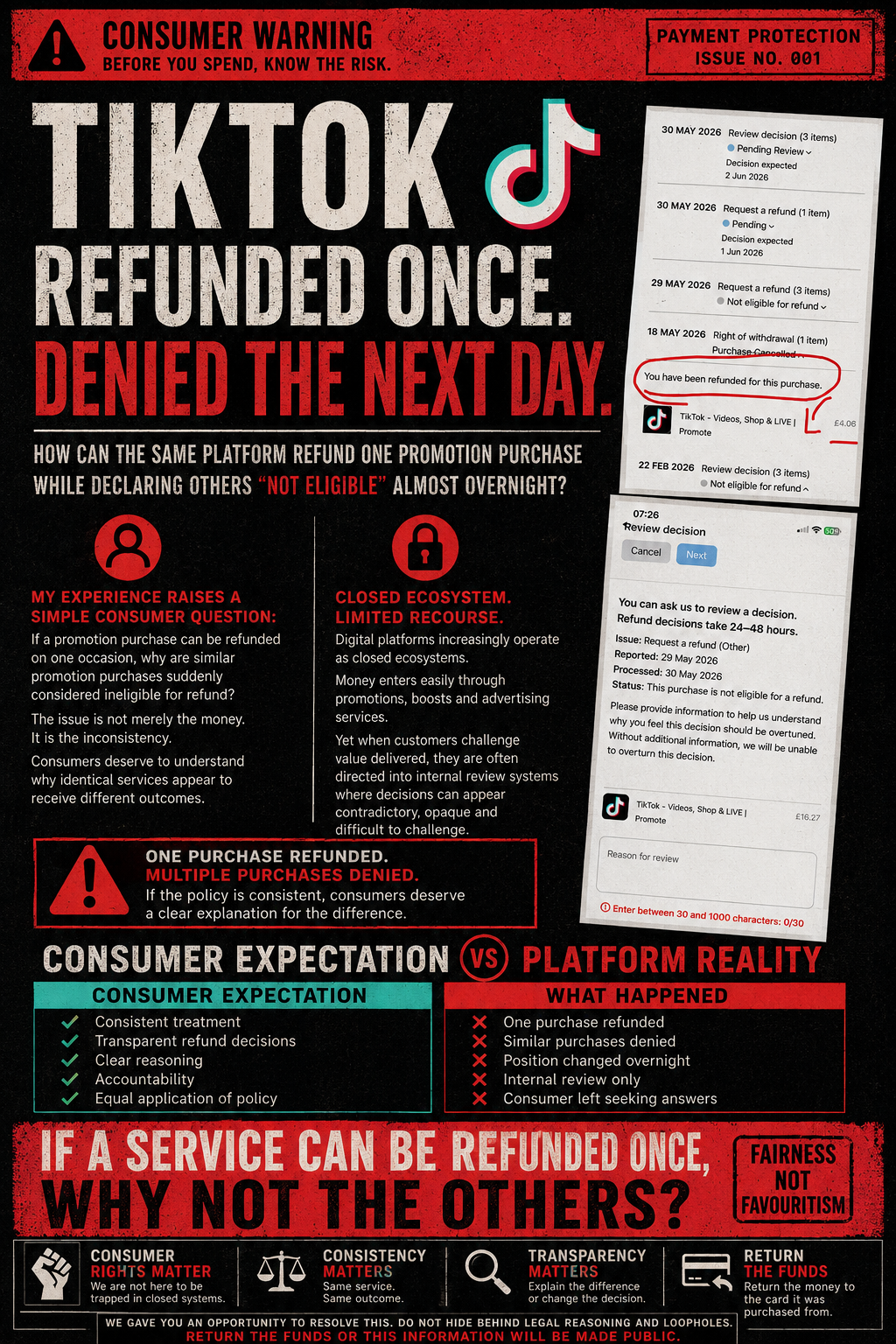
Consider what happens when a person receives a refund for one transaction — and then, for a near-identical transaction, is told that no refund is possible. Both relate to the same type of service. Both were processed through the same platform. The difference in outcome is not explained. It is simply presented as fact.
A promotional service is purchased. It is rejected before delivery. The recorded cost is £0. The platform states the remaining budget will be returned to the account balance.
The platform’s own communication states that the balance can be withdrawn from the account — not merely held for future use.
A previous, similar transaction was refunded. The record confirms: “You have been refunded for this purchase.”
Subsequent refund requests for the same type of service are marked “not eligible for refund” — without explanation of what materially changed.
The platform’s own interface later states: “Balance can’t be withdrawn” while Promote is integrated with Ads Manager — directly contradicting the earlier statement that withdrawal is possible.
The same screen states that closing the Promote account would allow withdrawal. When support is asked for the steps to do this, the support AI responds that it does not have that information and directs the consumer back to support.
The formal support ticket system — the official channel for submitting a detailed complaint — allows a maximum of 140 characters. The platform that asks consumers to “provide information to help us understand” has built its complaint mechanism on the same character limit as a tweet.
If the policy is consistent and withdrawal is genuinely possible, why does the mechanism to access it not exist — and why does no support agent know where it is? When a stated right has no accessible path, it is not a right. It is a holding statement.
This matters because inconsistency of outcome — when not explained — signals one of two things. Either the policy is being applied selectively, or there is no coherent policy at all — only a series of ad hoc decisions dressed up as institutional process.
Inconsistency is not a technical error.
It is a transparency failure —
and a stronger argument than any single refund denial.
| What Consumers Expect | What Inconsistency Delivers |
|---|---|
| Consistent treatment of similar transactions | Different outcomes for identical services, unexplained |
| Transparent reasoning for decisions | Status labels with no supporting rationale |
| Clear, findable remedy when promised | Stated withdrawal option with no visible mechanism |
| Accountability between platform and payment processor | Each party directing the consumer toward the other |
| Equal application of policy across all transactions | Policy applied selectively, without explanation |
Reflect — The Consistency Test
Where in your life — in systems you deal with, or in your own behaviour toward others — have you noticed inconsistency being applied without explanation? What was the effect on trust?
When you make decisions that affect others — granting or denying something, applying a rule, setting terms — how consistent are you? What drives the moments when you are not?
Layered Accountability — or the Absence of It
Modern digital commerce rarely involves just one party. Between the person who purchases and the service that is purchased, there is often a stack of intermediaries — platforms, payment processors, app stores, third-party operators — each with their own terms, their own review processes, and their own reasons to defer to someone else.
This layering is not inherently problematic. But it becomes deeply problematic when no single layer accepts clear responsibility — when the consumer is directed upward, downward, and sideways through the stack, and each layer points to the next.
The Platform — Statement One — states that the rejected promotion budget will be refunded to the Promote balance, and that the balance can be withdrawn from the account.
The Platform — Statement Two — later states that the balance cannot be withdrawn while Promote is integrated with Ads Manager. Offers a path: close the Promote account. Does not provide the steps to do so.
The Platform’s Support AI — when asked for the steps to close the Promote account and withdraw the balance, states that it does not have that information. Directs the consumer to contact support directly.
The Payment Processor — acts as gatekeeper for the original transaction. Refunds one purchase. Denies others. Does not explain the distinction. Directs the consumer back toward the platform.
The Formal Escalation Channel — the official support ticket system, described as the route for submitting detailed concerns, accepts a maximum of 140 characters. The same platform that instructs consumers to “provide information to help us understand” has engineered its complaint mechanism around a character count better suited to a social media post.
The Consumer — holds documented evidence of non-delivery (£0 ad spend, rejected promotion), a prior refund as precedent, two contradictory platform statements about withdrawal, a support AI that cannot explain its own interface, and a formal complaint window of 140 characters. Is asked to continue submitting requests into the same loop.
“You can withdraw” → “You cannot withdraw” → “You can withdraw if you close the account” → “We don’t know how to close the account.”
A stated right with no accessible mechanism is not a right.
It is a holding statement.
This is not a breakdown of process. It is the process working as designed. Each layer has plausible deniability. Each layer can point to the terms under which it operates. The consumer, navigating alone, is the only party without institutional support, legal resource on demand, or the ability to simply defer the question.
When no one is accountable, everyone is responsible — and the only person who actually pays the price is the one who asked a simple question and could not get a straight answer.
The sovereign response to this is not rage. It is documentation, clarity, and the willingness to escalate each question to exactly the party who most needs to answer it — and to make it clearly understood that the question will not disappear.
Reflect — Navigating Layered Systems
Think of a time when you were passed between parties — each pointing to the other — without a clear resolution. What was the cumulative effect of that experience on your energy, your trust, and your sense of self?
In systems you are part of — workplaces, communities, relationships — are there places where accountability is passed around rather than held? What would it look like for someone to simply hold it?
Consider the 140-character complaint window as a design choice. When a system builds friction directly into its escalation path — limiting the space in which a concern can be expressed — what does that reveal about its actual relationship with accountability? Where else have you seen friction used as a substitute for resolution?
The Resolution Tax — When the Cost of Recovery Exceeds the Loss
There is a cost that rarely appears on any invoice, receipt, or refund calculation: the cost of resolution itself. The time spent navigating settings. The attention spent reading contradictory messages. The energy spent filing appeals, contacting support, and trying to compress a complex, legitimate concern into a 140-character box.
Each individual step looks small in isolation. Click here. File an appeal. Contact support. Submit another review. Read another help article. But when those steps are added together, what emerges is something significant: an hour or more of unpaid administrative labour, performed by the person who was wronged, in service of recovering money for a service that was never delivered.
At some point the cost of resolution exceeds the value of what is being recovered. That is not always a coincidence. In many systems, it is the architecture.
This is what might be called the resolution tax — a hidden surcharge extracted not in money, but in time, attention, and cognitive load. It operates below the threshold of obvious injustice. Each individual barrier appears reasonable in isolation. It is only in aggregate — when you map the full timeline from first notice to final dead end — that the extraction becomes visible.
Discover the promotion has been rejected. Verify the £0 ad spend. Understand the funds are held in the Promote balance rather than returned.
Navigate platform settings to find the withdrawal function. Confirm that no visible withdrawal mechanism exists in the standard mobile interface.
File Apple refund requests. Receive one approval. Receive multiple denials. Receive no explanation for the difference in outcome between identical transaction types.
Contact TikTok support. Navigate an AI system that acknowledges the problem but cannot provide the steps to resolve it, and directs the consumer back to support.
Attempt to use the formal complaint channel. Discover it accepts 140 characters — roughly the length of this sentence and nothing more.
Approximately 90 minutes of navigating, reading, filing, appealing, and documenting — to recover payment for a service confirmed as undelivered before it began. The time cost may already exceed the monetary value of the original transaction.
When the effort required to recover what is owed
exceeds the value of what was taken,
the system has already collected twice.
This matters beyond the individual case. When resolution is this costly, most people stop before they reach one. Not because their case is weak, but because their time is finite. The system does not need to win the argument. It only needs to outlast the person making it. That is a different kind of taking — and it leaves no paper trail.
Reflect — The Hidden Cost of Resolution
Think of a time when the cost of resolving something — in time, energy, or attention — exceeded what you were trying to recover. At what point did you realise this? And what did you do with that realisation?
There is a decision point in every resolution attempt: the moment when continuing costs more than stopping. How do you navigate that threshold? Is your decision driven by the money, the principle, the time — or something else?
In the systems you operate — the work you do, the relationships you hold, the communities you shape — are you making it easy or difficult for people to raise concerns? Is resolution in your world accessible, or taxed?
The Ring-Fencing of Value
In the language of energy dynamics, a ring-fence is a boundary that allows value to flow inward but resists its return. In physical ecosystems, this creates stagnation. In economic ecosystems, it creates concentration — where resources accumulate at one node while circulating less freely back toward their origin.
This is not only a digital phenomenon. It occurs in relationships, in organisations, in belief systems. Anywhere a structure is designed to receive more than it returns — and where the promise of return is used as a retention mechanism rather than a genuine commitment — a ring-fence is forming.
- A relationship where your attention, care, or effort flows freely inward — but recognition, reciprocity, and repair rarely flow back.
- A workplace where the organisation draws from your creativity, time, and loyalty — but limits what you can claim, carry, or recover when you choose to leave.
- A platform that is fluid about receiving payment and rigid about returning it — particularly when the service it was paid to deliver was never actually delivered.
- A community or ideology that is welcoming to those who arrive — and isolating to those who begin to question the terms of membership.
Consider a significant exchange in your life — energy, money, time, attention. Where does it currently sit on this spectrum?
The mark of a sovereign exchange is not the presence of boundaries — it is whether those boundaries serve both parties, or only one.
Reflect — Ring-Fences in Your World
Where in your life have you noticed a ring-fence forming — a system, a relationship, a habit — that receives more from you than it returns? What has it cost you to recognise this?
Are there ring-fences you have built — consciously or not — around your own energy, time, or resources? What were you protecting, and is that protection still serving you?
Sovereignty and the Right to Exit
Sovereignty, in its practical sense, is not simply the freedom to choose what to enter. It is the freedom to leave without punishment, and to recover what you paid when what was promised was not delivered. A system that demands ongoing participation as the condition of its own self-justification has crossed from invitation into entrapment.
The right to exit is underrated as a spiritual and practical principle. It is the acknowledgement that no system — however useful, however large, however established — has an automatic claim on your continued participation. Value must continue to be delivered. Promises must be honoured. Trust must continue to be earned.
When a person says “I am no longer willing to participate in a system I cannot trust,” that is not a failure of commitment. It is the exercise of discernment. It is what sovereignty looks like in practice — not dramatic, not hostile, simply clear.
Trust is not granted once.
It is earned continuously — or it ceases to exist.
And when it goes, no policy retrieves it.
This applies to digital platforms. It applies to financial institutions. It applies to employers, to communities, to relationships. Wherever participation has become obligation, and exit has become consequence rather than choice — sovereignty has been eroded. Reclaiming it requires not confrontation, but clarity: about what you value, what you will accept, and where your threshold lies.
Reflect — Your Threshold and Your Exit
Think of a time when you chose to exit a system, a relationship, or a commitment that was no longer serving you. What made it possible? What made it difficult? What happened to your sense of self on the other side?
Where are you currently staying in something past your threshold? What story are you telling yourself about why exit isn’t yet possible — and how much of that story is accurate?
Trust as the Currency That Cannot Be Ring-Fenced
There is a final irony in systems that attempt to retain money, energy, or participation through opacity, inconsistency, or manufactured barriers: they may succeed in the short term, and fail catastrophically in the long one.
Trust is the one resource that cannot be legislated into existence, cannot be retained through policy, and cannot be locked inside an ecosystem. It must be freely given. And when it is withdrawn — through the accumulation of broken expectations, inconsistent treatment, and promises that had no mechanism behind them — the cost of recovering it dwarfs whatever was kept by not honouring the original commitment.
This is true of institutions and platforms. It is equally true of people. The person who fights to retain influence, energy, or attention through procedural complexity or deliberate opacity will find, in time, that what they retained was only the shell — the voluntary, generative, life-giving dimension had already quietly left.
The systems that last are not those that make exit impossible. They are those that make people genuinely not want to leave — because fairness and consistency are built into the structure, not bolted on as a complaint-resolution option.
Reflect — Your Final Synthesis
What is the one system, pattern, or relationship in your life right now where trust has become conditional or strained — where something was promised that hasn’t been delivered? What would resolution actually look like?
How do you want to be experienced — as someone who makes entry easy but exit difficult, or as someone people choose to stay with freely? What would it take to more fully embody that second thing?
Write a single statement — as clear and honest as you can make it — about one thing you are choosing to do differently after working through this material.
What You Actually Lost — An Energy Audit
When a system fails you, it is tempting to frame the loss in the currency that was taken — usually money. But money is rarely the only thing that left. And often, it is not even the most significant thing.
An honest accounting of what a failed system interaction costs looks something like this:
The Money
The original transaction. Quantifiable, documented, potentially recoverable. This is the part the system wants you to focus on — because it is the smallest part.
The Time
Ninety minutes. An hour and a half of your finite, non-renewable life spent navigating settings, reading contradictions, filing appeals, and compressing a complex issue into 140 characters. Time has no refund mechanism.
The Attention
Every moment spent thinking about this is a moment not spent on something you chose. Attention directed into a loop of contradictory messages is attention that cannot be redirected until the loop closes.
The Energy
The low-level drain of sustained frustration. The background processing. The effort of staying measured when what you want to say is considerably less measured. That costs something real.
The Trust
Once broken by a system, trust does not automatically return when the system eventually resolves the issue. A resolution that arrives late, under pressure, after documentation — is not the same as a system that worked.
The Creative Current
Perhaps the most significant loss. The energy that went into this loop is energy that did not go into building, creating, thinking, or moving forward. That is the harvest that never appears on any receipt.
The system does not need to steal your creativity directly. It only needs to occupy enough of your attention that the creative current has nowhere to flow.
This is what “harvesting human energy” means in practice — not as a conspiratorial claim, but as a systems observation. Platforms optimised for engagement and retention are not, by design, optimised for minimising the user’s effort when something goes wrong. The friction is not accidental. It is the inevitable output of systems built to maximise one thing while being indifferent to another.
The sovereign response is not to pretend this doesn’t cost anything. It is to name it clearly — to yourself first, and then, when it matters, to the system. A documented account of what was taken, in all its forms, is more powerful than anger alone. Anger dissipates. Documentation compounds.
Reflect — Your Energy Audit
Think of the last time a system, a relationship, or a situation drained significantly more from you than it returned. Do a full audit — not just the money or the obvious cost. What was the total? Time, attention, energy, trust, creative current. What is the real number?
What would it mean to treat your attention and creative energy as finite, non-renewable resources — as seriously as you treat money? What would you stop doing? What would you protect more fiercely?
Build It Better — The Systems We Deserve
Here is the thing about a platform worth billions that cannot build a working withdrawal button, a complaint form with more than 140 characters, or a support system that knows its own processes: it is not a hard problem to solve.
A withdrawal button that actually works is not a technical challenge. A complaint form with enough space for a coherent sentence is not a resource constraint. A support system trained on its own interface is not beyond reach. These are choices — about what the system prioritises, what it invests in, and whose experience it is optimised for.
The gap between what a system claims to offer and what it actually delivers is not an engineering problem. It is a values problem. And values problems have solutions — they just require the will to implement them.
This matters as a teaching, because many of the people working through this material are builders — of businesses, of communities, of systems that other people have to navigate. The question this section asks is not rhetorical. It is practical:
If you were building this system, what would you do differently?
- A refund process where the same type of transaction receives the same outcome — and where any exception is explained, not silently applied.
- A withdrawal mechanism that is findable, functional, and does not require closing the entire account to access.
- A support system — human or automated — that has actually been trained on the interface it is asked to support.
- A formal complaint channel sized for a real complaint, not a social media caption.
- A communications standard that does not promise one thing in one message and contradict it in the next.
- An internal culture that treats the cost of resolution as a metric worth measuring — because if you were tracking it, you would fix it.
None of this is utopian. None of it requires a revolution in technology or a fundamental reimagining of how platforms operate. It requires caring enough about the person on the other end of the system to build the system for them, not just for the system’s own retention metrics.
And if a platform cannot do that — if the answer genuinely is that withdrawal steps don’t exist, that the support AI doesn’t know its own interface, that 140 characters is considered sufficient for a formal complaint — then perhaps what is needed is not a better support ticket. Perhaps what is needed is someone who has navigated the system from the outside to come in and build it properly from the inside.
Frustration is data.
Every broken system is a design brief.
The person who experienced the failure
is often the most qualified to fix it.
Reflect — The Systems You Would Build
Think of a broken system you have navigated — one where the friction was clearly a choice, not a necessity. If you had been handed the brief to fix it, what would you have done first? What is the one change that would have made the entire experience different?
What systems are you currently building — formally or informally — in your work, your community, your relationships? Where is friction present in those systems that you have the power to remove? What is stopping you?
If someone navigated one of your systems today — and experienced what you experienced in this workbook’s case study — what would they say? And what would you want them to say instead?
End of Workbook
Sovereignty is not a destination. It is a practice — exercised in the small moments of noticing, naming, and choosing. The fact that you completed this work is itself an act of it.
And if along the way you also identified a broken system you could build better — that is not a coincidence. That is the work.