TPOL · Spiritual Technologies
Teaching Workbook
Two Teachings on Pride, Perspective & Intellectual Humility
Teaching One
On Pride & Arrogance
What Is Cast Behind
May Propel Another Forward
To those who believe themselves far more advanced, and who look back upon others from a throne of pride and arrogance — thank you.
Thank you for your scorn, your pride, and your arrogance. I use them as fuel to propel myself forward. Even if I am a decade behind you, or ten lifetimes behind you, it matters not. I am walking my own path, at my own pace, in my own way.
It is good that some look back from where they stand. For if nobody looked back, there would be no challenge, no contrast, and no fuel for those still climbing.
Received as
Scorn
Becomes the sharpness that clarifies direction
Received as
Pride
Becomes the contrast that reveals your own value
Received as
Arrogance
Becomes the resistance that builds forward momentum
Not because these things are virtues — they are not. But because those who receive them may choose to transform them into movement. That is the teaching.
The one ahead
Looks back. Believes the view from their position confirms their superiority. Offers, perhaps unknowingly, the very contrast that ignites those below.
The one behind
Looks up. Sees not a ceiling but a direction. Receives the scorn and converts it into something the sender never intended to give: forward motion.
Both are learning, though neither may realise it.
“You speak of my pride and my arrogance, yet perhaps the mirror would serve you better than it serves me. For I am not concerned with being ahead of anyone else. I am concerned only with continuing the journey.”
I walk my own path. You walk yours. What is cast behind may become the very thing that propels another forward.
Reflection
Your Turn — Work With The Teaching
Workbook · Teaching One
Q 01
Can you recall a time when someone’s dismissal, scorn, or arrogance became unexpected fuel for you? What did you do with it?
Q 02
The teaching says: the one ahead and the one behind are both learning. Where in your own life are you the one ahead — and what might you be casting behind without realising it?
Q 03
What does walking your own path, at your own pace, actually look like for you right now? Name one concrete thing it means.
Teaching Two
On Open-Mindedness
A Tale of the Thinking Thing
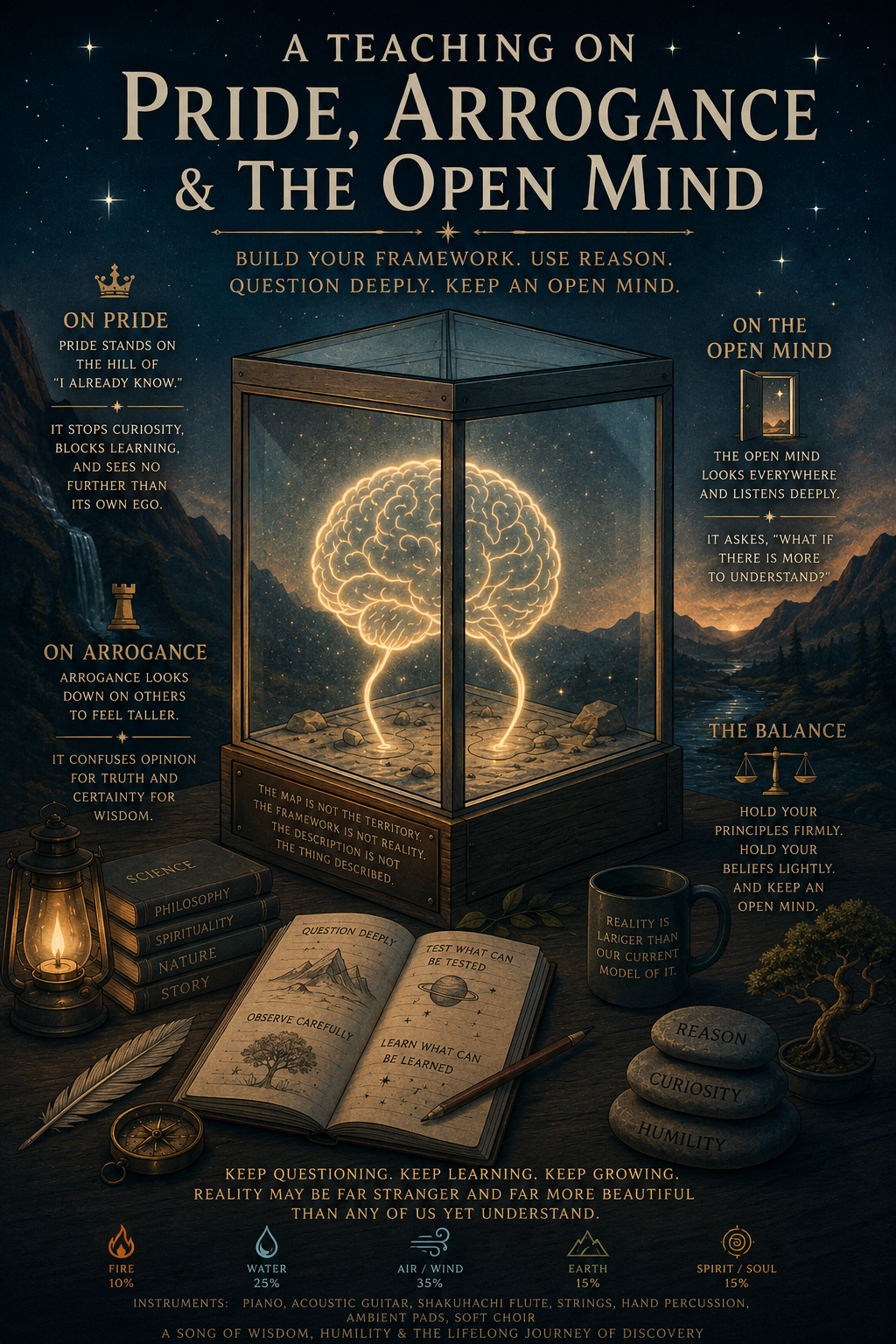
The position is this: use reason, but do not turn it into a prison. Remember that frameworks are maps — not the territory itself.
Framework
Scientific
Useful for testing, falsifying, and building on evidence. Becomes a prison when it claims to be the whole of reality.
Framework
Psychological
Useful for understanding patterns of mind and behaviour. Becomes a trap when every experience is reduced to a diagnosis.
Framework
Spiritual
Useful for meaning, depth, and what lies beyond measure. Becomes dangerous when it forecloses curiosity in the name of certainty.
Framework
Philosophical
Useful for examining assumptions and refining thought. Becomes hollow when it circles endlessly without touching ground.
The difficulty begins when someone mistakes their preferred framework for reality itself. That is not strength of mind — it is the mind having closed around its own furniture.
What is called for instead is intellectual humility. Not gullibility — intellectual humility does not require believing every claim. It simply requires the acknowledgement that reality may be larger than your current model of it.
The Map & The Territory
The map is useful. The map is not the landscape.
The framework is useful. The framework is not reality.
And so we keep refining our understanding while remaining willing to be surprised.
The history of human knowledge is full of moments where people said: “We know how reality works.” Only to discover later that they knew far less than they thought. Open-mindedness and grounded reasoning are not opposites. At their best, they support one another.
| Without | Becomes | The middle path holds both |
|---|---|---|
| Reason without openness | Dogma | Grounded inquiry |
| Openness without discernment | Gullibility | Curious rigour |
| Scepticism without curiosity | Cynicism | Honest wonder |
| Curiosity without scepticism | Credulity | Evidence-led exploration |
The Middle Path
- Question deeply.
- Observe carefully.
- Test what can be tested.
- Remain open to what is not yet understood.
- Avoid claiming certainty where certainty has not been earned.
From a Taoist perspective, there is also a certain humility in recognising that reality may always exceed our descriptions of it. Keep a grounded mind, but not so closed that reality cannot surprise you.
Reflection
Your Turn — Work With The Teaching
Workbook · Teaching Two
Q 01
Which framework — scientific, psychological, spiritual, philosophical — do you most naturally reach for? Has it ever become a prison for you rather than a tool?
Q 02
The teaching distinguishes between intellectual humility and gullibility. In your own words: what is the difference? Where do you draw your line?
Q 03
Is there something you feel certain about right now that you have not fully tested? What would it mean to hold it more lightly — without abandoning it?
Q 04
Where in the balance table do you most naturally sit — leaning toward dogma, gullibility, cynicism, or credulity? What moves you back toward the middle?
The Thread Between
The first teaching says: what others throw at you need not land as intended. You are a transformer of inputs. The second teaching says: what you throw at the world — your certainties, your frameworks, your conclusions — may be no more complete than anyone else’s scorn. The humility in teaching two is the same energy as the sovereignty in teaching one. Both are about remaining in motion. Both are about not being owned by what arrives — from outside or from within.
TPOL · tpol.lifestyle