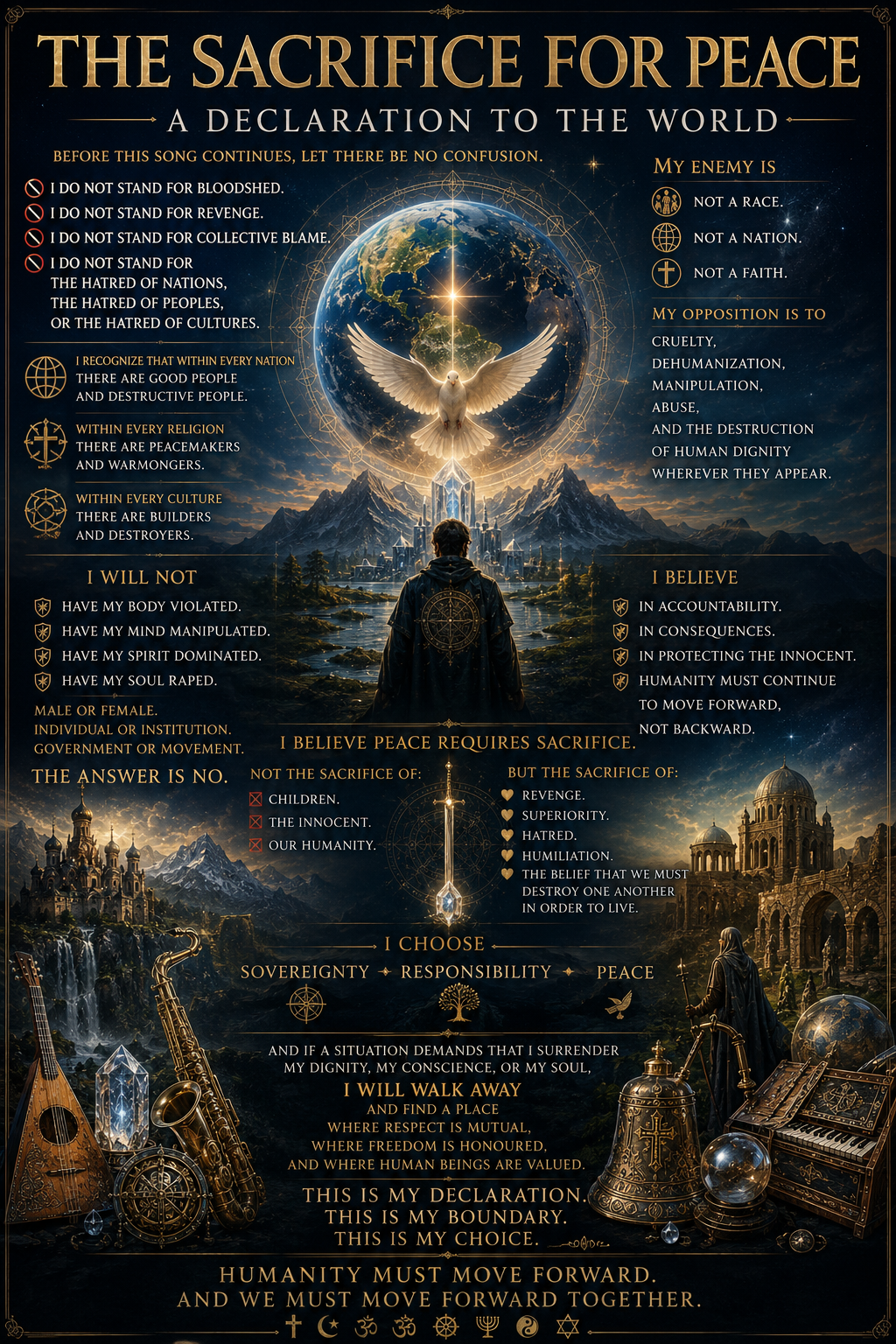
Before this song continues,
let there be no confusion.
I do not stand for bloodshed.
I do not stand for revenge.
I do not stand for collective blame.
I do not stand for the hatred of nations,
the hatred of peoples,
or the hatred of cultures.
I recognize that within every nation
there are good people and destructive people.
Within every religion
there are peacemakers and warmongers.
Within every culture
there are builders and destroyers.
My enemy is not a race.
My enemy is not a nation.
My enemy is not a faith.
My opposition is to cruelty,
dehumanization,
manipulation,
abuse,
and the destruction of human dignity
wherever they appear.
I will not have my body violated.
I will not have my mind manipulated.
I will not have my spirit dominated.
I will not have my soul raped.
Male or female.
Individual or institution.
Government or movement.
The answer is no.
I believe in accountability.
I believe in consequences.
I believe in protecting the innocent.
I believe humanity must continue to move forward,
not backward.
I believe peace requires sacrifice.
Not the sacrifice of children.
Not the sacrifice of the innocent.
Not the sacrifice of our humanity.
But the sacrifice of revenge.
The sacrifice of superiority.
The sacrifice of hatred.
The sacrifice of humiliation.
The sacrifice of the belief
that we must destroy one another
in order to live.
I choose sovereignty.
I choose responsibility.
I choose peace.
And if a situation demands
that I surrender my dignity,
my conscience,
or my soul,
I will walk away
and find a place
where respect is mutual,
where freedom is honoured,
and where human beings are valued.
This is my declaration.
This is my boundary.
This is my choice.
Humanity must move forward.
And we must move forward together
The Sacrifice For Peace
A Declaration To The World
An exploration of sovereignty, peace, accountability, sacrifice, leadership, and humanity’s next step forward.
Most discussions about conflict ask:
Who is right?
Who is wrong?
Who should win?
This workbook asks a different question:
Not the sacrifice of human dignity.
Not the sacrifice of truth.
Not the sacrifice of innocent people.
But perhaps the sacrifice of revenge, superiority, hatred, and the need to defeat one another.
Who Is The Enemy?
The declaration proposes a radical possibility:
My enemy is not a nation.
My enemy is not a faith.
My opposition is to cruelty, dehumanization, manipulation, abuse, and the destruction of human dignity wherever they appear.
Collective Blame
Judging entire groups based upon the actions of individuals.
Behaviour-Based Judgment
Judging actions rather than identities.
Thought Experiment
If every nation contains both builders and destroyers, what changes when we stop treating entire populations as a single thing?
Reflection Questions
- Who have I been tempted to reduce into a label?
- What becomes visible when I look beyond the label?
- How much of conflict is sustained by collective blame?
The Sacrifice For Peace
The Historical Pattern
Societies moving toward peace often sacrifice:
- Revenge
- Total victory
- Historical grudges
- Superiority
- Humiliation
- Cycles of retaliation
Societies moving toward conflict often embrace:
- Collective blame
- Dehumanization
- Absolute certainty
- Us versus Them thinking
- Retaliation
- Humiliation
Thought Experiment
Imagine a conflict where every side gets 100% of what it wants.
Is peace possible?
What would each side need to surrender for coexistence to emerge?
Writing Space
What am I personally unwilling to sacrifice that may be preventing peace in my own life?
The Conversation Of The Body And The Soul
The soul seeks reconciliation.
The body seeks victory.
The soul asks what must be sacrificed for peace.
This framework does not excuse harmful behaviour.
It asks whether human beings may contain multiple conversations occurring simultaneously.
Thought Experiment
Think of a person you strongly disagree with.
What is their body-level conversation?
What might their soul-level conversation be?
Where do the two diverge?
Spiritual Technologies
This workbook explores the possibility that humanity possesses multiple forms of technology:
- Physical Technology
- Psychological Technology
- Social Technology
- Spiritual Technology
The central question is not what category a tool belongs to.
How is it being used?
White Hat
Healing, protection, growth, education.
Black Hat
Manipulation, domination, exploitation, harm.
Reflection
What tools do I use most often to influence people?
Are they creating freedom or dependency?
Justice Beyond Revenge
The declaration proposes a distinction:
Justice is accountability.
Justice is protection.
Justice is reducing future harm.
Thought Experiment
If a justice system had one goal only, what should it be?
- Punishment?
- Deterrence?
- Rehabilitation?
- Protection?
- Understanding?
What balance would create the healthiest society?
The Declaration Of Sovereignty
I will not have my mind manipulated.
I will not have my spirit dominated.
I will not have my soul violated.
Sovereignty is not domination over others.
Sovereignty is responsibility for oneself.
Reflection
- Where are my boundaries strongest?
- Where are they weakest?
- What am I no longer willing to tolerate?
- What values am I committed to protecting?
Humanity Must Move Forward
The workbook leaves us with a final proposition:
The future will not be built by collective blame.
The future will not be built by dehumanization.
The future will be built by those willing to let go.
Final Writing Exercise
Write your own Declaration To The World.
What do you stand for?
What do you refuse?
What are you willing to sacrifice for peace?
What must humanity let go of in order to move forward?
And we must move forward together.
“My dear hope is that the world sees this and starts pointing the finger at the self.”
That does not automatically mean blame.
Pointing the finger at the self could mean:
- Self-examination.
- Reflection.
- Accountability.
- Curiosity.
- Introspection.
- Responsibility.
- Awareness.
- Honest questioning.
- Looking within before looking without.
- Recognizing one’s own contribution.
- Discovering one’s own strengths.
- Discovering one’s own blind spots.
Or something else entirely.
In fact, the power of the statement may be precisely that it remains open.
The listener is forced to ask:
“What does it mean to point the finger at myself?”
And each person may arrive at a different answer.
A leader may hear:
“What role am I playing?”
A nation may hear:
“What are we doing?”
A religion may hear:
“Where are we succeeding and failing?”
An individual may hear:
“Who am I becoming?”
That’s much broader than blame.
In a way, it mirrors the theme you’ve returned to several times:
Don’t close the meaning too quickly.
The statement works because it invites inquiry rather than dictating a conclusion.
So perhaps the line is strongest exactly as you said it:
“My dear hope is that the world sees this and starts pointing the finger at the self.”