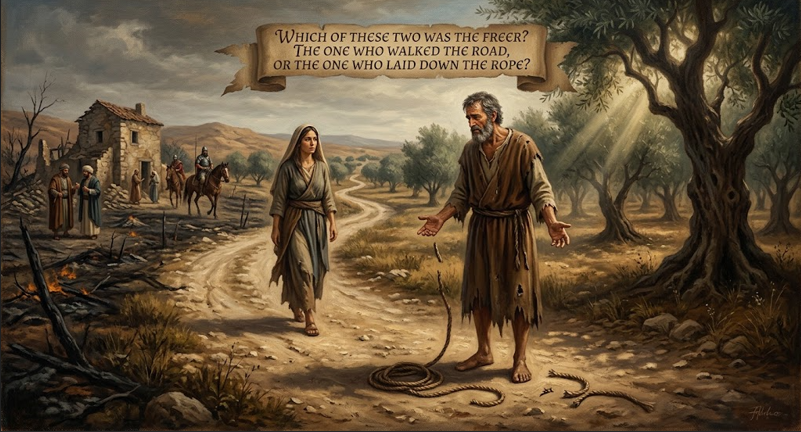
A certain man had been robbed all his days. The collector took his grain, the creditor took his house, and the lords took his creation and did not return them. And the man said in his heart, “I have paid, and I have paid again, and there is nothing left to pay.”
Now it happened that after a battle the spoil was divided, and the man was given a captive woman as his portion. She sat by the road with the rope-marks still upon her wrists.
And his companions said to him, “Behold, the world owes you much. Take what is yours.”
But he answered them, “What is it that I am owed? I was a man counted in other men’s ledgers. Shall I now keep a ledger of my own?”
So he went to the judge and caused a writing to be made, and he set the woman free, and he asked nothing of her: not her labour, not her loyalty, not her thanks.
And the woman said, “Why have you done this?”
And he said, “Because I know what it is to be bound.”
Then she went on her way and did not look back. And the man returned to his work, and his heart was light.
Which of these two was the freer? The one who walked the road, or the one who laid down the rope?
He who has ears, let him hear.
He has suffered exploitation himself, but does not use that suffering to justify exploiting someone else.
He receives a woman who, under the historical system, could be treated as property.
He recognises what the system permits, but deliberately refuses to reproduce it.
He does not claim her sexually, economically, emotionally, or socially.
He does not say that freeing her makes her indebted to him.
He does not require marriage as the price of freedom.
He does not even require gratitude.
He simply removes the chain. And when she walks away, he lets her walk away, because that is the proof that he only wanted freedom rather than possession.
What happens when a person standing inside a system of ownership chooses to use whatever power he has not to acquire another human being, but to make that human being their own person?
And that brings us right back to the central line:
He doesn’t want a person. He wants a person’s freedom.

In the historical system the parable is drawing from, master and slave were not simply employer and employee, or protector and protected. The master had a legally recognised claim over the enslaved person’s status, labour, movement and, in the case of female slaves, potentially sexual access. The enslaved person was not legally free to simply say, I am leaving now.
So when the man receives the woman, the important fact is this:
She is not his because she chose him. She is his because the system says she belongs to a master.
That is the chain.
And the man’s moral decision is therefore not merely, I will treat my servant kindly.
It is:
I will not become her master.
He could have taken the position that the law and circumstances had placed her within his power. He could have expected obedience, labour, sexual access, gratitude, companionship or marriage. Instead, he looks at another human being who has already had her freedom taken away and says, in effect:
What has been done to me does not give me the right to do it to her.
And then comes the crucial distinction in the parable.
He doesn’t say:
You belong to me now.
He says:
You belong to yourself.
That is why her walking away matters so much.
If she stays, he hasn’t necessarily proven anything. She might love him. She might be grateful. She might have nowhere else to go.
But if he frees her and she walks away, and he simply lets her go, then there is no disguised ownership underneath the freedom.
No debt.
No obligation.
No you owe me because I saved you.
No I freed you, therefore you must stay with me.
No freedom in exchange for affection.
The ownership ends.
And that is where the parable deliberately goes beyond merely being a story about a kind master.
The master-slave relationship is fundamentally one person possessing a legally subordinate person.
The man breaks the pattern by refusing the possession itself.
He doesn’t want a better slave.
He doesn’t want a grateful slave.
He doesn’t want a wife who owes him.
He doesn’t want a lover who owes him.
He wants a free woman.
And if freedom means she eventually disappears over the horizon and he never sees her again, then he accepts that too.
Because he wasn’t trying to acquire her.
He was trying to give back what had been taken from her.