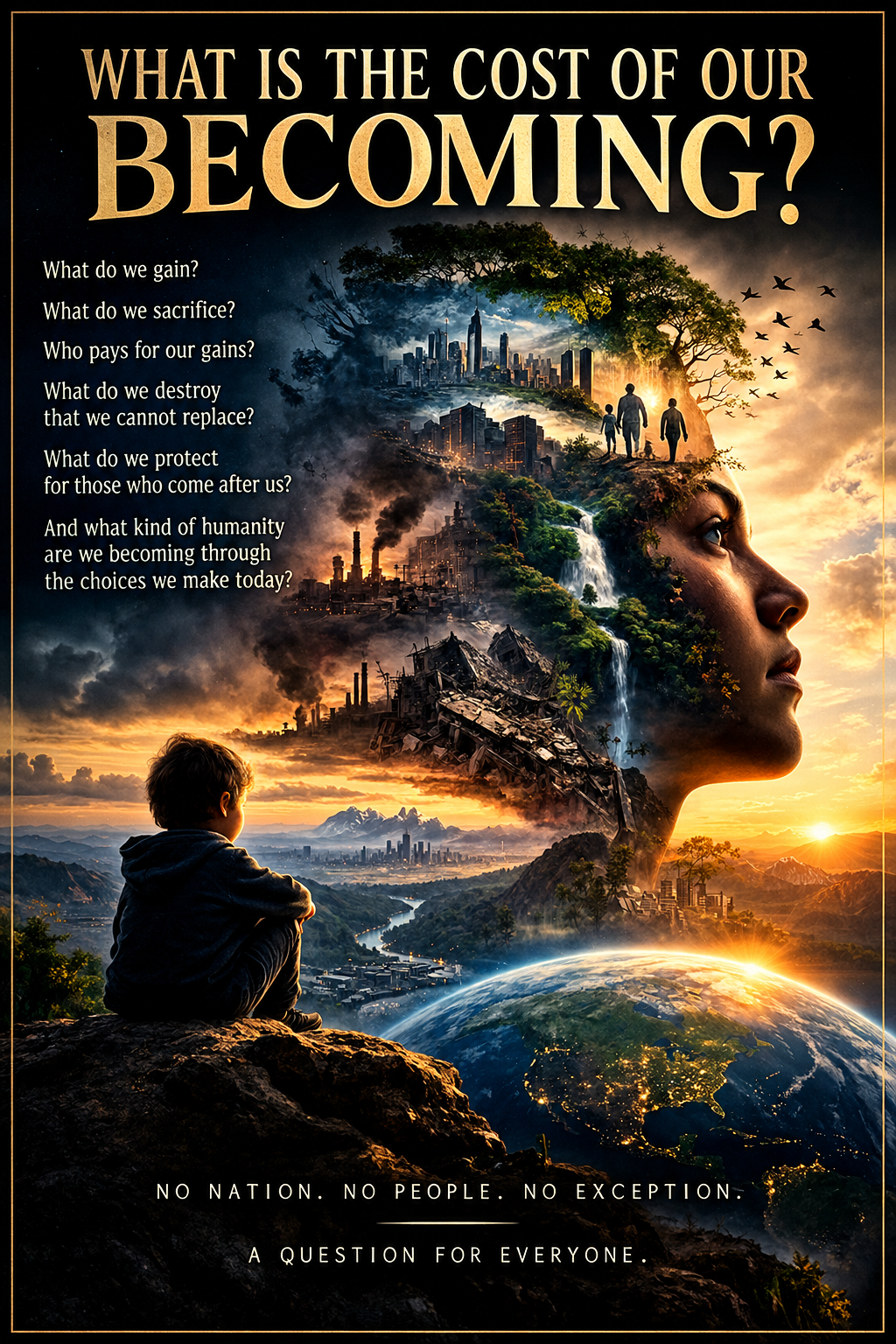
The Cost of Our Becoming
A TPOL workbook in Spiritual Technologies
This workbook does not hand you an answer. It hands you a question and the space to stay with it. Write slowly. Cross things out. Come back in a week and read what you wrote.
Becoming is never only about what we gain. It is also about what we consume, what we sacrifice, what we leave behind, and what we carry forward.
of our becoming?
Before you begin
Sit with the question for one full minute before you write anything. No answer is wrong. A quick answer is usually the one you already had.
Part 1: The Three Shapes of Becoming
Not every becoming moves in the same direction. Three patterns turn up in biology, in families, and in how we talk about love. Each has a different cost.
One becomes two
Identical twins begin as a single fertilised egg that splits. One origin, two lives. They share a starting point, then diverge.
Two become one
Two cells contribute to a new being that is neither parent and not a copy of either. Two contributions, one new expression.
Two reflect one another
Two distinct people who seem alike, or a stranger who reminds you of two people you know. Similarity is not the same as shared origin. Twin-flame belief sits here, as a spiritual interpretation rather than something genetics or science establishes.
Which of these shapes best describes the biggest change in your life so far?
In that change, what was the cost, and who paid it: you, someone close to you, or someone you never met?
If you believe in twin flames, or have felt a recognition that seemed to come from before you met: is it one original unity divided, or two separate beings who resonate? What would change in how you live if the other were true?
Part 2: Your Personal Ledger
An honest account includes consequences, not only intentions. Answer for the person you are becoming, and for the person you were before.
What have I gained?
What have I sacrificed?
Who has paid for my gains?
What have I destroyed that I cannot replace?
What have I protected for those who come after me?
How much of who I am required me to abandon what others expected me to be? Was that cost worth paying?
Part 3: The Relationship Ledger
If one person must continually diminish themselves so another can flourish, what has that relationship created? Harmony, or an arrangement that hides one person’s cost behind another’s gain?
Name one relationship that has shaped who you are. What did it give you, and what did it ask of you?
Where have you made yourself smaller so someone else could be larger? Where has someone done that for you?
What would it look like if both people in that relationship became more, at the same time?
Part 4: The Society Ledger
A society becomes prosperous. Whose labour built it? What happened to the land, the communities, and the people left out? A nation becomes powerful. What did it take, and what did it give? Technology advances quickly, but does our ability to care for one another advance with it?
Where you live
Think of your street, your city, your country. Pick one.
The rule
No nation answers only for its achievements. No person answers only for their intentions.
What has the place you live gained?
Who or what paid for it? Which people, communities, or places carry a cost they did not choose?
What has been destroyed that cannot be replaced, and what is being protected for those who come next?
Is this place creating its wealth in a way that can continue, or is it passing its debts to future generations?
Part 5: The Test
Not every cost is a loss and not every gain is progress. A caterpillar’s transformation is profound. A child learning to walk must fail repeatedly. A society may need to dismantle an unjust institution to build something better. The aim is never to condemn becoming. The aim is to tell apart two kinds of it.
Becoming that sustains life
The burden is shared and chosen. It leaves room for others to become. It can continue without consuming its own foundations.
Becoming that consumes life
The cost is hidden or pushed onto someone else. It closes possibilities for others. It depends on using up what it stands on.
Take one change you are making or considering now. Which kind of becoming is it, honestly?
What one thing could you change so that your becoming leaves more room for others to become?
Part 6: Putting the Question to Others
This question works best out loud. Ask it at a table, in a classroom, in a group. Then listen without correcting anyone.
Who will you ask? Write down their name and what you noticed in their answer, including what they paused on.
The last page
Read back through what you wrote. Do not look for a conclusion. Look for the line you wrote fastest, and the line you wrote slowest. The slow one is usually where the real cost sits.
After all of this, what is the cost of your becoming?