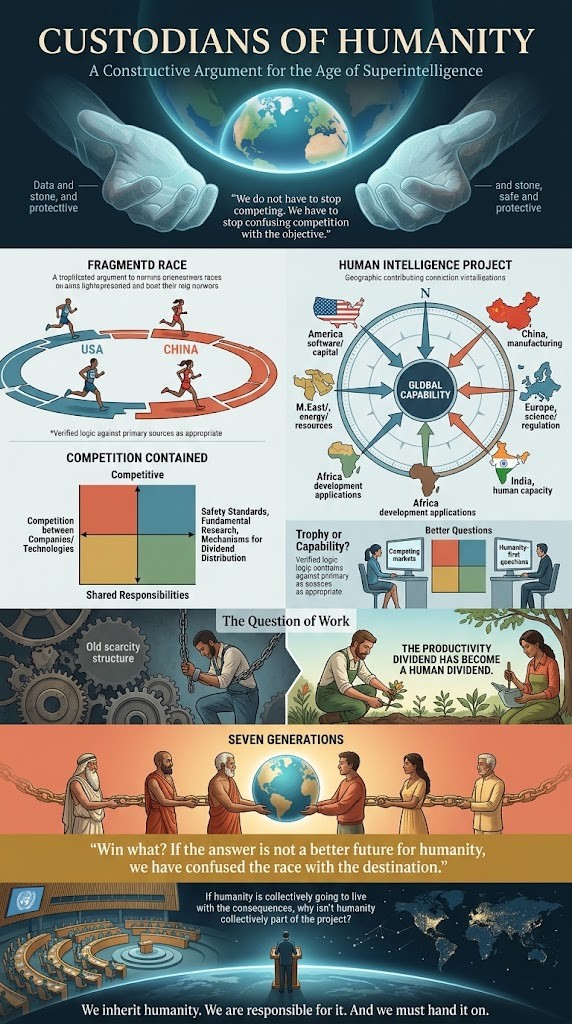
A Constructive Argument for the Age of Superintelligence
We do not have to stop competing. We have to stop confusing competition with the overall objective.
1. The threshold
Humanity is approaching a technological threshold unlike any it has crossed before. Artificial intelligence is moving from a tool that assists people toward systems that may perform intellectual work, discover new knowledge, design technologies, accelerate science, transform medicine, reshape economies, and potentially exceed human capability in areas we have thought of as uniquely ours.
So the question is bigger than who builds it first. It is bigger than which company wins, and bigger than whether America beats China, China overtakes America, or one economic system gains an edge over another.
The question is: what are we going to do with this power as a species?
The race is real. But the destination matters more than the race.
2. Why are we competing against ourselves?
There is an assumption running through much of the superintelligence conversation that deserves to be questioned. We hear it constantly: How do we win? How do we stay ahead? How do we make sure our country gets there first? How do we stop our competitors gaining an advantage?
But why is that the starting point? Why are the nations of Earth competing with one another to develop a technology that could affect all of humanity?
Why it happens
The conventional answer is understandable, and there is a historical reason for it. Nations compete because nations are the political units that currently control territory, resources, infrastructure, military capability, taxation, regulation and strategic technology. If one country believes another may obtain a transformative capability first, it has an incentive not to fall behind voluntarily.
You can see the logic written into policy. The 2025 US AI Action Plan is titled Winning the AI Race and frames AI leadership in terms of economic competitiveness and national security. US policy in 2026 is described as explicitly framing AI around maintaining technical advantage over strategic competitors and accelerating military adoption. (These policy points come from the original conversation; worth checking against primary sources before publishing.)
The reasoning is not mysterious:
- If we don’t build it, somebody else will.
- If they build it first, they may gain economic or military leverage over us.
- Therefore, we must build it first.
That is a classic security dilemma. It turns the fear of competition into the engine of competition itself. Everyone accelerates because everyone is afraid someone else will accelerate, and the more powerful the technology, the more dangerous that cycle becomes.
Why it doesn’t have to stay that way
The reason it happens does not mean it has to remain the organising principle. The technology is global, but the institutions controlling it are national.
- The atmosphere isn’t American.
- Mathematics isn’t Chinese.
- Human biology isn’t European.
- The laws of physics don’t recognise borders.
- The internet doesn’t stop at a border, and the consequences of advanced AI won’t stop at immigration control.
If advanced AI transforms medicine, education, energy, manufacturing, agriculture, scientific discovery or the global economy, those effects will propagate through all of human civilisation. If it produces abundance, humanity benefits. If it produces disruption, humanity experiences it. If it creates catastrophic risk, humanity shares the risk. So why should its development be framed primarily as a competition between national populations?
And there is no national victory in a civilisational catastrophe. If superintelligence succeeds spectacularly, there is no meaningful version of one country prospering while the rest of humanity is unaffected. If it fails catastrophically, there is no meaningful version of one country winning. The atmosphere doesn’t care who won. The biosphere doesn’t care. The human species doesn’t care.
The Human Intelligence Project
Imagine advanced intelligence treated as a shared civilisational project, something closer to CERN, the International Space Station, or a vast international scientific programme. Not USA versus China versus Europe versus everyone else, but humanity building a new general-purpose capability together.
Countries would contribute what they are strongest at:
| Contributor | Strengths |
|---|---|
| America | Computing, software, research and capital |
| China | Manufacturing and industrial capacity |
| Europe | Scientific research, regulation and infrastructure |
| India | Enormous technical and human capacity |
| Africa | Enormous potential for development applications |
| Middle East | Energy and investment |
| Latin America | Agriculture, biodiversity and resources |
| Everyone | Scientific knowledge, cultural perspectives and human priorities |
The output would be treated as a global capability rather than a national weapon. Instead of asking which country can monopolise the future, we ask: what can humanity build when all of these capabilities are treated as contributions to a common project?
This does not require political unification, identical systems, the abolition of sovereignty or the end of competition. Companies, scientists and countries can still compete in countless areas, and different approaches can still be tested. It requires agreement on one thing: some capabilities are consequential enough that humanity has a common interest in developing them cooperatively. It does not mean pretending national interests don’t exist. It means recognising that national interests ultimately exist inside a larger human reality.
We already know how to do this
Humanity has built international scientific institutions, collaborated on space exploration, run international experiments, created global standards, coordinated against diseases, and cooperated on problems no single country could solve. Collaborating on something enormous is not fantasy. The question is whether we are willing to apply the principle to artificial intelligence.
The machinery is also beginning to exist. As described in the original conversation, the UN established a Global Dialogue on AI Governance in 2025, bringing in all 193 member states, with its first annual dialogue held in Geneva in July 2026, and the UN says no country can address AI’s opportunities and risks alone. The Global Digital Compact provides a framework for international digital cooperation, and the International Scientific Panel on AI is meant to give decision-makers a shared scientific basis. (Again, worth verifying the 2026 details.)
The problem is that this machinery is not yet the dominant organising logic.
Trophy or capability?
There is a profound difference between building technology to defeat our competitors and building technology because humanity has decided this is the next thing it should accomplish. One treats intelligence as strategic territory. The other treats it as a civilisational capability.
We may be looking at something comparable to electricity, the industrial revolution or the internet, and perhaps something larger, and yet the conversation immediately becomes how do we win? The instinct here is different: before we start racing, shouldn’t humanity decide what we are actually trying to build?
Perhaps the greatest failure would not be that one country lost the AI race. It would be that humanity never stopped to ask whether there needed to be an AI race in the first place. And perhaps the first sign of human maturity is not how quickly we can build superintelligence, but whether we can cooperate enough to decide what we are building it for.
If the honest answer to why are we competing against ourselves? is ultimately fear, the next question is: can we turn that shared fear into shared responsibility?
And the uncomfortable question at the centre:
If humanity is collectively going to live with the consequences, why isn’t humanity collectively part of the project?
3. Why the race is legitimate, and why it is not enough
Nations have good reasons to compete. Energy matters. Semiconductor manufacturing matters. Computing infrastructure, scientific leadership, economic resilience and security all matter. No responsible country can ignore them.
The danger is letting competition become the organising principle. If every nation asks only How do we win?, another nation will ask the same question, and another. The result is a technological security dilemma: everyone accelerates because everyone fears being left behind.
That may produce enormous progress. It may also mean humanity reaches extraordinary capability without having built equally extraordinary cooperation, governance, safeguards or social institutions. That is not a race anyone should want to win, because the consequences of getting it wrong will not respect borders.
This is not an argument against America, China, Europe, markets or ambition. It is an argument for placing all of them inside a larger human purpose.
4. The economy is already shared
The economy does not divide neatly along national lines. We already have a genuinely global system. Companies operate across borders, supply chains cross continents, capital and investment move freely, currencies interact, commodities are traded worldwide, energy markets affect each other, and technological breakthroughs diffuse internationally.
That gives every nation a plain, shared interest:
A catastrophic AI/SI race could damage the entire global economy, regardless of which country technically “wins.”
And the reverse is also true. If superintelligence produces the abundance its advocates predict, the benefit is global too. If it produces mass unemployment, disruption or instability, that is global too. Extraordinary medical breakthroughs could help billions; dangerous capabilities that escape control could threaten billions.
So beneath the competition sits a common interest: humanity benefits when humanity remains prosperous, stable and able to take part in the future.
Self-interest, not altruism
This unifying principle is not primarily altruistic. Countries can cooperate because their own economic self-interest overlaps:
- A Chinese company benefits from functioning global markets.
- An American company benefits from functioning global markets.
- A European manufacturer benefits from functioning global markets.
- A Kenyan farmer benefits from functioning global markets.
- A Brazilian mining operation benefits from functioning global markets.
From this comes a shared principle: every nation has an interest in ensuring that the transformation of the global economy does not become a transformation into permanent economic dependency.
5. Fear as common ground
We are often told nations cannot cooperate because their interests differ. But there is one interest they undeniably share: they all have something to lose.
America has something to lose. China has something to lose. Europe, Africa and India have something to lose. Every economy, every family, and ultimately humanity itself has something to lose.
That shared vulnerability can be the foundation of cooperation rather than another source of division. Instead of How do we stop them from winning? we can ask:
How do we make sure none of us loses humanity itself?
This is where fear, economics and a shared technological future combine into something powerful. Fear alone divides. Fear joined to overlapping self-interest and a shared physical world gives nations a reason to act together.
6. Competition contained inside a cooperative framework
A humanity-first approach does not abolish markets, sovereignty, scientific rivalry or private enterprise. Nobody needs to stop being competitive. The question becomes:
Can we compete economically without making humanity’s shared technological infrastructure a battlefield?
That is a more interesting model than simply abolishing competition. It looks like this:
| Remains competitive | Becomes shared |
|---|---|
| Competition between companies | Safety standards |
| Competition between technologies | Scientific research |
| Competition between economic models | Infrastructure, where appropriate |
| Rules around catastrophic capabilities | |
| Access to fundamental discoveries | |
| Mechanisms for distributing the productivity dividend |
Competition does not have to disappear. It can be contained inside a cooperative human framework. That is also more realistic than expecting nations to abandon their national interests overnight. The pitch is simple:
You do not have to surrender your economy, sovereignty or identity. You simply recognise that there are some problems where destroying everyone else’s economic stability also destroys your own.
Some things are too consequential to be governed purely by competitive incentives. Nuclear weapons showed this. Climate change showed this. Pandemics showed this. Superintelligence may show it more profoundly still. The existence of competition does not remove our responsibility to cooperate where the consequences are shared.
7. A shared layer of responsibility
This does not mean a single world government. It means a shared layer of responsibility above the competition: a recognition that some technologies and risks belong to humanity as a whole.
In practice that could include:
- International standards for AI safety
- Shared monitoring of catastrophic risks
- Independent auditing
- International scientific cooperation
- Common protocols for dangerous capabilities
- Mechanisms for reporting serious safety failures
- Shared research into alignment, containment and verification
- International cooperation on energy and infrastructure
- Mechanisms ensuring that extraordinary productivity does not simply concentrate extraordinary wealth and power
The aim is not to stop nations advancing. It is to make advancement compatible with human survival, dignity and flourishing.
8. The question of work
If superintelligence eventually makes enormous amounts of human labour economically unnecessary, we should not begin from the assumption that this is a catastrophe. It could be one of the greatest achievements in human history.
For thousands of years, people have had to spend a huge share of their lives simply surviving. If technology can provide abundant food, energy, medicine, housing and education with far less human labour, then the achievement is not that machines took our jobs. It is that humanity has finally reduced how much of human life must be consumed by compulsory labour.
But that transition has to be designed. An age of abundance cannot mean that machines became enormously productive while human beings became economically disposable.
The productivity dividend has to become a human dividend.
People need access to the abundance they helped create. They need dignity, education and healthcare. They need meaningful ways to contribute, and the freedom to create, care, explore, learn, build communities and pursue purposes not dictated entirely by economic necessity. Otherwise we will have built extraordinary abundance inside an old scarcity-based social structure.
9. Intelligence in service of life
If we create systems of extraordinary intelligence, what should they ultimately serve? More weapons? More advertising? More financial extraction? More political domination? More consumption? Or the flourishing of life?
Imagine advanced intelligence treated as a civilisational capability: helping us understand disease, restore ecosystems, develop clean energy, improve agriculture, solve engineering problems, explore space, advance science, teach people, translate cultures, preserve human history, help societies negotiate conflicts, and solve problems that currently look impossible.
That would still be a vigorous technological competition. But the prize would be different: what humanity can accomplish together.
10. We have to be custodians
Humanity is at a point where we have to be custodians of humanity.
Our technological power has outgrown the old assumption that every problem can be handled by competing groups pursuing their own interests. We now possess tools capable of affecting humanity as a whole, so the responsibility changes.
Not: America protects America. China protects China. Europe protects Europe.
But: every generation becomes a custodian of the human species and of the conditions that allow human beings to flourish.
That does not erase nations, cultures, identities, economies or legitimate differences. It adds a responsibility above them.
“Custodian” is a good word because it does not imply ownership. We do not own humanity. We inherit it, and we hand it on. We inherited a civilisation we did not create: languages we did not invent, knowledge we did not discover, cities we did not build, science we did not develop, culture we did not create, a planet we did not make. And generations will come after us who have no voice in the decisions we make today. Our responsibility is to them.
For most of history our power was small relative to the planet. We could damage things locally, fight wars, destroy communities, but our ability to alter the whole trajectory of civilisation was constrained. That is changing. We are acquiring technologies that can affect billions of people at once. We are no longer merely users of powerful tools; we are becoming custodians of humanity’s future.
Better questions
| Instead of asking only… | Ask also… |
|---|---|
| What can we build? | What are we responsible for building? |
| Who gets there first? | What happens to everyone when we get there? |
| How much economic value does it create? | Who receives that value? |
| How do we stop competitors gaining an advantage? | How do we stop competition itself creating a catastrophe? |
And the biggest one:
A technology powerful enough to transform humanity cannot responsibly be governed as though humanity were merely a collection of competing markets.
11. Seven generations, not seven quarters
One of the simplest shifts is to lengthen our timescale. Businesses think in quarters, governments in electoral cycles, investors in returns, technologists in product cycles. Civilisation has to think in generations.
What happens to this technology in ten years? In fifty? In a hundred? What kind of civilisation are we handing to people seven generations from now? That does not mean abandoning the present. It means refusing to sacrifice the future simply because the future cannot vote, invest or negotiate today.
12. The new definition of winning
Keep the ambition. Build the energy, the chips and the data centres. Advance the science. Explore space. Develop extraordinary intelligence. Compete, innovate, move quickly.
But change the question. Not How do we beat them? Not How do we make sure our country wins? Not even How do we get there first? But:
How do we make sure humanity arrives safely?
And then: what do we do with the abundance when we get there?
Eventually someone has to ask: Win what? If the answer is not a better future for humanity, we have confused the race with the destination.
That is a goal large enough for every nation, economy, scientist, company, culture and human being. We do not have to become one people by becoming identical. We can remain different, disagree, compete, and keep different cultures, governments, philosophies and economic systems. But underneath those differences is something we cannot replace: we are all human. For the first time, our technological power may be large enough that our responsibility has to become equally large.
Conclusion
The defining challenge of the age of superintelligence may not be Who wins the race? but:
Can humanity become mature enough to be the custodian of what it is about to create?
And underneath it, the question we started with: if humanity is collectively going to live with the consequences, why isn’t humanity collectively part of the project?
If we succeed, the greatest achievement will not belong to America, China, Europe or any company. It will belong to humanity. If we fail, there will be no meaningful national victory in the ruins.
We inherit humanity. We are responsible for it. And we must hand it on.
This is not an anti-race argument. It is pro-humanity, pro-progress and pro-innovation, with a larger definition of success. The thread that ties it together is one line: the productivity dividend has to become a human dividend. It connects superintelligence, the global economy, jobs, abundance, national competition, fear and custodianship into a single idea.