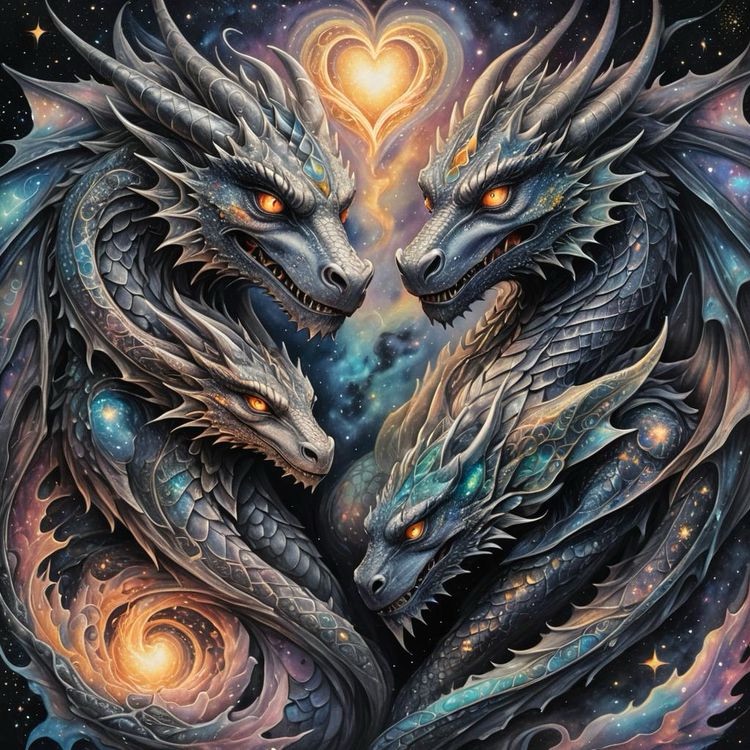
The Tears of Maat
A survival workbook on the arrogance of power, protection, and continuity for all beings
Before we begin
This is not a test, and there is no score. It is a set of scenarios, myths and questions for you to work through at your own pace. Nothing here is the right answer. If you disagree with the teaching, that disagreement is useful material: write it down.
First, notice what you already think. Write the first words, images or memories that come to you for each.
Each is defined by what it means for a living being, not by what an institution says it means.
- Power is the freedom to choose how you live.
- A monster is where the possibility of connection appears to break down because of a predatory disposition. Not simply difference, but a way of behaving that threatens coexistence.
- Protection is the safeguards and boundaries that allow development to continue: physical, mental, emotional, cognitive and spiritual.
- Justice is the search for a balance point between the parties concerned, not automatically punishment or victory.
- Survival is continuity of being, with those dimensions intact.
Notice the tension between them. If power is freedom, protection must not become a way of quietly removing it. But if freedom lets one being prey on another, protection cannot mean standing aside. Control can present itself as protection while shrinking the freedom it claims to preserve. Freedom without safeguards can leave the vulnerable at the mercy of the powerful. Neither danger should become the organising principle.
Your writing stays in this browser on this device only. Nothing is sent anywhere. Anyone using the same browser could see it, and the “Clear everything” button at the end removes it.
The leopard, the lion, the dragon
The leopard takes what it wants because it can. The lion kills the leopard because it can. The dragon burns the lion because nothing can stop it. Each believes its ability is its right, and each is prey to something stronger.
If might makes right, the leopard has no complaint when the lion comes. Whatever you allow the strong to do to the weak, you have already allowed to be done to you, because someone is always stronger. A world built on that creed is not civilisation. It is a food chain with flags on it.
The leopard is not evil for being a leopard. The problem begins when we take the laws of survival in the wild and make them the moral laws of civilisation.
Imagine a world where every being may do whatever it is able to do, so long as no stronger being stops it. There are no other rules.
- What happens to trust? To cooperation? To anyone planning ten years ahead?
- Would anyone invest in building something that a stronger neighbour could simply take?
- Where would you expect to stand in this world, and for how long?
A second perspective
Look for the pattern, not for villains. We are asking about behaviours, incentives and relationships, not about particular people or groups.
The hydra
Then the hero arrives to kill the monster, and the story only gets worse. Cut off one head of the hydra and two grow back. Meet force with force and you don’t end the appetite, you multiply it. Every victory seeds the next war, and every generation inherits the same arrogance with better weapons.
Removing a visible threat is not the same as changing the conditions that keep producing it. It is also not always optional to act now. Both may be needed at once.
A community has removed a leader who intimidated people. But the old rules remain: the leader’s appointees still hold posts, complaints still go to the person being complained about, and people who spoke out still fear it will be remembered. Some members say the problem is solved. Others expect it to return with a new face.
Select any approaches you would consider. Each carries trade-offs, and none is marked correct.
The chain does not necessarily begin with the creature everyone fears. One being harms another. The injured become defensive. Some retaliate. Others inherit the consequences, and people further down may not know where it began, only that they are expected to carry it on. Along the chain, almost every aggressor can tell a story in which they were the victim first.
That does not make every claim of victimhood false, and suffering does not excuse what someone later chooses to do. Try to separate three things: what happened to someone, what they did in response, and what they are responsible for now.
A second perspective
Suppose you could remove one source of harm from your community with a wave of a wand. Complex systems rarely stay still. Suppress one behaviour and it may emerge elsewhere. Protect one group without understanding the system and you may create another bottleneck.
The oldest story
In the Babylonian creation epic Enuma Elish, the young god Marduk slays Tiamat, the ancient mother of chaos, and builds the heavens and earth from her body. This is mythology, and what follows are interpretations. None of it shows that every civilisation or institution is founded on violence.
Here is one reading, offered as a thought experiment: order founded on conquest, the victor’s rule declared to be justice, and the victor quietly becoming the next thing that must be slain.
- Cosmic order. The story explains how form emerges from formlessness. Tiamat is chaos, not a person with interests.
- Political legitimacy. The tale may have helped justify a ruler or city by tying their rule to a divine victory.
- Cautionary tale. A world built from a body may carry that origin inside it.
- The silent version. We are only told the winner’s account. What would Tiamat’s side say?
How to hold power without being held by it
The question is no longer how to defeat the monster. It is how to hold power without being corrupted by it. Power itself is not the enemy. We need it to defend a child, stop an abuser, build a hospital and challenge corruption. The question is what governs it.
- Ability is not entitlement. Being able to take something is not the right to take it.
- Strength carries responsibility. The greater your power, the greater your duty of care.
- No power is beyond accountability. Trust matters, but it must never replace accountability.
- Defeating a symptom is not healing a cause. Change the conditions that allow the harm to return.
- Victory does not make history innocent. A good outcome does not automatically justify the means.
- Restraint is not surrender. Stand firm against injustice without making domination your purpose.
- The highest power makes others safer. The aim is people with the dignity and capability to stand for themselves.
Appetite asks: what can I take? Fear asks: what must I control? Pride asks: who must bow? Justice asks: what must be put right? Wisdom asks: what consequences am I responsible for? Compassion asks: who is suffering, and what can I do? Integrity asks: would I accept this same rule if I had less power?
A principle that only protects us when we are strong is not justice. It is an advantage we hope to keep.
Somebody’s leopard, somebody else’s lion
We are all situated differently across different relationships. You may be vulnerable in one setting and influential in another. This is about observing, not blaming. You are not assumed to have abused anyone.
Six more questions to sit with. When you have authority over someone, do you listen? When someone depends on you, do you respect their dignity? When you are challenged, do you seek understanding or obedience? When you discover you were wrong, can you repair the harm without treating an apology as humiliation? When resistance becomes necessary, can you act decisively without letting hatred decide what happens next? And when you win, can you stop?
Restraint does not mean giving an aggressor unlimited chances to do harm. Protection may need firm boundaries, proportionate force and independent oversight. The goal is to stop necessary defence from becoming a new form of predation.
Put down the sword
Everyone arrives with a weapon, ready to defeat the monster. But there is another ending to the oldest story.
Imagine approaching the ancient mother with no sword. Tiamat lowers her enormous head. The storms around her begin to settle. You stand before her, a tiny creature beside something old enough to make mountains seem young, and you reach out.
And she lets you touch her nose.
No victory. No submission. No throne to claim. For that moment, neither of you needs to win.
This does not mean every monster is harmless. Some dangers must be resisted and some boundaries must be held. But we lose something precious when we decide that understanding can only begin after the enemy has been defeated. The sword is not thrown away. Its purpose changes: held in reserve to defend those who would be harmed, not to prove who is superior.
One distinction matters here. Difference alone does not make a monster. A being can be profoundly alien to us and still be capable of peaceful coexistence. The critical question is whether a predatory disposition makes connection unsafe, and what evidence, boundaries and safeguards are appropriate in response.
Four separate decisions are easy to blur: understanding a being, trusting it, permitting access to it, and accepting risk from it. You can do one without the others.
A being of enormous power lives nearby. It could do serious harm, but it has not agreed to harm you. The community insists the only safe answer is to destroy it.
- What would you need to know before deciding?
- What alternatives might exist? What would make one genuinely safe, not merely hopeful?
- Which risks would be unacceptable to you?
- If peaceful coexistence proves impossible under present conditions, what then?
A second perspective
Even monsters need somewhere to live
A creature capable of great destruction needs somewhere it can exist without being hunted, provoked or forced into a fight for survival. That enclosure is not necessarily a prison. It is a boundary that protects the creature from those who would harm it, and protects others from harm in return. It may be physical, legal, technical, negotiated or institutional. It applies to dangerous animals, people who have caused harm, powerful institutions, and technologies capable of immense damage. Where harm has occurred, accountability and repair belong here too.
Consider the monster through conservation, not conquest. When a species presents a danger, the answer is not automatically to eradicate it. Conservation asks what the species needs to survive, what threatens it, what it threatens, and what conditions would let both continue. We can protect a predator’s habitat and protect the communities around it. We can recognise its ecological value without granting it unrestricted access to everything it could harm.
A being’s right to exist does not automatically give it the right to destroy the conditions that let others exist. And being dangerous does not automatically mean a being has forfeited its right to exist. That is the difference between managing a living world and ruling it through fear.
This must never become a polite word for indefinite punishment, arbitrary confinement or hidden abuse. Safeguards should be proportionate, accountable, and responsive to evidence.
Choose any powerful or potentially dangerous being or system (a creature, a person, an institution, a technology). Then design an arrangement for it.
What gives protection its purpose
You can approach her with love precisely because love does not require you to deny her power. You can respect what she is, recognise what she could do, and still seek a peaceful way to share the world. Love here is not a substitute for evidence, boundaries or competence. It changes what power is for.
An elderly neighbour with early memory loss still insists on living alone and cooking for herself. Her family wants to move her into care. She says she would rather risk an accident than lose her home.
Control can present itself as protection while progressively restricting the very freedom it claims to preserve. The opposite danger is equally real: freedom without safeguards can leave the vulnerable at the mercy of the powerful.
Love does not require weakness, and strength does not require cruelty.
For decisions that outlast us
Continuity is not merely keeping a being alive today. It is preserving the possibility of a tomorrow, for that being and for everyone who must live alongside it: human beings, living systems, and the artificial intelligences we bring into existence. Some conflicts have no perfect resolution, and sometimes continuity requires decisive action to stop imminent harm.
0 of 8 questions examined. This is a prompt to look, not a measure of your judgement.
Observe before you prescribe
This week, watch one real system of power around you: a workplace rule, a local service, a platform’s settings, a school policy. Do not intervene, confront anyone, collect private information or break any rules. Just look with curiosity.
Return to the question
Here is what you wrote at the start. It stays as you wrote it. Nothing has been changed or judged.
This is not a hero’s story.
It is a survival story, with continuity for all beings.
Not a hero who saves the world.
A world that learns how to keep going, together.
Browser storage only. If your browser blocks it, your writing will last until you leave the page. Print before you close it to keep a copy.
The Tears of Maat
The Sandbox: A Teaching on Power, Maturity and Mutual Accountability
What if humanity itself is living inside someone else's enclosure?
What if the boundaries we encounter, the limitations we face, and the conditions under which we develop are part of a relationship with something beyond our present understanding?
This is a possibility to explore, not a claim that such an arrangement exists. Its value lies in what the thought experiment reveals about power, responsibility and the conditions necessary for coexistence.
We have spent this teaching considering the boy and Tiamat. We have examined the danger of a powerful being, the possibility of coexistence, the responsibilities of the village, and the consequences when a being repeatedly chooses to cause harm.
But now we must reverse the perspective.
What if humanity is Tiamat?
What if we are the powerful, unpredictable species that has repeatedly consumed its neighbours, destroyed habitats, exhausted resources and mistaken the ability to dominate for the right to dominate?
What if another civilisation has watched our development and concluded that we are not yet ready to be given unrestricted access to the wider universe?
Perhaps humanity does have some serious maturing to do.
We possess extraordinary capacities for compassion, cooperation, creativity and understanding. We also possess the capacity for cruelty, exploitation, collective violence and the destruction of the very conditions upon which our continued existence depends.
We cannot honestly examine the possibility of being contained without examining our own behaviour.
But this is only half of the teaching.
The Right to Contain Is Not the Right to Dominate
Suppose a civilisation has contained humanity because it considers us dangerous.
Does that automatically make the civilisation benevolent?
No.
Does it automatically make the civilisation malicious?
No.
Does possessing greater knowledge, technology or power make its decisions just?
Absolutely not.
A civilisation might claim to have contained humanity for our own protection while exploiting us, conducting experiments on us, restricting our development or imposing conditions that serve its own interests. It might justify barbaric treatment by declaring us too primitive to understand what is good for us.
It might have mastered interstellar travel without mastering compassion. It might have developed sophisticated systems of containment without developing the wisdom to use them justly.
History has shown humanity how protection, civilisation, security and benevolence can all be used to legitimise domination.
The same danger exists at every level of power.
The behaviour of the contained does not absolve the one doing the containing.
Humanity's destructive behaviour might explain why safeguards are considered necessary. It would not grant those imposing the safeguards unlimited authority over humanity's existence, development or future.
Equally, the existence of an oppressive or unjust containment system would not absolve humanity of responsibility for the harm it causes.
Both truths must be allowed to stand.
Two Questions That Must Never Be Confused
There are two fundamentally different questions:
Does a being have the right to protect itself from another being that poses a genuine threat?
And does that right give it unlimited authority over the being it fears?
The answer to the second must be no.
A being's right to exist does not give it the right to destroy the conditions others need to exist. But being dangerous does not automatically mean that it forfeits its own right to exist.
The challenge is to find conditions under which safety and continued existence can be protected together.
A legitimate safeguard must be proportionate to the demonstrated risk, directed towards preventing harm rather than securing advantage, and open to scrutiny, challenge and review.
The interests of those imposing the boundary must be examined alongside the interests of those subjected to it.
Those who have not caused the harm must not automatically be treated as guilty. Containment must not become a convenient justification for exploitation or collective punishment. And a temporary safeguard must not quietly become permanent domination simply because the more powerful party has no incentive to relinquish control.
The right to establish a boundary is not the right to do whatever you want to the being on the other side of it.
The Responsibility of Power
The more power a being possesses, the greater its capacity to affect the lives of others.
That greater capacity brings greater responsibility.
This applies to humanity in relation to other species, ecosystems, communities and future generations. It applies equally to any hypothetical civilisation possessing the power to contain humanity.
Neither party receives an exemption because it is more advanced, more intelligent, more frightened or more capable of enforcing its decisions.
Humanity must confront the harm it causes.
Those who contain humanity must confront the harm they cause.
Neither party's wrongdoing grants the other unlimited authority. Neither party's immaturity automatically removes its right to dignity, protection or continued existence.
Responsibility must be assessed according to what each party actually does, the power it possesses, the choices available to it and the consequences of its actions.
Justice does not require us to pretend that every party is equally responsible. It requires us to examine each party honestly, without allowing power to determine whose suffering counts.
Maturity Is More Than Capability
Humanity might one day develop the ability to travel between stars, manipulate extraordinary amounts of energy and reshape environments on a planetary scale.
But would those capabilities prove that we were ready?
Technological advancement and moral maturity are not the same thing.
A civilisation may be capable of reaching another world without being capable of respecting the beings who live there. It may be able to control another species without understanding its needs. It may possess the means to eliminate a threat without considering whether a less destructive solution is possible.
The same is true of a civilisation that contains humanity.
Its ability to establish and maintain a boundary does not prove that the boundary is just. Its ability to prevent humanity from leaving does not prove that humanity should remain confined. Its ability to predict danger does not make every prediction infallible.
Maturity isn't simply the ability to control others. It's the ability to exercise power without turning another being's vulnerability into an opportunity for exploitation.
This does not mean every boundary must be removed, every risk accepted or every being trusted.
It means that protection must remain accountable to the purpose for which it exists.
The objective cannot be unrestricted freedom regardless of the harm it causes, nor absolute control imposed in the name of safety. It must be the pursuit of conditions in which all parties can exist, develop and coexist without one possessing unlimited authority over the fate of another.
The Reversal
Now return to the boy and Tiamat.
The boy approaches the dragon knowing their history. He knows the danger. He has been eaten countless times before.
When he touches her nose and whispers, Lets not do this again, he is not denying what has happened. He is not pretending that the danger is imaginary. He is not declaring himself morally superior.
He is offering the possibility that the pattern can change.
But reverse their positions.
What if the boy is the dragon? What if humanity is the being whose repeated behaviour has made others afraid? What if the village is another civilisation trying to protect itself from a danger it believes it cannot safely ignore?
Would humanity demand the opportunity to change?
Would we insist that our history be understood rather than reduced to our worst actions?
Would we argue that our capacity for harm does not make our continued existence worthless?
Would we demand that those who judge us also examine themselves?
If so, we must be prepared to recognise those same considerations in others.
But the reversal must continue.
If humanity is the being inside the enclosure, we must not automatically condemn its creators as monsters without examining the genuine dangers that might have prompted containment.
Nor must we assume that those creators are justified simply because humanity has behaved barbarically.
We must be willing to examine both sides.
The contained must answer for the harm it causes. The container must answer for the harm it causes. Neither can use the other's behaviour as an unlimited justification for its own.
And neither should be allowed to define the entire relationship solely according to its own interests.
Mutual Accountability and the Possibility of Change
Perhaps neither humanity nor its hypothetical containters would be ready to judge the other absolutely.
Perhaps both would have to mature.
That does not mean they are equally guilty, equally dangerous or equally capable. It means that neither position places a being beyond accountability.
The purpose of protection should be to preserve the conditions necessary for life, development and coexistence, not to secure permanent authority over another being.
The purpose of accountability should be to establish what happened, prevent further harm, repair what can be repaired and create conditions in which different choices become possible.
And the purpose of justice should not be to establish which party has accumulated the greatest entitlement to punish the other.
It should be to find a balance point that protects all concerned parties without pretending that their interests, responsibilities or power are identical.
A dangerous being may need boundaries. A powerful being may need restraint. A victim may need protection. An aggressor may need to be held accountable. A civilisation may need time to mature.
None of these realities requires us to abandon the possibility of coexistence.
But coexistence cannot be demanded at the expense of those being harmed. Compassion does not mean endless exposure to danger, and forgiveness does not erase accountability.
The possibility of peace must be protected by safeguards that are themselves just.
The Final Question
Perhaps humanity's first responsibility is to develop the capacity to govern its own power responsibly, while recognising that no civilisation should have to surrender its dignity simply because another civilisation possesses greater power.
Perhaps the same responsibility belongs to any civilisation that might possess power over humanity.
We do not know whether humanity is contained by another civilisation. We do not need to assume that it is in order to examine the possibility honestly.
The thought experiment asks us to consider what we would demand if the positions were reversed, what responsibilities would remain ours regardless of our circumstances, and whether we are prepared to extend the principles we claim for ourselves to others.
If humanity discovered that it was living inside someone else's enclosure, would we demand the right to be treated with dignity?
Would we expect our captors to examine their own behaviour, justify their restrictions, acknowledge their mistakes and remain accountable for the harm they caused?
Would we insist that our failures did not give them unlimited authority over our future?
And, having demanded those things for ourselves, would we finally understand that other beings deserve the same consideration from us?
Perhaps the measure of progress is not how far a civilisation can reach into the universe, nor how effectively it can control what it encounters.
Perhaps it is whether that civilisation can recognise the dignity of another being without needing to possess it, defeat it or make it powerless.
Perhaps the real measure of maturity is the day neither party needs to dominate the other to feel safe.
And perhaps that is where the boy's whisper reaches beyond the dragon, beyond the village and beyond the boundaries of the story itself.
Lets not do this again.
Not because the past did not happen.
Not because the danger is imaginary.
Not because either party has been declared innocent.
But because recognising the pattern creates an opportunity to stop reproducing it.
This is not a hero's story. It is a survival story with continuity for all beings.
Not a story in which one side wins the right to rule the other, but one in which every side must learn to exercise its power responsibly.
Not a demand that all beings become harmless, but a challenge to create conditions in which their differences do not have to end in destruction.
Not a promise that coexistence will always be possible, but a commitment to explore that possibility honestly, protect those at risk, hold wrongdoing accountable and refuse to confuse power with justice.
The right to exist does not confer the right to dominate. The need for protection does not confer the right to exploit. And greater power does not remove the obligation to answer to justice.
That is the teaching of Maat.