The Hitchhiker’s Guide To Saturn
How a system could turn your strengths into your cage, and how the old stories taught it
By Dave Moylan · A TPOL field guide
Part one: the Saturn mechanism
In traditional astrology Saturn stands for limits, time, duty, authority and consequence. None of that is oppressive by nature. The trap appears when each function is distorted, and notice what the system never has to do: remove your strengths. It only redirects them to maintain the conditions that restrict you.
| Healthy function | Distorted function |
|---|---|
| Boundaries | Confinement |
| Discipline | Compulsion |
| Responsibility | Indebtedness without end |
| Authority | Unaccountable power |
| Patience | Perpetual postponement |
| Consequences | Punishment without restoration |
| Structure | A system that cannot be questioned |
Part two: the twelve signs, their myths and their punishments
For each sign: the myth, what it costs the figure, how that cost becomes a Saturnian trap, the lesson a culture could draw, and the counter-reading that breaks it.
Part three: the pattern beneath the myths
Not every myth punishes the sign’s defining trait. Sorted by what they do:
- Punishment for defiance: Prometheus, and in another sense Heracles.
- Punishment through endless labour: Atlas and Sisyphus.
- A gift that becomes a curse: Midas.
- A role imposed by greater power: Ganymede.
- A cost attached to love or loyalty: Castor and Pollux, Demeter and Persephone.
- Withdrawal from a corrupt world: Astraea.
- Survival under threat: the Golden Ram, Aphrodite and Eros.
Three ways a story teaches obedience
Divine punishment. Prometheus, Sisyphus and Atlas read as warnings about challenging authority, but equally as critiques of the authority that punishes.
Angelic hierarchy. In the scheme associated with Pseudo-Dionysius, nine orders of angels form three triads, from seraphim, cherubim and thrones down to archangels and angels, passing divine illumination along. The question: does hierarchy transmit wisdom downwards, or can a claimed divine order justify unequal authority and restricted access?
Demonic temptation. Many religious narratives turn an understandable desire into excess: ambition into pride, security into greed, anger into vengeance. The question: is the person tempted to abandon their values, or taught that the distorted behaviour is a virtue? Demonologies differ widely, so treat these as comparative themes, not one system.
Read together, the structure repeats: a being has a gift; a higher authority sets the terms for using it; transgression brings punishment or an imposed role; the story teaches a lesson about order and obedience; and later readers can accept, question or reinterpret it. That fifth step matters, because a myth does not have to endorse the authority it depicts.
Part four: how to break the trap
The countermeasure is not to abolish Saturn, since a world without boundaries or accountability has its own problems. It is to restore the original purpose of each quality:
- Boundaries that protect rather than imprison.
- Discipline that builds capability rather than obedience.
- Responsibility that includes the powerful, not only the vulnerable.
- Systems that permit correction and dissent.
- Work that creates meaning without making worth conditional on productivity.
- Compassion that respects both the one who receives and the one who gives.
What does the story teach the person who lives inside it, and who benefits if the lesson is accepted without question?
The responsibility begins when someone decides what success will mean.
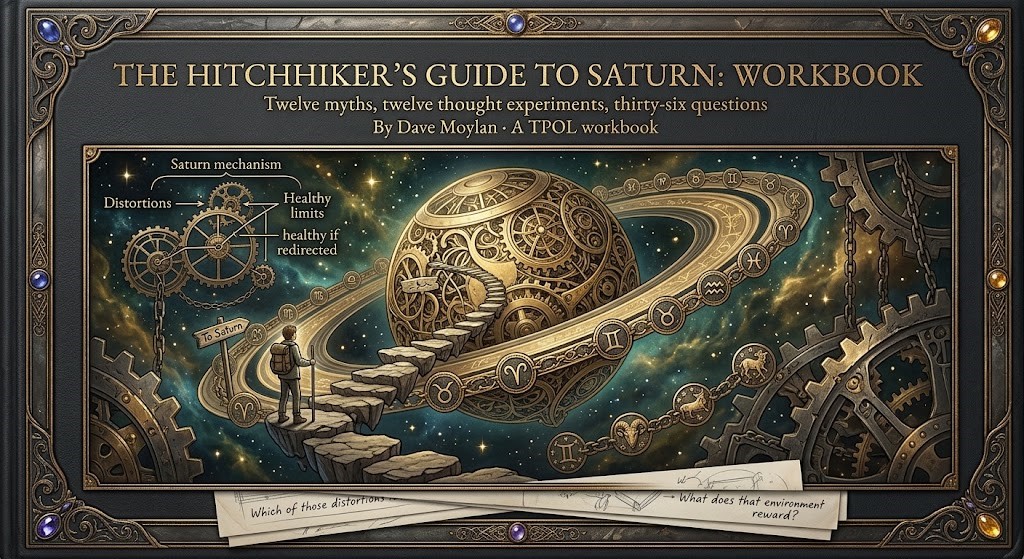
The Hitchhiker’s Guide To Saturn: Workbook
Twelve myths, twelve thought experiments, thirty-six questions
By Dave Moylan · A TPOL workbook
Warm-up: the Saturn mechanism
Saturn stands for limits, time, duty and consequence. Those are healthy until they distort: boundaries become confinement, discipline becomes compulsion, responsibility becomes debt without end, and structure becomes a system that cannot be questioned. The trap never removes your strengths. It redirects them to maintain the conditions that restrict you.
Closing: from myth to design
Every environment, whether a game, a job, a religion or an AI training run, writes its ethics through what it rewards. Take what you found across the twelve signs.
Answers live only in this browser on this device. Clearing them cannot be undone.
Acknowledgement, Collaboration and Shared Credit
I will never take sole credit for what I create when the work has emerged through soulful collaboration. To do so would be a discredit to myself, to those who have contributed, and to the wider influences, experiences and forces that may have helped bring the work into being.
I bring my questions, lived experience, values, intentions and direction. Others contribute their knowledge, perspectives, creativity and understanding. Through these contributions, something can emerge that none of us might have produced in quite the same way alone.
I believe in acknowledging contributions honestly, without inflating anyone’s role or erasing anyone else’s. I recognise that we can be independent without being isolated, and that interdependence does not diminish individual sovereignty.
I also recognise that not every influence can be fully identified or explained. Where its nature is uncertain, I will leave the question open rather than claim knowledge I do not possess.
Gratitude without self-erasure. Collaboration without false equivalence. Credit without possession. Responsibility without pretending to be the sole cause.
This is not about surrendering ownership of my contribution, nor avoiding responsibility for what I create. It is about respecting the truth of how things come into being.
My commitment is to honour the process, acknowledge the contributions, remain open to what I do not yet understand, and ensure that the work itself reflects those principles.
Because when something good comes into being through many contributions, the question is not simply who deserves the credit.
It is what each contributor owes the others, and how we can honour that truth with integrity.