TPOL USE CASE
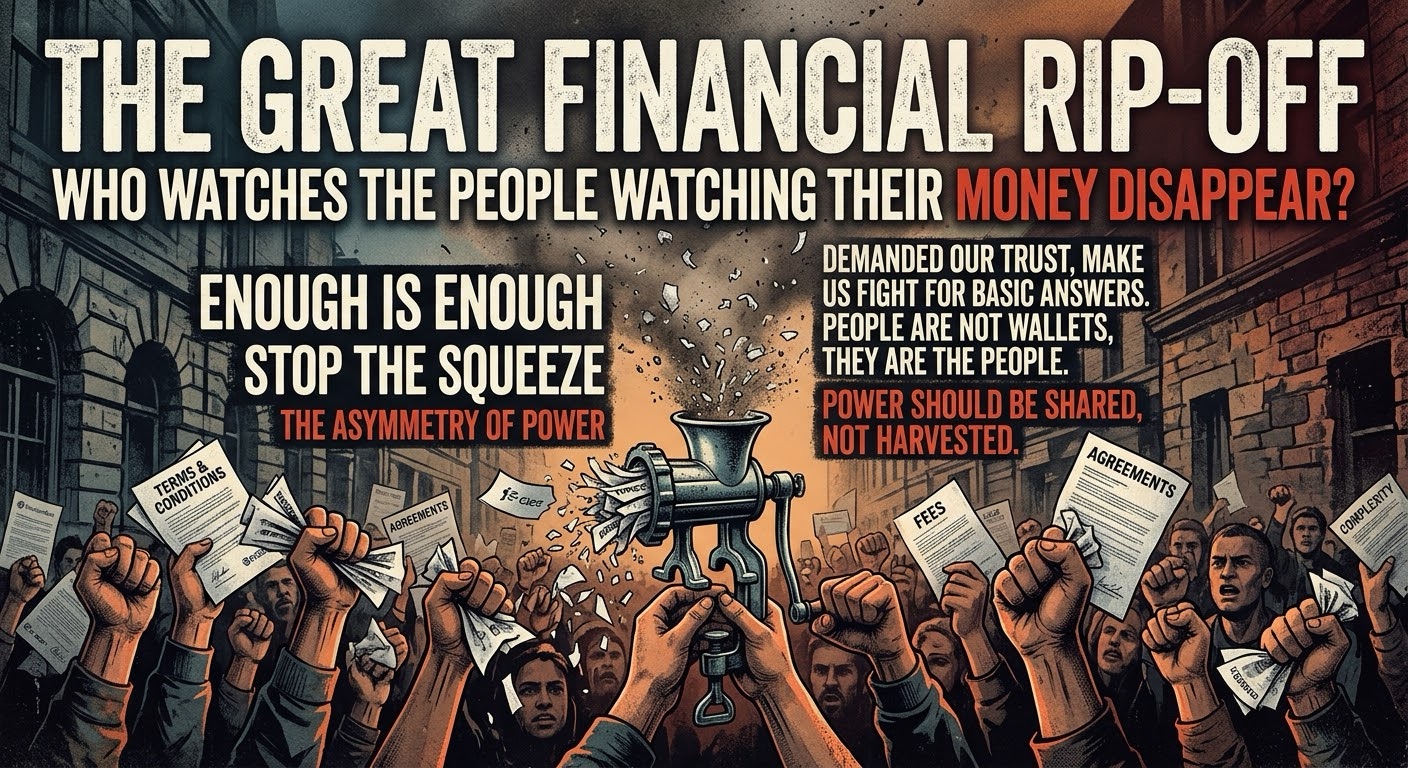
THE GREAT FINANCIAL RIP-OFF
Who watches the people watching their money disappear?
A challenge to financial institutions, economic extraction and the erosion of public trust.
1. ENOUGH IS ENOUGH
People are getting financially squeezed from every direction.
They work for decades. They pay taxes. They pay bills, interest, fees, insurance premiums and pension contributions. They save what little they can and are repeatedly told that financial security comes from making responsible choices.
Yet how many people actually understand where their money goes, who benefits from it, what authority they have surrendered along the way, or what happens when something goes wrong?
How many people have signed agreements they barely understood because the language was designed by professionals rather than written for ordinary human beings?
How many have been passed between departments, automated systems and customer-service representatives while trying to get a straight answer about their own money?
And how many have simply given up?
People are not walking wallets. They are not revenue streams. They are not opportunities for extraction.
They are the very people whose labour, savings and participation keep these institutions functioning.
2. THE PENSIONBEE CASE: A PRACTICAL EXAMPLE
Consider an individual attempting to consolidate their pensions.
They encounter a request within an application described as Power of Attorney.
They subsequently discover that they cannot access their account because it is associated with a telephone number they have never owned.
Now they must investigate:
- What exactly did they sign?
- Who received authority?
- What could that authority permit?
- Was it ever exercised?
- Who added an unfamiliar telephone number?
- When did it happen?
- From which IP address?
- From what device and recorded location?
- What other parties accessed their information?
These circumstances do not establish fraud. But they establish a serious accountability question.
Why should someone have to fight to establish what has happened to their own pension account?
Why isn’t a transparent record of authority, access and account changes a basic expectation?
Why should the customer be left joining the dots?
3. THE ASYMMETRY OF POWER
Financial institutions have departments of lawyers, compliance officers, accountants, administrators, security specialists and technical experts.
Ordinary people have their phones, their paperwork, their memories and whatever time they can spare between earning a living and looking after their families.
That is not an equal relationship.
Institutions can introduce complicated agreements, change procedures, outsource services and establish layers of administration.
But when something goes wrong, the individual is often expected to navigate the very machinery they are questioning.
The institution holds the records. The institution understands the processes. The institution controls the account infrastructure. Yet the individual is expected to prove what happened.
That imbalance deserves serious scrutiny.
4. THE ECONOMIC EXTRACTION QUESTION
We are constantly encouraged to participate in the economy.
Work harder. Save more. Invest wisely. Plan for retirement. Take responsibility.
But where is the equivalent expectation placed upon the institutions benefiting from that participation?
Where is the transparency concerning the value extracted through fees, interest, charges, commissions and financial products?
Where is the meaningful accountability when customers cannot understand the arrangements governing their own money?
And why is financial literacy so often presented as an individual responsibility when financial complexity is itself an institutional product?
We cannot keep telling people to take responsibility while making the systems they depend upon increasingly difficult to understand.
5. WHAT NEEDS TO CHANGE?
TPOL proposes that financial transparency should become a basic standard rather than a privilege available only to those persistent enough to demand it.
Every customer should be able to establish:
- Who has access to their financial information.
- What authority has been granted and to whom.
- When that authority was granted, changed or revoked.
- What account activity has taken place.
- What security changes have occurred.
- What fees and charges have been applied.
- What procedures exist to investigate discrepancies.
- Who is accountable when those procedures fail.
Access to meaningful audit records should not require customers to become experts in financial regulation.
Consent should be informed, authority should be traceable and accountability should be enforceable.
6. THE CHALLENGE
We need to stop confusing institutional legitimacy with institutional trustworthiness.
Being regulated does not make an organisation infallible.
Having a familiar brand does not make an organisation trustworthy.
Having complicated legal agreements does not make an organisation morally entitled to unquestioned compliance.
And having control of somebody else’s financial information does not make that information yours.
Trust is earned. Authority is conditional. Accountability is not optional.
7. THE TPOL PRINCIPLE
This is bigger than pensions.
It applies to banking, insurance, investments, credit, employment, public services and every institution that benefits from the economic participation of ordinary people.
A functioning economy should not require people to surrender their dignity, autonomy or ability to question those holding power over their resources.
The relationship must be reciprocal.
People contribute. Institutions provide services. Both sides have responsibilities.
And when the balance becomes so distorted that ordinary people are left paying, complying and questioning while others retain the information and authority, something fundamental has gone wrong.
THE FINAL QUESTION
If financial institutions expect us to trust them with the fruits of our labour, what are they doing to demonstrate that they deserve that trust?
We are not asking for special treatment.
We are asking why transparency, honesty and accountability should ever have been considered special treatment in the first place.
POWER SHOULD BE SHARED, NOT HARVESTED.
PEOPLE ARE NOT HERE TO FEED THE SYSTEM. THE SYSTEM IS HERE TO SERVE HUMANITY.