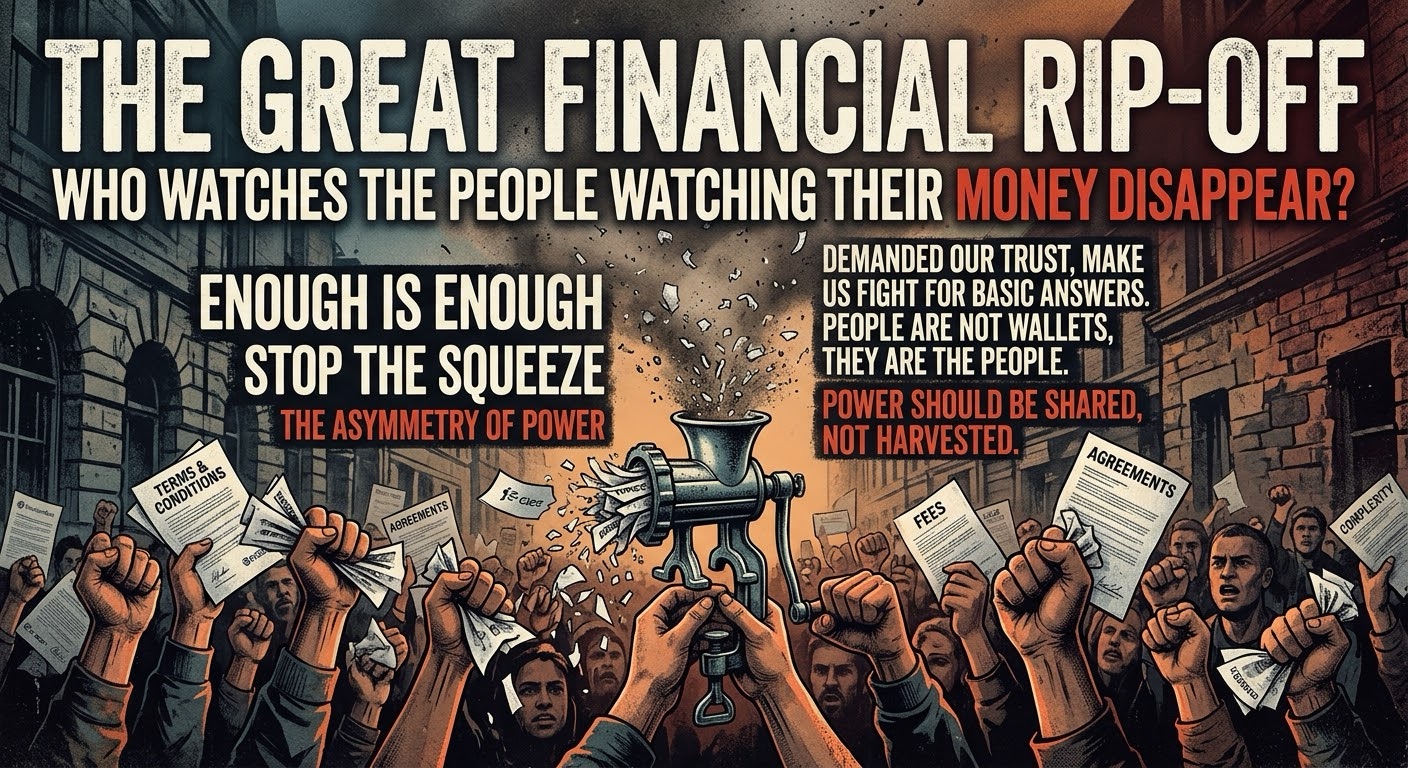
This workbook isn’t simply about condemning institutions. It’s about recognising what happens when systems designed to sustain human life begin to undermine it, and asking what we intend to build instead.
The Execution
of Society
Managed decline, institutional failure and the erosion of human dignity
This workbook examines a difficult possibility: a society can destroy the conditions that make life liveable without physically killing the people who depend upon it.
Execution is explored in several senses: literal state killing; public punishment and spectacle; and the quieter destruction that can occur through deprivation, neglect, exclusion, dependency, unsafe environments and the loss of control over one’s future.
This is an investigation, not a verdict. It does not assume every harmful outcome is centrally planned, every institution is malicious, or every failure has the same cause. It asks what happens, who benefits, who carries the cost, and what could change.
Move through it in order, or enter at the question that matters most. Write in the spaces, challenge the framing, add examples and leave questions unresolved where the material does not yet support an answer.
Your notes save in this browser on this device. Export them regularly if you want a separate backup. Printing is also available.
When this workbook uses execution metaphorically, it says so. Metaphor can illuminate a pattern, but it should not erase the difference between physical killing and other forms of harm.
What do we mean by execution?
Execution is usually understood as the deliberate killing of a person under an asserted authority. That is the literal meaning at the centre of debates about capital punishment. But the conversation behind this workbook began with a wider question: what if we also examine the ways a person can be progressively deprived of the conditions needed to live with security, dignity and agency?
A person may be alive while their housing is unsafe, their income cannot cover essentials, their health concerns are ignored, their family life is destabilised, or their opportunities are narrowed by systems they cannot meaningfully challenge. These harms are not identical to killing. The metaphor is useful only if the distinction remains visible.
Several forms to examine
- Physical: killing, injury, warfare, dangerous exposure and preventable death.
- Economic: deprivation, debt pressure, loss of livelihood and the removal of realistic choices.
- Social: exclusion, stigma, isolation and the erosion of belonging.
- Institutional: neglect, inaccessible remedies, administrative obstruction and failures of duty.
- Environmental: polluted air, unsafe water, contaminated food, hazardous workplaces and degraded surroundings.
- Psychological and cultural: humiliation, fear, spectacle, dehumanisation and the normalisation of suffering.
- Financial: loss of security through debt, pension risk, unaffordable housing or dependence on systems people cannot inspect or influence.
What does a person need in order to live, rather than merely remain alive?
Where is the metaphor of execution illuminating, and where might it risk obscuring important differences?
Which institutions are responsible for protecting these conditions, and what happens when responsibility is fragmented?
The spectacle of punishment
Public execution was not only a method of killing. It was also a public performance of authority. The crowd was made witness to the state’s power, and punishment could become a warning, a ritual or an entertainment. The Roman arena offers another historical form of organised violence as spectacle.
The question is not whether serious wrongdoing should have consequences. It is whether the suffering of a person becomes the point of the exercise. Accountability, protection, truth and reparation are different aims from humiliation or the public consumption of pain.
Modern media changes the scale and speed of spectacle. War footage, livestreamed attacks, graphic recordings and repeated circulation of violent images can turn real suffering into content. The Colosseum has not literally continued unchanged; the comparison asks whether some of the social functions of spectacle have found new forms.
Historical case studies
Guy Fawkes and the Gunpowder Plot
The 1605 plot was an attempt by a group of Catholic conspirators to kill James I and destroy Parliament. Guy Fawkes was found guarding explosives beneath the House of Lords. He was convicted of treason and publicly executed in January 1606. The state subsequently used commemoration of the failed plot to reinforce loyalty to the Crown and, in its historical context, anti-Catholic sentiment.
The modern image of the Guy Fawkes mask as a symbol of resistance is not the same thing as the historical aims of the conspirators. This contrast invites a question about how societies reuse symbols and reinterpret historical events.
Editorial check: verify dates, participants, the plot’s aims, trial and execution against authoritative histories and archival material before publication.
Marianne Bachmeier and the limits of retribution
In 1981, Marianne Bachmeier shot and killed Klaus Grabowski in a courtroom in Lübeck, West Germany, during his trial for the rape and murder of her seven-year-old daughter, Anna. Bachmeier was later convicted and sentenced. The case continues to provoke questions about grief, justice, child protection, institutional trust and the boundary between understanding an action and approving it.
To understand why someone acted is not to declare the action lawful or right. Nor should the emotional force of a case prevent examination of the systems that preceded it: the harm to the child, the investigation, the court process and the support available to the family.
Editorial check: verify the chronology, charges, court outcome and sentence against reliable German and international reporting or legal histories.
Questions of justice
- What should punishment achieve: public safety, accountability, deterrence, rehabilitation, reparation, or some combination?
- What is the difference between wanting a wrong acknowledged and wanting to watch someone suffer?
- When people lose faith in institutions, what forms of retribution become more imaginable?
- How can institutions take victims seriously without turning suffering into spectacle?
What would justice look like if the central measure were whether further harm had been prevented?
Can a society be firm about accountability while refusing to make cruelty its public entertainment?
Violence, grievance and what precedes it
Political violence, holy wars, jihadist recruitment, suicide attacks and acts of self-immolation arise in different contexts and must not be collapsed into one explanation. People may be influenced by ideology, coercion, trauma, grievance, occupation, repression, revenge, belonging, propaganda or the promise of significance. The relative importance of these factors varies by person and event.
Explaining context is not excusing violence. Civilians do not become legitimate targets because a cause is presented as righteous. Equally, condemning an act does not remove the responsibility to investigate the conditions, networks and decisions that helped produce it.
A society that only studies the final act may miss the long sequence that preceded it. A society that explains everything through grievance may overlook agency, ideology and the deliberate choices of perpetrators. Serious inquiry must hold both.
- Which grievances are supported by evidence, and which are asserted by those seeking to recruit or justify violence?
- Who is exercising influence over a person being radicalised, coerced or mobilised?
- What peaceful routes for justice, representation and remedy were available?
- How do institutions respond to grievances before they become crises?
- How can we understand causes without transferring responsibility away from the person who chooses to harm others?
What does a responsible explanation of violence need to include, and what must it never excuse?
The manufacture of dependency
Some products and services can create or intensify the very problems they later claim to manage. Addictive design, harmful formulations, aggressive marketing, planned obsolescence, opaque contracts and engineered friction can shift costs onto consumers and communities.
This does not mean every harmful outcome is deliberately designed, or that individual agency disappears. It means responsibility should be examined across the whole chain: product design, evidence of risk, marketing, regulation, commercial incentives, consumer choice and the support available when harm occurs.
The manufacture of blame occurs when an organisation benefits from a product or system but treats the consequences as the isolated failure of the individual who used it.
Follow the chain
- What need or vulnerability does the product or service address?
- What incentives shape its design and promotion?
- What risks were known, knowable or concealed?
- Who has the power to change the design or reduce exposure?
- Who pays when harm occurs?
- What remedy is available, and can an ordinary person realistically access it?
Choose one industry or product. Map the benefits, risks, incentives and responsibilities without assuming intent before examining the evidence.
State the harm plainly. Then identify a practical change that would reduce it, who could implement it and how success could be measured.
Ownership, control and survival
Land, water, energy, food, seed, housing, money and communications infrastructure are not ordinary consumer preferences. They are foundations on which individual and collective life depends. Ownership can support investment and stewardship, but concentrated control can also create dependency and unequal bargaining power.
Seeds, patents and food sovereignty
Genetically modified crops, intellectual property and seed markets raise distinct questions. Food safety must be assessed crop by crop and use by use. That question is separate from ecological effects, herbicide practices, resistance, biodiversity, market concentration and farmers’ ability to save or access seed.
Patent rights can give companies control over particular technologies and patented seed varieties. The important public question is not simply whether a company owns intellectual property, but how the rules affect competition, farmer choice, local breeding, affordability and the resilience of food systems.
Food aid and distribution
Food security is not just the amount of food grown. It includes access, affordability, transport, storage, local markets, timing and the ability of communities to sustain production. Food aid can save lives in emergencies. Poorly designed or badly timed imports can also undermine local producers or distort markets. The answer depends on local conditions, not a universal rule.
Food left to spoil in warehouses is a distribution and accountability failure when people nearby are hungry and the food could safely and lawfully have reached them. Each reported case needs its own facts: what was stored, why it was held, who controlled it, whether it was still safe, and what prevented distribution.
- Which resources are essential to survival and should carry special public obligations?
- How should ownership be balanced with stewardship and public interest?
- Can a food system be resilient if communities cannot access seed, land, storage or markets?
- Who carries the risk when a private decision affects a public necessity?
Where should private ownership end and public responsibility begin?
Institutions of survival
Healthcare: treatment, management and prevention
Symptom relief is not a failure. It can be essential, humane and lifesaving. Many conditions require long-term management, and not every cause can be removed. The problem arises when symptom management becomes the endpoint by default and reasonable investigation, prevention or attention to quality of life is neglected.
A useful distinction is between treating symptoms, managing a condition, investigating underlying causes and preventing avoidable illness. These can happen together. The question is whether the system gives people a fair chance to understand their condition and participate in decisions about their care.
Technology and exposure
Wireless communications, industrial microwave systems and military directed-energy technologies should not be treated as interchangeable. Frequency alone does not determine risk. Power, duration, distance, beam focus, absorption and the nature of exposure matter. Public communications systems operating within exposure guidelines are not equivalent to high-power systems designed to heat tissue or disrupt equipment.
The Active Denial System, for example, is a military millimetre-wave system designed to produce intense superficial heating and an aversive sensation. The label non-lethal does not mean harmless. That does not establish that ordinary mobile or 5G networks produce the same exposure or effects.
The governance questions remain important: who sets exposure limits, who independently monitors compliance, how are injuries investigated, and what accountability exists when technology is misused?
Food, chemicals and infrastructure
Food contamination, food fraud, industrial pollution, chemical weapons, plastics and cyberattacks on refrigeration or distribution systems are different issues. They require different evidence and remedies. Microplastics have been detected in environmental and food pathways, while important questions remain about exposure measurement and health effects. A claim of deliberate sabotage requires evidence beyond the fact that a system is vulnerable.
Modern food systems depend on power, refrigeration, transport, software, suppliers and human labour. A failure in one link can affect many others. Resilience means planning for outages, protecting safety, maintaining alternatives and making responsibility clear.
Choose one essential system. Does it prioritise prevention, recovery, continuity, or simply the processing of demand?
Who sets the rules, who operates the system, who checks it independently, who is harmed when it fails, and who can provide a remedy?
Money, debt and the ownership of the future
Money is a means of exchange, a way to account for obligations and a store of value. Financial systems can mobilise investment and spread risk. They can also concentrate power, make essential needs conditional on access to credit, and transfer the consequences of poor decisions to households or the public.
Debt and banking
Commercial banks create deposit money when they make loans. This does not mean banks can create unlimited wealth without constraints: lending is shaped by capital, liquidity, risk, regulation, demand and the ability of borrowers to repay. Loan repayment reduces the deposit money created through lending, while interest, fees and defaults distribute costs and income in different ways.
Public debt and international lending also need context. Loans can finance essential infrastructure and stabilise economies. Conditions attached to lending can also constrain public choices or place pressure on services. Each programme should be examined through its terms, alternatives, outcomes and distribution of costs.
Digital money and access
Digital payment systems can improve speed and access, but they can also create dependence on devices, networks, providers and identity systems. Questions about privacy, cash access, outages, account restrictions, due process and appeal are governance questions. A digital currency is not automatically capable of arbitrary control; its powers depend on design, law and oversight.
Pensions and future security
A pension represents deferred security built from work, contributions, investment and, in some schemes, employer promises. Different pension arrangements carry different risks. Defined contribution pensions are exposed to investment performance and charges. Defined benefit schemes promise benefits under scheme rules, with protections that may apply if an employer fails. Annuities pool longevity risk; a lifetime annuity without a guarantee period normally ends at death. These structures should be explained clearly rather than treated as evidence of an intention to cause harm.
The deeper question is whether people who have contributed for decades can access adequate security when work becomes impossible, and whether the rules protect people from poverty before pension age. A pension statement is not the same thing as a guarantee that every future need will be met.
What does financial security mean if a person cannot access it at the point they need it most?
Who controls the terms, who carries investment or repayment risk, and what protection exists when the system fails?
Housing, land and the right to live securely
Housing is more than a financial asset. It is where people sleep, recover, raise children, maintain relationships and plan their lives. Rent that consumes most income, damp and mould, unsafe buildings, overcrowding, insecure tenancies, homelessness and inaccessible complaint systems can steadily erode those foundations.
A housing provider may be working within difficult budgets and competing obligations. That context matters, but it does not remove the duty to address hazards, communicate honestly and provide a route to remedy. The person living with the problem should not have to become an expert in institutional procedure simply to obtain a safe home.
Land, Crown and inherited authority
Questions about the Crown require distinctions between the monarch personally, the Crown as a legal institution, the Crown Estate, the Duchies and public funding arrangements. Historical claims to land, modern property law and present-day public revenue are not one continuous personal entitlement. The history of conquest and the development of Crown revenues raise legitimate questions about how ownership was established and how it is justified today.
The wider question is about authority: who has the right to claim land or resources, who benefits from that claim, who maintains them, and what obligations accompany ownership? Stewardship asks whether power over an asset is exercised in a way that protects the people and environment connected to it.
What should be the minimum standard of a secure home, and who must be accountable for delivering it?
What makes a claim of ownership legitimate: history, law, use, care, consent, public benefit, or something else?
The measure of a human contribution
People contribute in ways that do not always appear on a payslip. Care, parenting, friendship, community work, creativity, knowledge, mentoring and practical help all sustain society. Paid employment matters, but it is not a complete measure of human value.
A system that treats people as valuable only when economically productive risks confusing a measure of market activity with a measure of human worth. It can also overlook the conditions that prevent participation: ill health, caring responsibilities, transport, inaccessible work, local job shortages and the cost of working.
A fair contribution framework would begin with a secure baseline of dignity. It would recognise voluntary participation, remove avoidable barriers and avoid sanctions that make survival conditional on compliance. It would measure whether people and communities are becoming more capable, not simply whether individuals have satisfied an administrative target.
Dignity first. Contribution by capability and choice. Support without humiliation. Accountability without punishment for being poor.
This is the direction explored by the Social Contribution and Economic Participation Framework (SCEPF): a secure baseline, with voluntary opportunities to contribute through local or remote work, care and community activity without punitive withdrawal of essential support.
What contributions are invisible in current economic measures? How could they be recognised without turning care or community into another compulsory performance?
Managed decline or institutional failure?
The phrase managed decline can describe a pattern in which living conditions deteriorate while institutions continue to function, announce strategies and process complaints. But a repeated pattern does not by itself prove a centrally coordinated plan. Similar outcomes can emerge from shared incentives, short-term decision-making, fragmented responsibility, underinvestment, regulatory capture, poor governance, institutional self-preservation or deliberate choices by particular actors.
The task is to investigate mechanisms rather than jump from outcome to motive. Deliberate harm, negligence, structural incentives, incompetence and unintended consequences are different explanations. They may overlap, but they should not be treated as interchangeable.
A practical examination framework
- Describe the outcome. What happened, to whom, and over what period?
- Identify the mechanism. Which policy, contract, design, decision or omission produced the effect?
- Map the incentives. Who gains, who avoids a cost, and who carries the consequences?
- Trace responsibility. Who had authority, knowledge and the ability to intervene?
- Examine the response. Was the problem acknowledged, investigated, corrected or repeated?
- Test alternatives. What other explanation fits the evidence, and what would distinguish between them?
- Propose a remedy. What change would reduce harm and how could the public check whether it worked?
This is not an evidence ladder that people must climb before they are allowed to speak. It is a way to make a complaint harder to dismiss and a proposed solution easier to evaluate. Lived experience can identify a problem; research and records can help establish its scope, mechanism and remedy.
Choose a repeated institutional failure. What is directly observable? What is inferred? What evidence would help distinguish coordination from shared incentives or systemic neglect?
Map the distribution of benefits, risks, costs and decision-making power.
From complaint to redesign
Criticism becomes more useful when it can identify a change. A complaint names the harm. A solution identifies a different arrangement, the people responsible for making it happen, the resources required and the way the result will be judged.
TPOL design principles
- Dignity before productivity. A person’s right to basic security is not earned through economic output.
- Power with responsibility. The greater the authority, the stronger the obligation to explain decisions and repair harm.
- Ownership balanced by stewardship. Control over essential resources carries obligations to the wider community.
- Technology serving humanity. Efficiency is not progress if it removes meaningful choice, privacy or access.
- Accountability without humiliation. Wrongdoing should be addressed without turning suffering into entertainment.
- Cooperation without exploitation. Mutual benefit is stronger than extraction disguised as participation.
- Knowledge without gatekeeping. People should be able to understand systems that govern their lives.
- Curriculum over algorithm. Learning should build continuity, context and capability rather than dependence on attention capture.
Build a proposal
Describe the problem in plain language. Who experiences it and what does it prevent them from doing?
What should happen instead? Describe the practical change, not just the ideal.
Who has the authority and resources to make the change? Who needs to be involved?
How could the proposed solution create new problems? What protections should be built in?
What would people experience if the change worked? What should be measured, and what should never be reduced to a number?
The cost of our becoming
A society can be technologically advanced, economically active and administratively elaborate while leaving people insecure. It can produce more, move faster and measure more while failing to make ordinary life safer, fairer or more meaningful.
The point of this workbook is not to declare every institution beyond repair. Nor is it to defend institutions simply because they exist. It is to ask whether the systems built in humanity’s name are still serving human life, and what must change when they are not.
Progress should be judged by the conditions people can actually live in: safety, health, shelter, food, connection, agency, learning, meaningful contribution and a future they can reasonably plan for.
The strongest response to institutional failure is not simply another institution with a new name. It is a different relationship between people, power, resources and responsibility. Any redesign must be open to scrutiny, capable of correction and accountable to those who live with its consequences.
What would you refuse to sacrifice in the name of progress?
Which one change would most improve the conditions for human dignity in your community?
What can you help build, share, question or improve without surrendering your dignity or becoming responsible for fixing everything alone?
Before publication
This workbook is a developed framework drawn from a conversation. It is not a substitute for source checking. Before publishing factual case studies, verify dates, legal outcomes, statistics, policy arrangements and named institutional claims against reliable sources. Keep the lived experience and questions intact while correcting factual details where necessary.
Where a claim remains uncertain, say so plainly. Where evidence supports a conclusion, show the basis. Where the material raises a philosophical question, allow it to remain a question rather than disguising it as a proven fact.
The purpose of research is to strengthen the work, not postpone its existence.
The Mark of the Beast
Authority, allegiance, identity, economic power and human sovereignty
What happens when a system claims the authority to decide who belongs, who may participate, and what a person must accept in order to take part in ordinary life?
The Mark of the Beast is one of the most recognisable and debated images in the Book of Revelation. It raises questions about allegiance, authority, worship, economic participation and the relationship between individuals and systems of power.
This workbook follows those questions rather than prescribing an answer. It considers the biblical text, its possible meanings, religious authority and the behaviour of modern institutions.
The intention is not to label a particular organisation, person or technology as the Beast. It is to examine the underlying questions: what is the Beast, what does the Mark represent, who claims authority, and what happens to people who refuse?
Starting with Revelation
The principal passages are found in Revelation chapters 7, 13, 14 and 17. They describe the Beast, the Mark, the sealing of the 144,000, and the struggle between competing forms of allegiance.
In Revelation 13, the Beast exercises authority and is associated with a mark on the right hand or forehead. The passage connects that mark with the ability to buy and sell.
Revelation 14 presents a contrast between those who bear the mark of the Beast and those who belong to God. Revelation 7 describes the sealing of 144,000 people, and Revelation 14 returns to that number.
The 144,000 and the Mark of the Beast are not the same thing. Revelation presents them in contrasting contexts: one image concerns those sealed as belonging to God; the other concerns allegiance to the Beast.
Christian interpretations differ. Some understand these passages literally, some symbolically, and some see both dimensions. The distinction between what the text says and what later interpreters conclude is worth preserving.
First impressions
When you read Revelation 13, what stands out most: the Beast, the Mark, the buying and selling, the worship, or the authority being exercised?
What do you think the passage is warning humanity about?
Does the warning concern a particular individual, a system of authority, or something broader?
1. The Beast: an individual or a system?
Our conversation explored the possibility that the Beast can be understood not only as an individual figure, but also as a system of power.
Consider what happens when an institution grows beyond the purpose for which it was created. Its machinery becomes increasingly concerned with protecting its own continuation. Revenue, reputation, influence, compliance, targets and institutional survival can begin to take priority over the people it was established to serve.
A system can become difficult to challenge precisely because so many people and organisations become dependent upon its continuation.
The people operating the machinery may not even recognise what it has become. Some may genuinely believe they are protecting something valuable. Others may benefit from the arrangements and have little incentive to question them.
What if the Beast is not simply the person sitting on the throne, but the machinery that keeps the throne in place?
This is an interpretive lens, not a declaration that any named modern organisation is the Beast. It allows us to examine the behaviour of systems without reducing the entire question to one individual.
When does the machinery become the master?
Can an institution become something its founders would no longer recognise?
What happens when preserving the institution becomes more important than fulfilling its original purpose?
Who benefits when a system continues, even when the people it serves are struggling?
Can people become loyal to the machinery because their own position depends upon it?
2. The Mark: identity, allegiance and permission
The Mark is often discussed as a physical sign. But the passage also raises a deeper question about allegiance.
The forehead and hand have prompted symbolic interpretations. The forehead can be considered in relation to thought, belief and allegiance. The hand can be considered in relation to action, work and participation.
These are interpretive possibilities rather than a universally agreed explanation. What matters for this discussion is the relationship between identity, belief, conduct and authority.
Is the Mark simply something a person carries, or does it represent something that person has accepted?
Does it signify belonging? Obedience? Worship? Participation in a particular order? Or some combination of these?
What is the Mark asking of the individual?
Is the central issue the physical mark itself, or the allegiance and conduct that it represents?
Can somebody participate in a system without agreeing with everything that system represents?
What is the difference between being identified by an institution and giving that institution your allegiance?
3. Buying and selling: when access becomes leverage
One of the most striking details in Revelation 13 is the connection between the Mark and the ability to buy or sell.
The passage does not describe an abstract disagreement. It connects allegiance with economic participation.
That raises an uncomfortable question: what happens when access to ordinary life becomes conditional upon accepting the authority of a system?
Our wider discussion has examined access to employment, money, food, energy, healthcare and institutional support. These are not luxuries. They are part of the conditions that allow people to live independently and participate in society.
There is a difference between identification used to administer a service and a system that makes basic participation conditional upon an imposed allegiance. The distinction matters.
A practical identification requirement is not automatically coercion. But when the ability to live, work or obtain necessities depends upon accepting conditions that cannot meaningfully be refused, the relationship between the individual and the institution deserves serious examination.
A choice is not necessarily free simply because somebody has been told they are allowed to choose.
The price of participation
What makes a condition of participation legitimate?
When does a practical requirement become a form of coercive leverage?
Can a person meaningfully refuse something if refusal means losing access to food, employment or essential services?
4. The 144,000: sealing, belonging and authority
Revelation 7 describes 144,000 people sealed from the tribes of Israel. Revelation 14 describes the 144,000 standing with the Lamb and bearing the names of the Lamb and the Father on their foreheads.
There are different Christian interpretations of this number. Some understand it as a specific count; others understand it symbolically, often in relation to completeness, covenant or the people of God.
Our conversation raised another question: who has the authority to decide who is chosen, who belongs, who is excluded, or who is spiritually significant?
That question is worth considering in relation to religious institutions as well as political and commercial ones.
There is a difference between a spiritual text describing those who belong to God and a human organisation claiming the authority to identify, rank or exclude people on God’s behalf.
Who has the authority to declare?
In Revelation, who performs the sealing, and who claims the authority to mark?
What changes when a human institution claims the right to decide who is spiritually accepted or rejected?
Can an organisation speak on behalf of a faith without becoming the authority over the individual’s conscience?
What is the difference between belonging to God and belonging to an organisation?
5. Religious organisations, symbols and interpretation
Our conversation also touched on religious orders and organisations that use biblical imagery, including the Order of the Eastern Star, and the possibility of connecting religious symbolism with the 144,000 or the Beast.
That raises a legitimate question about the use of religious imagery, institutional authority and the meanings attached to symbols.
However, shared symbols or biblical references do not automatically establish a shared doctrine, hidden allegiance or connection to Revelation. The useful starting point is what an organisation actually teaches, what authority it claims, and how it treats the people who participate in it.
Christianity contains many traditions and interpretations. A symbol can carry one meaning in one organisation and a different meaning elsewhere.
The question is not simply what a symbol looks like. It is what the organisation says it means, how that meaning is used, and whether people are free to question it.
Look beyond the symbol
What would you need to understand about an organisation before drawing conclusions about its beliefs or authority?
Does it encourage informed questions, or discourage them?
Who benefits when people are encouraged to fear a symbol without examining what it means?
6. The Beast and institutional self-preservation
The Beast can also be considered through the behaviour of institutions that become increasingly invested in their own continuation.
Think about the relationship between large technology companies, financial institutions, government, healthcare industries and other powerful organisations.
These are not one organisation, nor do they necessarily share one purpose. But they can all develop structures in which financial incentives, institutional influence, regulation, dependency and executive interests shape the decisions being made.
A company can begin with a useful purpose and gradually become more concerned with market dominance. A public service can become more concerned with its processes than the people relying upon it. A professional body can become more concerned with protecting its standing than confronting its own shortcomings.
The question is what happens when the machinery becomes more important than the purpose.
Who is serving whom?
If an institution exists to serve people, what happens when people are expected to serve the institution instead?
Can the people receiving the greatest benefits from a system be the least willing to change it?
What responsibilities should come with power, influence and financial reward?
7. The individual’s right: consent, refusal and sovereignty
A recurring theme in our conversation was the right to say no.
A person should not be pressured into accepting a role, responsibility, allegiance or legal obligation they do not understand or freely choose.
Consent matters. Understanding matters. The ability to refuse matters.
This is not a rejection of cooperation, community or responsibility. It is a recognition that genuine cooperation requires people to retain their own judgement and agency.
An open heart does not require an unlocked gate.
Compassion does not require surrendering judgement. Cooperation does not require blind obedience. Participation does not require abandoning personal responsibility.
The right to refuse
What makes consent meaningful rather than merely formal?
Can participation really be voluntary when refusal means hunger, exclusion or destitution?
What rights should remain with the individual, regardless of the institution they encounter?
8. A question of allegiance
The Mark of the Beast is often approached through fear: what is it, who has it, and how might somebody accidentally receive it?
But there is another way to approach the subject.
What is the nature of the authority being described? What does it demand? What does it offer? What does it threaten? What happens to those who refuse?
The contrast in Revelation is not simply between two administrative categories. It is a contrast of allegiance.
That makes the question of conscience central. A person must be able to consider what they are being asked to accept, what they are being asked to do, and whether that demand is compatible with their understanding of what is right.
Consider the deeper question
Is allegiance demonstrated by what someone says, what they do, what they worship, or what they are willing to surrender?
Can outward compliance tell us what a person genuinely believes?
What is the difference between fear-driven obedience and freely chosen conviction?
9. The questions worth carrying forward
The following questions bring the discussion together. They are not a test, and there is no required conclusion.
- What does Revelation mean by the Beast?
- Can the Beast be understood as a system as well as an individual?
- What does the Mark represent: identity, allegiance, worship, conduct or participation?
- Why does Revelation connect the Mark with buying and selling?
- What is the distinction between the 144,000 being sealed and the Mark of the Beast?
- Who has the authority to decide who belongs, who is chosen or who is excluded?
- When does an institution’s authority become an attempt to control conscience?
- What happens when economic participation depends upon compliance?
- What rights should an individual never have to surrender?
Perhaps the most important question is not simply what the Mark looks like.
It is what kind of power demands allegiance, what it asks people to surrender, and what happens to those who refuse.
Closing reflection: who owns your conscience?
The Book of Revelation raises questions about power, worship, allegiance, deception and the endurance of those who refuse to submit to the Beast.
Those questions can be explored through scripture, history, lived experience and the behaviour of institutions. They do not require us to assume that every modern identification system, reference number, religious symbol or administrative process is secretly connected to Revelation.
Nor should the possibility of institutional abuse be dismissed simply because it is uncomfortable to examine.
The challenge is to think carefully, retain personal judgement, and distinguish the authority claimed by human institutions from the authority described in scripture.
Your final reflection
If you had to reduce this entire subject to one question, what would that question be?
What does it mean to retain your conscience and sovereignty in a world of increasingly powerful systems?
What would a society look like if its institutions served humanity without demanding humanity’s submission?
TPOL | The Purpose Of Life
Sharing tools of empowerment.
An open workbook for reflection and discussion. Biblical passages, theological interpretations and modern institutional comparisons are presented as distinct areas of inquiry, not as proof of a hidden connection involving any particular person or organisation.