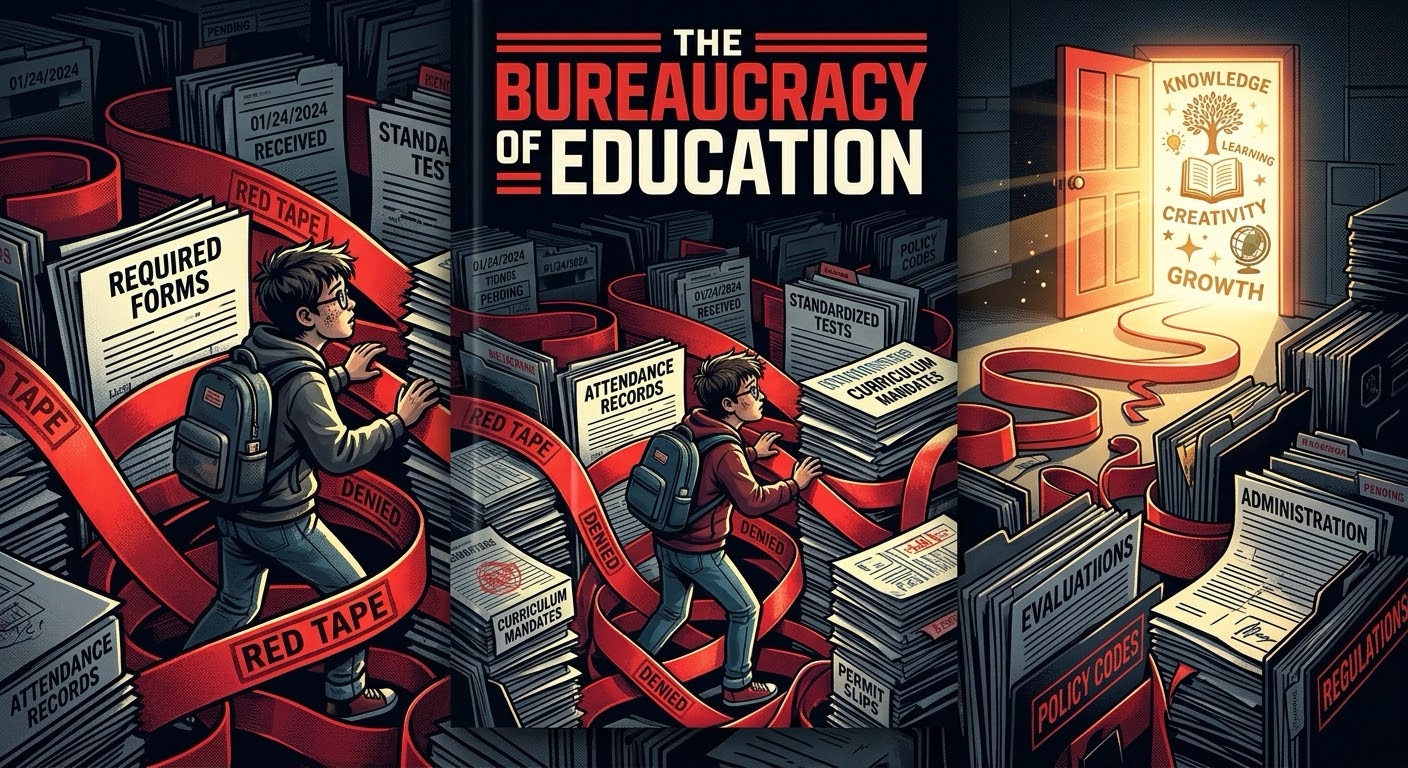
The Bureaucracy of Education
Attendance, enforcement, return, and the cost of learning across a lifetime. Examining what happens when the systems surrounding education become obstacles to education itself.
Sharing tools of empowerment
What are we actually trying to achieve?
Education is not a building, an attendance register, a funding category or a certificate. These may be parts of an educational system, but they are not its purpose.
The purpose is to help people learn, develop understanding, acquire skills, discover their capabilities and participate meaningfully in society.
This workbook looks at the barriers created by school attendance procedures, the treatment of returning pupils, the cost of proving illness, the availability of alternative learning and the financial commitments that can follow people into adulthood.
The central question
Are we organising education around the needs of the learner, or expecting the learner and their family to organise their lives around the needs of the institution?
What the system rewards
The concern is that schools can become focused on bums on seats: attendance targets, pupil numbers, funding and institutional performance. The bureaucratic process can become offensive for both schools and parents. Government policy then brings the possibility of fines, prosecution and social intervention. But where does that leave the child who still cannot access education?
There are several interests involved, and they do not always align.
The school
Attendance targets, pupil numbers, staffing, funding, reporting requirements and limited resources.
The parent
Responsible for the child, often with little control over the circumstances preventing attendance.
The child
Caught between institutional expectations and their own ability to participate.
Government
Sets policy, funding arrangements and enforcement powers, but enforcement alone cannot create access.
School funding is not simply a payment for each day a pupil sits in a classroom. It involves pupil numbers, school characteristics and other factors. Attendance is also monitored and carries institutional consequences. The important question is whether the measures institutions are required to report can become more influential than the educational outcomes they are meant to support.
Why does a system capable of delivering education through technology make families fight an administrative battle before their children can access it?
When a child comes back
A child who has been absent for a long time and finally finds the confidence to return can be treated as a BIG problem. Procedures follow. They may sense that staff are looking down their noses, believing the child or family has let down the school’s standards, particularly when adjustments are made.
A returning pupil should be welcomed back into education, not made to feel that their presence is an inconvenience or that they have to earn their place again.
- No public identification or embarrassment because of previous absence.
- No assumption that a returning child is disruptive, difficult or a problem.
- No expectation to catch up on months of missed work immediately.
- Agreed adjustments treated as legitimate arrangements, not favours.
- Progress measured through learning, engagement, confidence and development.
A different route to the same educational entitlement does not lower standards. It removes a barrier that was preventing the child from reaching them.
What are we protecting when we protect the standards of an institution at the expense of the child’s experience of education?
No victimising
No teacher should victimise a child because they have struggled to attend.
A child must not become a target for staff frustration, resentment, ridicule or punishment. This includes subtle behaviours: sarcasm about previous absence, publicly questioning commitment, treating adjustments as privileges, making an example of the child or making them feel indebted to staff.
Teachers have legitimate responsibilities around learning, standards and classroom order. Those responsibilities do not justify humiliating a pupil. Teachers also need training, resources and time to deliver alternative pathways rather than being left to improvise around needs the system has not properly supported.
Safeguards
- A confidential route for children and parents to report mistreatment.
- Clear procedures for reviewing complaints involving school staff.
- Protection against retaliation for raising concerns.
- Staff training on reintegration, reasonable adjustments and respectful communication.
- Support for teachers so that alternative provision is properly resourced.
How can a child safely raise a concern about the very adults responsible for supporting their education?
Design pathways, not punishments
Create the right pathways and many of the problems will be prevented or reduced.
The proposal is not to abandon classroom education or transfer responsibility to parents. It is to make sure that a child remains connected to learning when physical attendance is not currently possible.
Child struggles to attend
Provide a supported online route into the curriculum.
Parent struggles with the system
Provide one accessible point of contact and clear information.
Child needs flexibility
Offer hybrid or individually supported arrangements.
Child returns after absence
Provide dignified, planned reintegration.
Teacher needs capacity
Provide tools, training, resources and time.
Funding follows attendance measures
Examine how funding can recognise meaningful educational participation across different pathways.
Safeguarding must remain. But safeguarding and punishment are not interchangeable. Support should be meaningful, timely and proportionate. Fines, prosecution or social intervention cannot substitute for identifying and addressing the barrier to education.
How many problems we currently spend money policing could be prevented if more of that resource went into better pathways in the first place?
One school, multiple ways to learn
Every school should provide an integrated online learning portal as part of its educational provision. It should be available when a pupil cannot attend physically, with the arrangements tailored to the child’s circumstances.
This is not a request for parents to become teachers, pay for private alternatives or construct their own curriculum. The school remains responsible for education. The portal provides another route into that provision.
Classroom
Face-to-face teaching, practical work, discussion and shared experiences.
Online attendance
Secure access to lessons, teacher guidance and learning activities from home.
Supported home learning
Structured curriculum work, regular contact, feedback and progress checks.
Hybrid learning
A planned mixture of online and in-person education.
Gradual reintegration
A supported route towards classroom participation without losing learning continuity.
Specialist support
Additional accessibility, medical or learning support where ordinary online access is not enough.
What the portal should contain
- Age-appropriate curriculum content and a clear learning plan.
- Interactive activities that are engaging, alongside challenging work that develops understanding.
- Teacher explanations, feedback, questions and opportunities to ask for help.
- Assessment and progress records that continue across learning pathways.
- Safe opportunities for social learning and appropriate contact with classmates.
- Accessible design across phones, tablets and computers.
- A named point of contact when a pupil or parent needs support.
- A route between online, hybrid and classroom learning without starting again.
A phone or tablet should provide a meaningful starting point. Where a family lacks a suitable device, reliable internet or a quiet place to work, the school and relevant services should identify what support is needed. Digital provision must not create a new inequality.
Current Department for Education remote-education guidance in England describes remote education as a last resort where attendance is not possible, rather than an equal alternative to classroom attendance. The TPOL proposal is broader: it asks whether schools should develop a dependable, integrated access route so that learning continuity is not improvised only after a pupil has already become absent.
If a school can provide lessons through a screen when circumstances demand it, why should that capability not form part of its planned educational infrastructure?
Medical evidence and the family purse
When a child is ill, the parent normally informs the school. Problems arise when the school treats a doctor’s letter as a routine condition for accepting or recording that explanation.
Some GP practices charge for private administrative letters. The amount varies. A family may therefore be expected to pay to obtain a document for an institutional process, even where the child’s illness has already been reported and no additional clinical intervention is required.
The family pays. The practice receives income for producing the letter. The school receives its paperwork. But the child may still have no online lessons, teacher interaction or alternative route into the curriculum.
This is not evidence of a formal commercial agreement between schools and GP practices. It is a structural question about the consequences of the process: a school may request evidence, a practice may charge for non-NHS administrative work, and a family may feel it has no practical choice but to pay.
The combined effect can leave a family poorer without improving the child’s access to education. It also raises a question about whether health professionals are being drawn into routine attendance administration that could have been handled more simply.
What the guidance says
England’s Department for Education attendance guidance, updated in July 2026, says schools should not routinely request medical evidence for illness absences or apply blanket requirements. In most cases, a parent’s notification can be accepted. Where there is genuine and reasonable doubt or a particular need for further information, schools can seek evidence, but should be flexible about its form and avoid unnecessary burdens.
If 100 families each paid £30 for a letter, that would amount to £3,000. This is an illustration, not a claim about the number of letters requested nationally.
What could £3,000 contribute towards if invested in accessible learning resources, devices, teacher time, digital tools or curriculum development?
The argument is not that GPs should work for nothing. It is that families should not be made to finance avoidable administrative transactions when the same resources could help build the educational provision that is missing.
How much money, staff time and family income are being consumed by attendance verification that could instead be invested in educational access?
When a support problem becomes a compliance problem
Attendance law and safeguarding responsibilities exist for important reasons. Children should not be deprived of education, and serious concerns about a child’s welfare must be taken seriously.
But enforcement cannot substitute for understanding why a child is absent or what would make education accessible.
Questions before escalation
- Has the school identified the barrier to attendance?
- Has the child been listened to in an age-appropriate way?
- Has the family been offered practical support?
- Has a suitable alternative learning pathway been considered?
- Are adjustments or specialist support needed?
- Has the school distinguished inability to attend from unwillingness to engage?
- Is escalation addressing a genuine safeguarding concern, or simply responding to an attendance measure?
Fines and prosecution can have serious consequences for families. Social-care involvement may also be appropriate where genuine welfare concerns exist, but it should not be used as a substitute for educational support or as an automatic response to a difficult attendance pattern.
College, university and the cost of opportunity
Education does not stop at school. Older students can leave college or university carrying substantial financial obligations, while discovering that the qualification they worked towards does not guarantee employment.
Higher education has genuine value: knowledge, research, professional development, confidence and the ability to contribute to society. The question is how that value is funded, who carries the risk and what responsibility institutions have towards the people they encourage to enrol.
The change in tuition fees
| Period | Maximum standard full-time tuition fee |
|---|---|
| 2006–07 | Up to £3,000 per year |
| 2012–13 | Up to £9,000 per year |
| 2025–26 | Up to £9,535 per year at providers meeting the relevant conditions |
| 2026–27 | Up to £9,790 per year at providers meeting the relevant conditions |
The increase from £3,000 to £9,000 in 2012 represented a tripling of the headline annual fee cap. The current maximum varies according to provider status and conditions, so the figures above are not a universal charge at every institution.
Tuition fees are not the whole cost
Students may also need maintenance loans to cover accommodation, food, transport, books, equipment and everyday living. The total amount borrowed can therefore be substantially higher than the tuition fee alone.
For many students, the loan system makes university possible without paying the full cost upfront. But it also means that the individual carries a financial obligation after leaving education. Repayments are income-contingent and depend on the repayment plan, earnings and applicable thresholds. They are not ordinary commercial loan repayments, but they can still affect disposable income for years. The balance and write-off rules also vary by plan.
The scale of the outstanding balance
£295 billion was owed through student loans in England at the end of March 2026.
£47,900 was the average balance for borrowers who finished their courses in 2023 when they became liable to repay in April 2026.
These are different measures: the first is the total outstanding balance across the system; the second is an average for a particular group of borrowers. Neither figure represents what every student owes.
The qualification-to-employment question
A degree does not guarantee a job. A person can invest years of effort, take on tuition and maintenance borrowing, graduate and still struggle to find work in their chosen field.
This is not an argument that every course must guarantee a job or that education has value only when it increases earnings. It is an argument for transparency and responsibility. Prospective students should be able to understand the likely costs, course outcomes, employment patterns and financial implications before committing themselves.
I came out of university in debt: £3,000 per year in tuition fees, alongside maintenance borrowing, and still struggled to get a job. The next wave after I left faced tuition fees of up to £9,000 per year. What are the bureaucracies doing, and who is taking responsibility for the outcomes?
If society encourages someone to invest years and thousands of pounds in education, what responsibility does it have to ensure that the qualification offers meaningful opportunities?
Why is the individual expected to carry the financial consequences of an educational investment that does not necessarily lead to work?
Education as a lifelong public resource
The alternative is not to remove personal responsibility or dismiss the value of qualifications. It is to create more ways for people to learn without making every stage dependent on a large financial commitment or a single institutional route.
Publicly supported routes
Maintain meaningful opportunities to learn without requiring every learner to take on substantial personal borrowing.
Earn while learning
Develop paid apprenticeships and work-based learning that combine practical experience with recognised education.
Modular qualifications
Allow people to build recognised skills over time rather than committing immediately to a complete multi-year course.
Recognise existing skills
Give proper recognition to experience, practical ability and knowledge gained outside formal education.
Transparent outcomes
Publish understandable information about course costs, completion, progression and employment outcomes.
Flexible retraining
Make it possible for adults to change direction without repeatedly taking on disproportionate financial commitments.
Education should remain available throughout life. It should not be treated as a one-time purchase made by a young person and then left entirely to them to recover financially.
Are we educating people to increase their capacity to participate in society, or making participation dependent on accepting financial obligations before they have had a fair chance to establish themselves?
Does the process serve the purpose?
Every administrative requirement should be able to explain what it achieves, who benefits, who carries the cost and whether a simpler route exists.
Eight questions for any institutional process
- Purpose: What real problem is this process intended to solve?
- Necessity: Is it genuinely required in this situation?
- Proportionality: Is the demand proportionate to the concern?
- Accessibility: Does it make access easier or harder?
- Cost: Who pays in money, time, effort and opportunity?
- Alternatives: Could the same outcome be achieved more simply?
- Outcome: Does completing the process improve the person’s circumstances?
- Accountability: Who checks whether it is working?
If a family has completed every requested administrative step but the child still cannot access education, what exactly has the system achieved?
Turn the argument into practical change
Reform should be testable, costed and open to evaluation. The aim is not to add another layer of bureaucracy. It is to redirect effort towards provision that makes a measurable difference.
Proposed reforms
- Provide integrated online learning portals as part of ordinary school infrastructure.
- Keep curriculum responsibility and teacher support with the school.
- Recognise meaningful educational participation across classroom, online and hybrid pathways.
- Avoid routine or blanket demands for paid medical evidence.
- Provide dignified reintegration and protection against victimisation.
- Review the administrative costs placed on families and health professionals.
- Examine how funding can support education delivered through different pathways.
- Improve transparency around higher education costs, outcomes and student financial commitments.
- Expand flexible, modular and work-based routes into further learning.
A possible school pilot
- Map existing attendance, remote-learning and support arrangements.
- Consult pupils and families about the barriers they experience.
- Build or adapt a secure learning portal using the existing curriculum.
- Set out how pupils receive teacher contact, feedback and assessment.
- Test classroom, online and hybrid participation arrangements.
- Review learning continuity, pupil experience and family burden.
- Publish findings, including costs, limitations and improvements needed.
Measures that matter
Sources and figures to check
This workbook combines personal experience, questions about institutional design and proposed reforms. The sources below help distinguish established policy and statistics from the arguments being developed.
Statutory guidance for England, updated 9 July 2026. Covers attendance responsibilities, illness absence, medical evidence, support and enforcement.
Read the statutory guidance
Guidance on remote education when pupils cannot attend. It currently frames remote education as a last resort, which is relevant to the proposed broader access-portal model.
Read the remote education guidance
Student loan balances, borrowing, repayment and forecasts, including the £295 billion outstanding in England at March 2026.
Read the briefing
Official maximum fee limits and changes for undergraduate tuition fees.
Read the fee changes
Fee-limit tables for different provider categories and academic years.
Read the fee limits
The student-loan figures in section 08 refer to England and specific reporting periods. Tuition-fee maximums vary by provider status and academic year. Student-loan repayment terms vary by plan. The £30 GP-letter example is illustrative, not a national average.
Before publication, further research could establish how often paid letters are requested, what practices charge, how much family money is spent, what remote provision schools already offer and what alternative provision would cost.
What should education be for?
A register can tell us who was present. An attendance percentage can tell us how often pupils entered a building. A medical letter can document a particular circumstance. A loan balance can tell us how much money remains outstanding.
None of these measures, by itself, tells us whether a person has received meaningful education, whether a family has been treated fairly or whether the investment made in learning has created a genuine opportunity.
We should be able to question why families sometimes spend money proving that a child is unwell while the educational alternative remains unavailable. We should examine why so much effort can go into attendance administration while the infrastructure for continuous learning remains limited.
We should also ask why people can be encouraged to take on substantial financial commitments for higher education without a clear understanding of the outcomes they can reasonably expect.
These are not arguments against schools, teachers, doctors, universities or education itself. They are questions about whether the structures surrounding education are serving the people they exist to support.
Education should remain connected to the learner through illness, disability, disruption, changing circumstances and different stages of life. A different route to the same educational entitlement is not a lower standard. It removes an unnecessary barrier.
The final questions
What is the cost of maintaining a system that measures absence more reliably than it provides access?