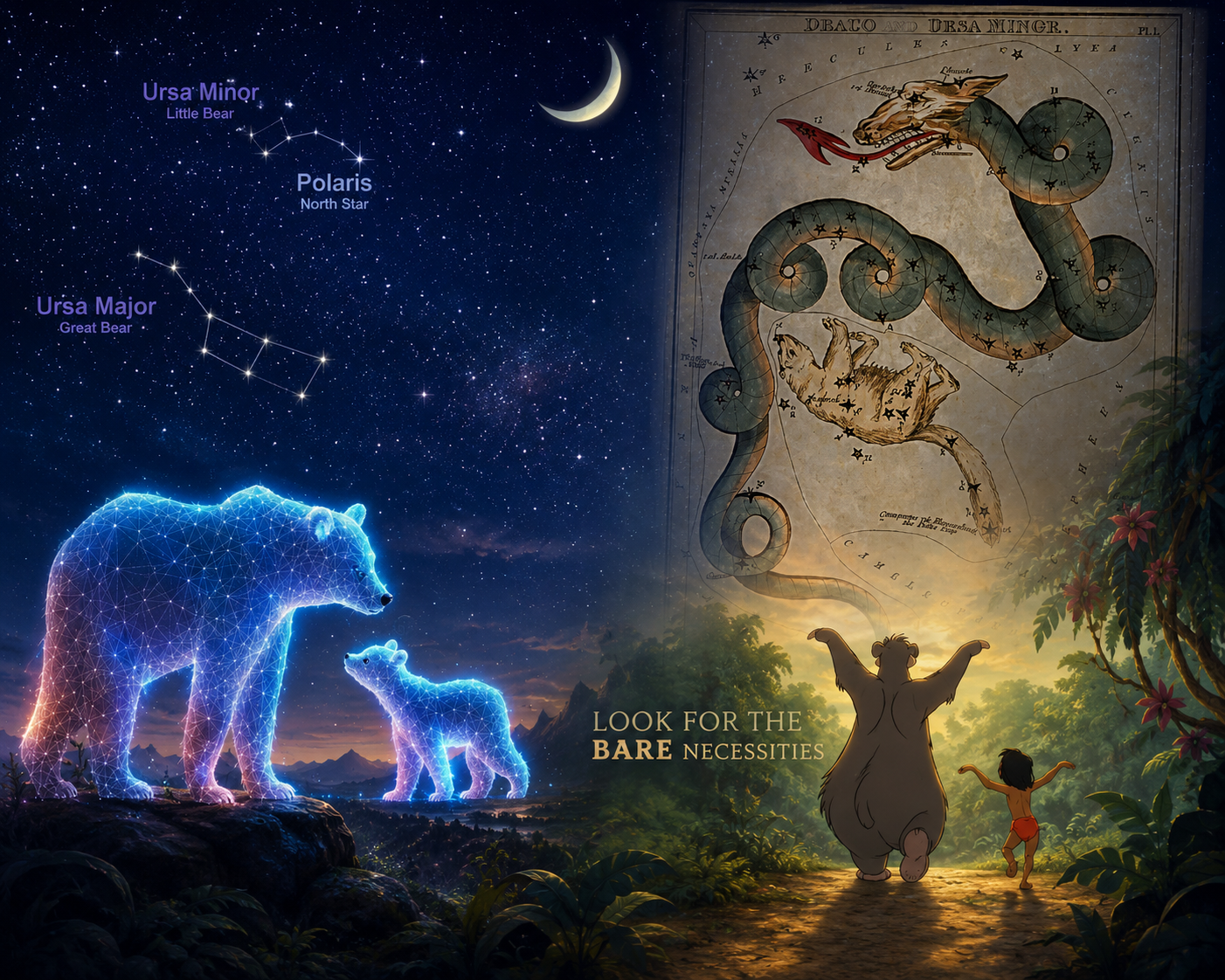
Ursa Major (the Great Bear) and Ursa Minor (the Little Bear)
The Great Bear Of The Night Sky
“Do not mistake kindness for weakness.”
This workbook does not argue doctrine. It does not accuse. It walks slowly around a set of old symbols — a bear, a sacrifice, a pair of hands, a star that does not move — and asks what they reveal when we look honestly. The aim is not to tell you what to believe. It is to invite you to notice what you already stand for, and why.
You will be asked questions. Some have no clean answer. Sit with the ones that resist you. The friction is the work.
The Great Bear Above
Before any of us arrived, the bear was already watching. Across Europe, Asia, and North America, peoples who never met one another looked up at the same handful of stars and independently saw the same creature: a bear. That shared recognition is itself worth pausing on — something in those points of light spoke a common language to scattered minds.
There are two bears in the northern sky. Explore them below.
Ursa Major is the Great Bear. Its most recognisable part is the Big Dipper — known in the UK as The Plough.
| Dubhe | One of the two “pointer stars” of the Dipper. |
| Merak | The second pointer. A line drawn through Dubhe and Merak leads the eye to Polaris. |
| Alioth | The brightest star of the constellation. |
| Mizar | Famous as a double star — a test of eyesight for the ancients. |
| Alkaid | The star at the very tip of the bear’s tail. |
The pointer stars do not shine for themselves. Their purpose, for the traveller, is to point beyond themselves — toward the one star that holds still.
Ursa Minor is the Little Bear, and it holds Polaris — the North Star.
Polaris sits almost exactly above the north celestial pole, so while the whole sky wheels around it through the night, Polaris barely moves. For centuries, sailors and travellers steered their lives by it. Not because it was the brightest light — it isn’t — but because it was the faithful one. The fixed point you could trust when everything else turned.
In Greek mythology, the Great Bear and Little Bear were tied to Callisto and her son Arcas, placed together among the stars. A mother and her child, set side by side and made permanent.
Many cultures carried their own bear stories into these same stars. What recurs, again and again, is not a story of conquest. It is a story of a parent and a child, kept together, watching over the cold edge of the world.
The claws are not the point
People often imagine the bear as a creature of aggression. But that is not what makes the bear powerful. A bear is powerful because it protects. The claws are not the point. The cubs are the point.
Picture the Great Bear above you — ancient, silent, watching. It does not ask what you have achieved or what was taken from you. It asks one question only:
“What do you stand in front of?”
Not metaphorically. Literally. If something dangerous walked into the room right now, who or what would you place yourself between it and?
Strength, Misunderstood
The older one becomes, the clearer it grows that many people misunderstand strength. They think strength is domination. Control. Influence. Authority. The ability to make others bend.
But the strongest force is not domination. It is protection.
That is strength — not because it seeks power, but because it accepts responsibility. Power protects itself. Protection protects others. They are not the same impulse wearing different clothes; they move in opposite directions.
A protector still needs some measure of force, or the protection is only a wish. The point is not that strength is bad — it is that strength is a tool, and a tool is judged by what it is turned toward. The claws matter. But the cubs decide what the claws are for.
The Question Of Sacrifice
Here the ground gets harder, and we will walk it carefully — fairly, and without accusation. The aim is to look at a symbol clearly, not to indict anyone who reads it differently.
Many systems throughout history have been built upon sacrifice. Sacrifice for status. For wealth. For favour. For access. For power. And there is an old, recurring story-shape in which something loved must be given up to gain something needed.
So the honest question is asked plainly: Why is sacrifice required at all? Why is love so often described as a transaction?
Consider the case that opened this inquiry: a person, reportedly, in legal trouble for quoting a line of scripture about a father giving a son. Several distinct threads sit tangled together here, and they are worth separating.
In many liberal democracies, expressing a religious belief — including quoting scripture — is generally protected. A court does not usually convict a person because judges dislike a belief; it convicts for breaking a specific law, and the precise reason given matters enormously. Headlines tend to leave that reason out.
A clean free-speech position can hold three things at once:
| 1 | People should be free to express even controversial beliefs. |
| 2 | Institutions are equally free to publicly criticise those beliefs. |
| 3 | Disagreement should not automatically become criminalisation. |
From this lens: if a society’s true objection is to the endorsement of harming the innocent, the honourable move is for the institution to say so openly — to state its moral position in public — rather than to convert a moral objection into a conviction and leave the principle unspoken.
The same words can be read in at least two very different registers, and confusing them is where most of the heat comes from.
As symbol: Many traditions speak of sacrifice as the giving up of comfort, ego, status, attachment, or time — surrendering the smaller self so something truer can grow. Mainstream Christian theology, notably, reads its central story as something done once, by the divine, to end the need for human sacrifice — not as a command for people to sacrifice children. It generally rejects human sacrifice outright.
As literal demand: A bargain that asks an actual innocent to be the payment. Historically, some cultures did practise blood sacrifice. Modern legal and moral systems overwhelmingly reject it.
The challenge this workbook puts to the reader is simple: be sure which register you are in before you praise or condemn. To read a symbol of self-surrender as a literal demand on a child is a category error — and so is dressing up a real demand on the innocent in the borrowed robes of “symbol.”
Out of all of it, one conclusion holds — not handed down by doctrine, but arrived at through life, loss, and watching what happens when power turns on innocence:
Any bargain that asks for the innocent as payment is already corrupt. Any bargain that demands the vulnerable carry the burden of the powerful is already broken.
Common sense says this. Love says this. Life says this. The test is not the costume the bargain wears — religious, political, economic, familial. The test is who is asked to bleed for whom.
Imagine a court that, instead of quietly convicting, stood up and said aloud: “You are free to say this. And we, as a society, declare that any reading which approves the sacrifice of the innocent is wrong, and we will not hide that view.”
Which does more to protect the vulnerable — a silent verdict, or a stated principle? When is it better to name a wrong than to punish a sentence?
Love Versus Transaction
If sacrifice-as-bargain is suspect, what stands in its place? The answer is not the absence of giving. It is a different shape of giving.
A transaction asks: what do I get? Protection asks: what stands behind me, and have I covered it? The transactional mind keeps a ledger. The protective heart keeps a watch. One can look almost identical to the other from the outside — both involve giving — but inwardly they could not be further apart.
This does not mean every exchange is corrupt. Trade, agreements, fair wages — these are healthy when freely entered and mutually honoured. The corruption enters only when the price is paid by someone who never agreed and cannot defend themselves. Keep that distinction sharp; do not let it slide into a blanket suspicion of all giving.
The Eye Of The Beholder
“Beauty is in the eye of the beholder.” Perception is the domestic key — it unlocks how we live inside the same world so differently. Two people can look at the identical object, event, or act and experience it as entirely opposite things, shaped by their beliefs, their history, their culture, their aims.
Some people find beauty in taking a head. Others find beauty in restoring it.
This is the hinge of the whole workbook, so hold it precisely: that perception is subjective does not mean all actions are equal. Two people may genuinely behold the same act differently — that is real. But the world also lives downstream of the act. The aesthetic experience is in the eye. The consequence is in the world, and the world keeps no opinion — only results.
Stand a demolisher and a restorer in front of the same ruined house. Both say, with full sincerity, “It is beautiful.” One means: beautiful to bring down. The other means: beautiful to bring back.
Neither is lying about what they see. But a month later, only one of two things stands on that ground. Ask yourself: when does honouring someone’s perception require us to also ask what their perception builds or unbuilds? Where is the line between respecting how someone sees and being honest about what their seeing does?
The Many Hands
From here the inquiry opens outward. Across spiritual traditions, “hands” become a way of naming the many forces, functions, and expressions moving through life at once.
Some read the destroyer and the restorer as faces of the same dance. In Hindu thought, Shiva is often linked to destruction — but, in many traditions, not destruction for its own sake: the dissolution of what has grown stagnant, so renewal can come. Ganesha is linked to the removing of obstacles, to wisdom and discernment, to clearing the path forward. Set together, they sketch a cycle:
In that lens, what looks like destruction from one angle may be transformation from another. But the traditions themselves keep a crucial line drawn: transformation that serves life and wisdom is not the same as harm done out of anger, greed, or cruelty. The cycle does not bless every act of breaking. It distinguishes the breaking that makes room from the breaking that only takes.
And there are many other hands than these two:
| build | Some hands raise what was not there. |
| heal | Some hands close what was torn. |
| teach | Some hands pass on what was learned. |
| protect | Some hands stand between danger and the vulnerable. |
| nourish | Some hands feed what is still growing. |
| challenge | Some hands press, so something stronger can form. |
| clear | Some hands sweep away what is finished. |
| midwife | Some hands help bring forth what is waiting to emerge. |
No single hand performs the whole dance. A Taoist lens might put it this way:
So the real question shifts. It becomes less “Which hand exists?” and more:
“Which hand am I choosing to be in this moment?”
Not as a judgement — as an orientation. Every action leaves a trace in the world, and over time those traces become the path we have walked.
What Makes A Life Worthwhile
For a long time, much was measured the old way — by wealth, by recognition, by influence, even by the size of what was taken away. That measure no longer holds. Something quieter has taken its place.
Perhaps that is the whole lesson of the Great Bear. Not that power matters. Not that sacrifice is required. Not that life is fair. But that responsibility belongs to the strong — and that love, when it is genuine, protects.
The Great Bear still stands in the night sky. It was there long before any of us arrived, and it will be there long after we are gone — a reminder that true strength is not measured by what we can take, but by what we are willing to stand between and defend.
Integration — carry it down from the sky
Mark what you are ready to carry forward. These are not commands. They are the few stars worth steering by.
0 OF 6 CARRIED
Your North Star — name it
Polaris held still while the whole sky turned. Write the one fixed thing you will steer by, then generate your closing page.