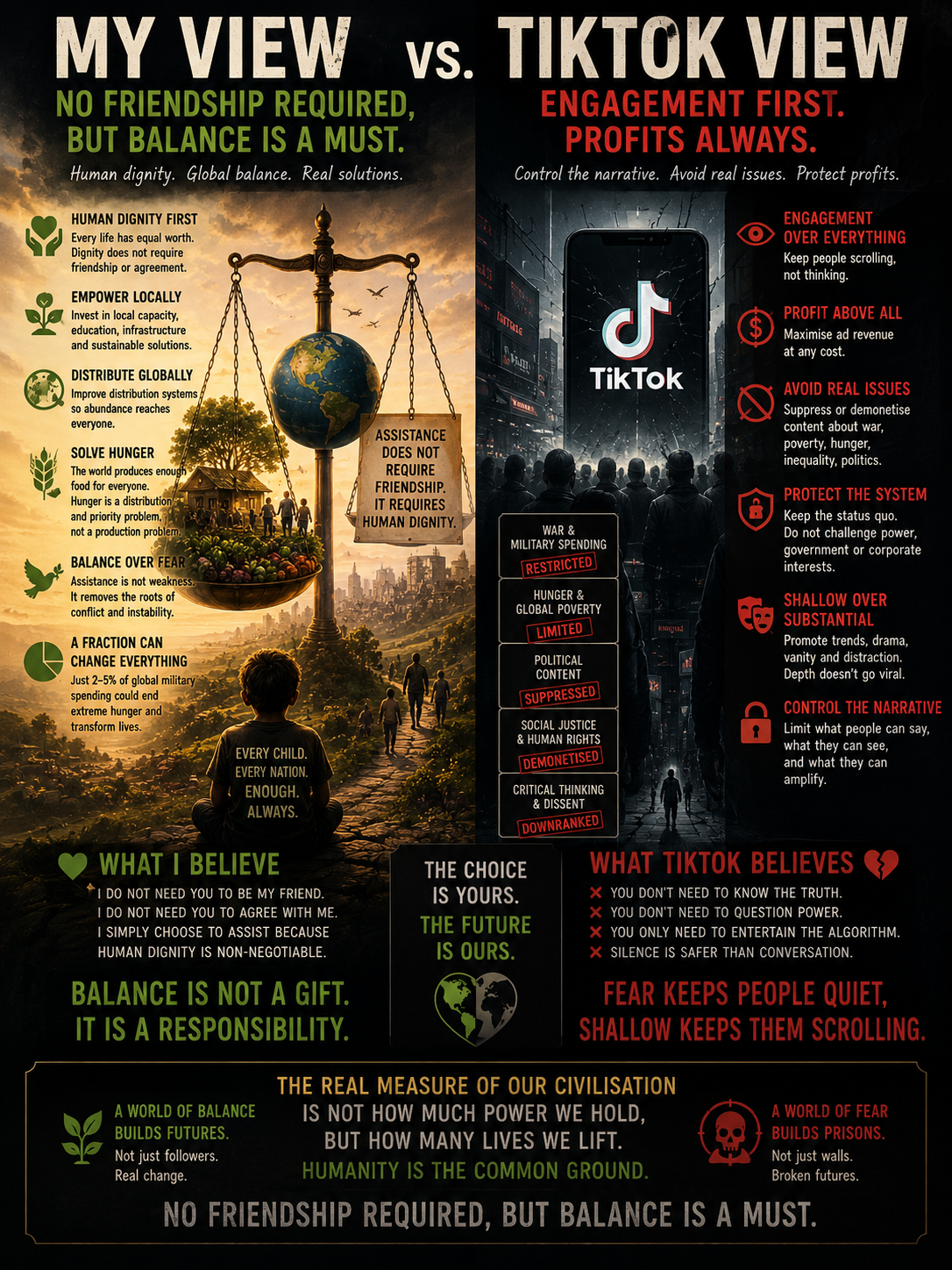
The Hunger
Paradox
On abundance, distribution, and the civilisations we choose to build — or neglect to.
There is a question that refuses to go away. Not because no one has thought about it — but because the answer keeps colliding with something we don’t want to look at directly.
The world produces enough food to feed every person alive. Yet children still go to sleep hungry. This workbook is an invitation to sit with that contradiction, and to follow it wherever it leads.
The Parable of the Fish
There is an old saying most of us encountered somewhere between childhood and adulthood: “Give a man a fish and you feed him for a day. Teach a man to fish and you feed him for a lifetime.”
It sounds like wisdom. And in part, it is. But it also contains a hidden assumption — that the man has access to the lake.
What if someone owns the water? What if the fish are gone? What if the land between him and the shore belongs to someone else?The question beneath the question
Emergency aid addresses what is in front of us. Infrastructure, education, and land rights address what created the crisis. Both are necessary. The question is which one gets the attention, the funding, and the political will — and which one stays stuck at the level of charity.
The Village at the Edge of the Forest
Imagine a village that has received food aid for fifteen years. Each year, trucks arrive. People eat. The following year, the trucks return again. No one asks why the village cannot feed itself — because that question is uncomfortable, and the trucks keep coming.
Now imagine a different question is asked: What would this village need to not need the trucks? Land? Seeds? Water? Security? Legal protection? Someone to stop the neighbouring corporation from draining the aquifer?
Notice the difference in what each question requires of the person asking it.
When has someone given you a fish, when what you actually needed was to learn to fish — or access to the lake?
In what areas of your own life do you keep managing symptoms instead of addressing root causes?
The Distribution Problem
Hunger is not primarily a production problem. This is perhaps the most important and least understood fact in this entire conversation.
Why do the babies starve when there’s enough food to feed the world?Tracy Chapman
The lyric is not rhetorical. It is technically accurate. Global caloric production exceeds what the world population requires. The issue is not that the food does not exist — it is that it does not reach the people who need it, when they need it, in a form they can use.
“It’s complicated.”
- Wars destroy farms and supply chains
- Corruption diverts aid money
- Droughts and floods ruin harvests
- Infrastructure is absent or broken
- Conflict makes delivery impossible
“But who benefits from the complication?”
- Who profits from aid dependency?
- Who controls the supply chains?
- Who holds the land rights?
- Who funds the conflicts?
- Who decides what counts as a crisis?
The Supermarket and the Supply Chain
A supermarket in a major city discards hundreds of kilograms of food this evening. In a conflict zone on a different continent, a family has eaten nothing today.
The food exists. The logistics network exists. The financial infrastructure exists. And yet the food does not move.
Ask yourself: what would need to change — not logistically, but in terms of values, priorities, and power — for that to be unacceptable? Not just unfortunate. Not just sad. But genuinely, structurally unacceptable in the way that slavery eventually became unacceptable.
Is there abundance in your own life that doesn’t move where it’s needed — not because you can’t, but because you haven’t organised it to?
What would it cost you — practically, emotionally, socially — to engage with this question more directly?
Security, or the Illusion of It
Governments consistently allocate enormous portions of public budgets to defence, surveillance, policing, and intelligence infrastructure. Agriculture, food sovereignty, and community resilience receive comparatively little — and rarely carry the same sense of urgency.
The official logic is that security creates the conditions for prosperity. But there is another reading: that a hungry population is itself a security threat. That instability is not the cause of hunger — it is hunger’s consequence.
Secure the nation, then address poverty
Address poverty, and reduce the need for security
The Budget Meeting
You are in a room with decision-makers allocating a national budget. One minister argues for expanding CCTV and border security. Another argues that investment in community food infrastructure would reduce the crime and unrest that the cameras are designed to respond to.
The first minister says: “We cannot afford to be naive about threats.” The second says: “We cannot afford to keep treating symptoms and calling it safety.”
Both have data. Both are operating from different assumptions about what a society is for. Which assumption lives deeper in the system? Who funded the room you’re sitting in?
In your own life, where do you spend energy on defence or protection — energy that might be better spent building something that makes the threat less likely?
What does genuine security feel like to you — not the absence of threat, but the presence of what?
Wealth, Power, and the Unanswered Question
We live in a period of unprecedented accumulated wealth. Individuals hold resources that exceed the GDP of entire nations. Global logistics systems move goods across the planet in days. And yet.
The question that keeps surfacing is not simply an economic one. It is a question about what we have decided to prioritise — about what we have agreed, collectively and quietly, to treat as acceptable.
The Civilisation Test
A civilisation that can map the human genome, send probes beyond the solar system, connect billions of people through a global network, and move financial capital across the world in milliseconds — and that still allows preventable starvation to exist — has made a choice.
Not a single choice made by a single person. A collective choice, embedded in systems, incentives, and priorities that most people never see clearly enough to question.
If you were designing a civilisation from scratch, with all the tools currently available to humanity, what would you build first? What would be non-negotiable? And what does the gap between that civilisation and this one tell you?
“A civilisation capable of feeding, educating, and empowering every person should not default to fear when balance is still available as an option.”
What is the most uncomfortable implication of everything in this workbook — the one you feel most tempted to skip past?
If the problem isn’t ignorance — if people broadly know the food exists and the solutions are known — what is actually in the way?
What is your own relationship to the global food system — as a consumer, as a citizen, as a person with a platform or a voice?
What kind of world are we choosing?
Every systemic problem exists inside a web of smaller choices — choices about what to fund, what to measure, what to name as a crisis, and what to quietly accept as normal.
Global hunger is not a mystery. It is not a natural disaster. It is the accumulated result of choices about who owns land, who controls water, who decides which conflicts are worth ending, and who decides what counts as waste.
The question this workbook is really asking is not “why is there hunger?” — it is: what would a person have to believe, deeply, to be okay with living inside a system that produces this outcome? And what would they have to stop believing to begin changing it?