
Evidence Without Access
Part One: The Discussion
1. The Starting Point
Modern institutions rest their authority on evidence. Medicine is evidence-based. Policy is evidence-led. Regulation, finance, employment decisions and public services all claim the same foundation. The claim carries real weight, and it should, because decisions grounded in evidence are generally better than decisions grounded in habit, rank or opinion.
Yet there is a question that is rarely asked out loud: evidence available to whom? An institution can hold excellent evidence and still leave the person most affected unable to see it. This workbook examines that gap, using a simple and tangible example as its anchor.
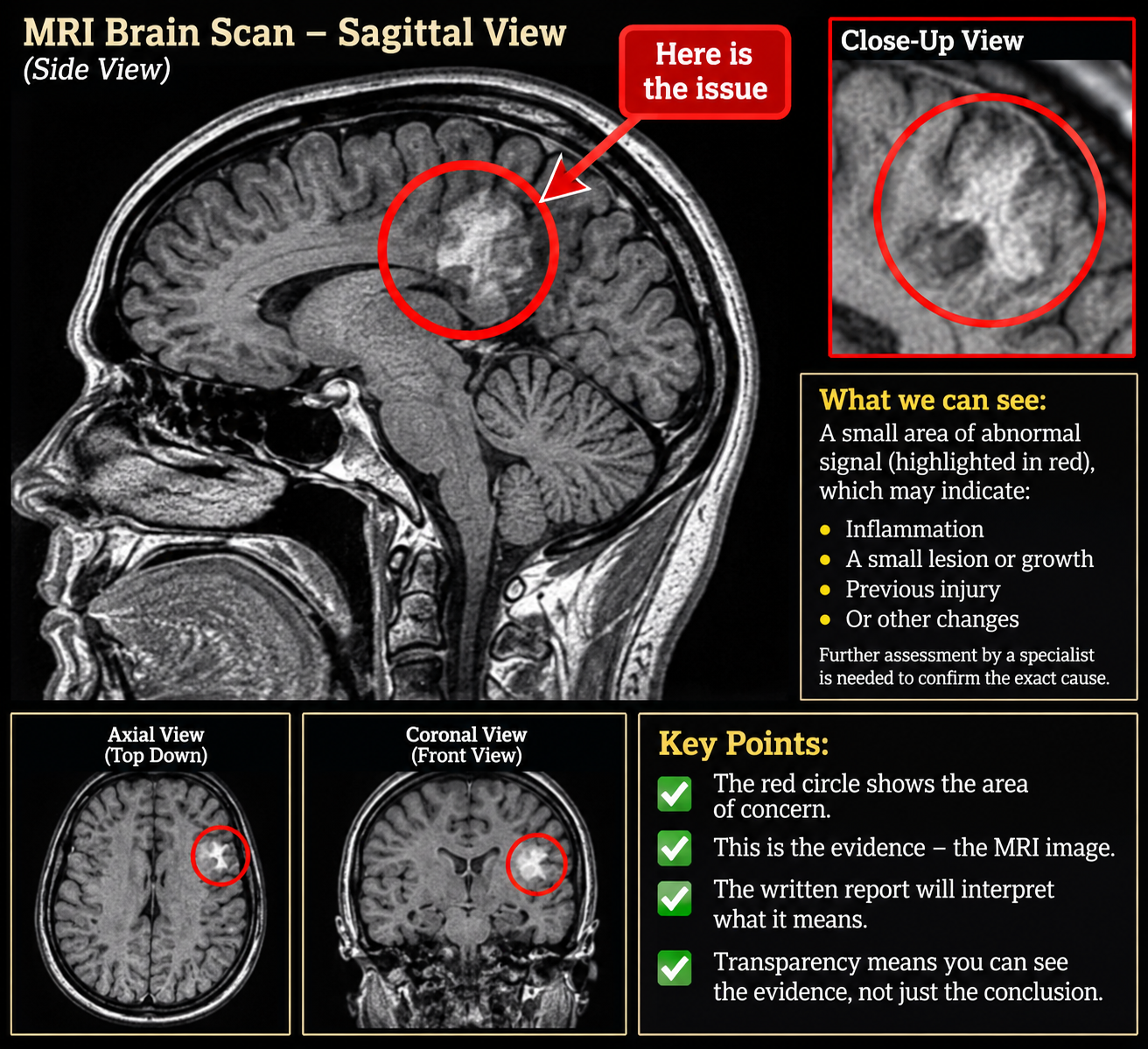
The anchor example. A person undergoes an MRI scan after a long wait. The scan produces images. A radiologist views them, interprets them, and writes a report. Someone then communicates the findings. The person whose body was scanned receives a conclusion, and may never see the images themselves.
The point is not that the radiologist is incompetent. The point is that the person has very little visibility into, or participation in, a process concerning their own body.
2. The Information Chain
Every evidence-based decision travels through a chain. At each link, the information passes through another person or process.
None of this implies bad faith. A chain with many hands is not a conspiracy. But every link is also an opportunity for omission, delay, misunderstanding and what can be called information asymmetry: one party holds knowledge that the other needs and cannot easily reach.
3. Four Things That Are Not the Same Thing
Institutions often speak as though the following were a single fact. They are four separate facts, and a person can be given the last without being given the others.
- Evidence exists. The data was captured or gathered.
- Evidence has been interpreted. Someone has formed a view of what it means.
- The interpretation has been documented. A report, ruling or record exists.
- The affected person has been given access to all of the above. They can see the evidence, the interpretation and the reasoning.
Transparency is the fourth item. The first three can be fully satisfied while the fourth is never met.
4. Conclusion Is Not Evidence
Being told a conclusion is not the same as being shown how it was reached. A statement that something is “evidence-based” is itself only a claim until the evidence can be examined. Likewise, expert interpretation is not the same thing as transparency, and trust is not a substitute for accountability.
5. Expertise and Access Are Not Opposites
The argument here is not that every person should interpret their own scan, or that expertise should be replaced by amateur opinion. A radiologist sees what a layperson will miss, and that skill is valuable. The argument is that professional interpretation and personal access to evidence can coexist, and that both are worth having.
In practice this is often possible. In England, for example, a patient can request their imaging and written report through a Subject Access Request, and images can be supplied in a standard format (DICOM) that compatible software can display. The right exists in many fields. What varies is whether people know it exists, how easy it is to use, and whether using it is treated as ordinary or as a challenge.
Which leads to the central claim: expertise should withstand scrutiny, and scrutiny should not be treated as hostility. If the evidence is strong, transparency cannot weaken it. If an institution reacts to being asked to show its evidence by becoming defensive, that reaction is itself information.
6. The Contradiction
There is an uncomfortable asymmetry in many systems. Institutions place heavy emphasis on evidence, professional standards and evidence-based decision-making, and they often demand evidence from the people they deal with: proof of income, proof of illness, proof of eligibility, proof of identity. Yet the person on the receiving end can struggle to see the evidence being used against, or about, them.
A system that demands evidence from everyone else but does not make its own visible is asking for trust while withholding the means of verification. That is not evidence-based. It is authority-based, wearing evidence’s clothes.
7. Beyond Healthcare
The MRI is only a vivid example. The same structure appears wherever decisions about people are made:
- GPs and primary care: notes, referrals, test results and the reasoning behind a diagnosis or a refusal to refer are written down, but the patient often meets only the outcome.
- Police: a person can be stopped, recorded, investigated or categorised on the basis of information they have never seen, and may not know what is held about them or why.
- Legal services: advice rests on documents, precedents and judgements about risk. The client is asked to approve costs and strategy while seeing only a summary of the reasoning, and sometimes not the file itself.
- Courts and tribunals: decisions turn on evidence bundles and procedural rules that ordinary people struggle to navigate, let alone challenge.
- Government and benefits: a decision is issued, but the data and reasoning behind it are hard to obtain.
- Local authorities, housing and education: assessments, panel decisions and case notes shape access to homes, schools and support, often without the person seeing what was recorded.
- Employment: an assessment, score or dismissal rationale is relied upon but not shared.
- Finance and insurance: a credit, risk, fraud or claims decision is made by a process the person cannot inspect.
- Public services and regulation: standards are cited without the underlying data being published in usable form.
- Automated systems: algorithms increasingly sit inside the chain, adding a link that is harder still to examine.
The list could go on, and that is the point. The pattern is not a feature of one profession. It is a feature of any system in which one party holds the record and the other lives with the consequences.
In England, several routes exist that apply across many of these bodies: the right to request your own personal data (a Subject Access Request), Freedom of Information requests for how public bodies make decisions, formal complaints procedures, and ombudsman services. Their scope and limits differ by body and situation, so check current guidance for your case before relying on any of them. What matters here is the principle: access should be an ordinary, expected part of the system, not something a person must fight to discover.
The governing question is the same in every case: If information is being used to make decisions that affect you, should you have meaningful access to the evidence, the interpretation and the reasoning?
8. Fair Objections
A serious discussion must test its own position. Four objections deserve honest answers.
“People will misread raw evidence and be harmed or misled.” This is a real risk. The answer is not to withhold, but to pair access with explanation: the interpretation delivered alongside the evidence, with room to ask questions. Misreading is a reason for better communication, not for closed doors.
“Some information must be restricted for safety or privacy.” Sometimes true, for example where another person’s data is involved or where disclosure creates genuine danger. The test is whether the restriction is specific, reasoned and explained, or a blanket default. A justified limit can be stated openly.
“Full transparency is slow and costly.” Access has a cost. So does opacity, in mistrust, complaints, errors that no one outside the chain can catch, and decisions people cannot meaningfully challenge. A good system treats scrutiny as quality control that someone else is helping to pay for.
“Wanting to see the evidence means you distrust the expert.” Not necessarily. A person can respect expertise and still want to understand. Treating the request as an accusation turns a normal act of participation into a conflict.
9. The Transparency Test
Any system that claims to be evidence-based can be held to five plain questions:
- Visibility: Can the affected person see the underlying evidence?
- Interpretation: Can they see who interpreted it and what that person concluded?
- Reasoning: Can they see how the conclusion followed from the evidence?
- Timing: Do they receive it before or while decisions are made, not afterwards?
- Challenge: Is there a clear, non-hostile route to question or contest it?
A system that passes all five earns the word “evidence-based.” A system that passes some has partial transparency, which is worth naming honestly. A system that passes none is asking for faith.
10. Information Held About You on Other Systems
So far this discussion has focused on evidence that was generated for a particular decision. There is another layer: the information organisations hold about you in the background, across systems you never see. Case notes, call logs, emails, assessment records, risk flags, scores, CCTV, recordings and databases shared between departments can all form part of the picture an organisation has of you, and decisions can quietly rest on any of it.
In the UK, the main tool for looking behind that curtain is the Subject Access Request (SAR), which is the practical form of the right of access under data protection law. The right gives people a copy of their personal information, plus supplementary information about how and why it is being used, so they can check it is being handled lawfully.
The essentials, in plain terms.
- How: a request can be made verbally or in writing, including through social media. Writing it down is wiser, because it gives you a dated record.
- Who: you can make it yourself, or a third party with proper authority can make it for you.
- Time: the organisation generally has one month. It can extend that by up to two further months where a request is complex or you have made several, but it must tell you and explain why within the first month.
- Pauses: the clock can pause while the organisation seeks genuine clarification or proof of identity, and resumes once you reply.
- Cost: a SAR is generally free. Fees apply only in limited circumstances.
- Search: the organisation must make a reasonable and proportionate search for what you ask for.
- If ignored: you can complain to the Information Commissioner’s Office (ICO).
Asking Across Systems
The useful habit is to ask broadly and name the places. An organisation may respond only from its most obvious system unless you point further. Consider asking for personal data held in:
- main case-management or records systems;
- emails, messages and internal notes that mention you;
- call recordings, CCTV or other audio-visual records;
- assessments, scores, risk ratings or flags;
- data shared with, or received from, other bodies, and the sources it came from;
- any decision made solely by automated means that significantly affected you, and the logic involved.
You can also ask for the supplementary information: why the data is held, who it has been shared with, where it came from, and how long it is kept.
The Honest Limits
A SAR is a powerful tool, but it is not a magic key. A few cautions keep expectations realistic:
- It gives you your personal data, not necessarily every document. Internal policies, reasoning and wider evidence may need a different route, such as a Freedom of Information request to a public body.
- Exemptions exist. Information about other people, legally privileged material and some law-enforcement or investigative material can be withheld or redacted. A good response should tell you that something has been withheld.
- Some areas follow different rules. Policing and criminal-justice data, for example, sit under their own provisions, so check current guidance for the body concerned.
- Quality varies. Responses can be incomplete. You are allowed to question gaps, ask what was searched, and escalate.
This is general information, not legal advice. For a serious or contested matter, consult the ICO’s guidance, a legal adviser or an advice service.
Part Two: The Workbook
Work through these exercises slowly. Choose one real decision or process from your own experience, in any area of life, and keep it in mind throughout. Write honestly. Nothing here asks you to accuse anyone; the aim is to see structure clearly.
Map the Chain
Pick a decision made about you or someone you know. Trace the five links.
The Four-Things Audit
For the same decision, mark honestly what you actually had. Add a note on what you were missing.
| Item | Did it exist? | Did I see it? | Notes |
|---|---|---|---|
| The evidence itself | |||
| The interpretation | |||
| The documented record | |||
| The reasoning linking them |
Conclusion Versus Evidence
Write the conclusion you were given in one sentence. Then list what you would need to see to judge whether it follows.
Run the Transparency Test
Score the system you chose: Yes, Partly or No. Then write one line of evidence for each score.
| Question | Yes / Partly / No | What is the basis for my answer? |
|---|---|---|
| Visibility: can I see the evidence? | ||
| Interpretation: can I see who concluded what? | ||
| Reasoning: can I see how the conclusion followed? | ||
| Timing: did I get it in time to matter? | ||
| Challenge: is there a clear, non-hostile route to contest it? |
Sector Survey
The same structure appears everywhere. For each sector, name one decision in which evidence is used about people, and say who can see it.
| Sector | A decision made about people | Who can see the evidence? |
|---|---|---|
| Hospitals and scans | ||
| GP and primary care | ||
| Police | ||
| Legal services | ||
| Courts and tribunals | ||
| Benefits and government services | ||
| Local authority, housing, education | ||
| Employment | ||
| Any other sector I deal with | ||
| Finance and credit | ||
| Automated or algorithmic systems |
Steelman the Other Side
Honest thinking requires the strongest version of the opposing case. Choose one objection from Part One, section 8, and argue it as well as you can.
Scrutiny Without Hostility
Asking to see evidence is more effective when it is calm, specific and framed as participation. Draft a request for the evidence behind a decision.
The Mirror
The standard applies to us as well. Each of us makes claims, holds opinions and influences others.
A Personal Transparency Charter
Write the principles you believe any system making decisions about you should meet, and any you will commit to in your own work.
The SAR Planner
Plan what information you might want to ask for. Start with one organisation that has made a decision about you. Think about the systems that might hold relevant data, not only the obvious one.
A skeleton for a written request. Adapt it, keep it factual, and keep a dated copy.
“I am making a subject access request under data protection law. Please provide a copy of all personal data you hold about me, from all systems, including [name the systems or record types]. Please also confirm why the data is held, where it came from, who it has been shared with, how long it is kept, and whether any decision about me was made solely by automated means, with information about the logic involved. If you withhold anything, please say what and why. My details for identification are [name, address, any reference number]. Please acknowledge receipt and confirm your response date.”
Then keep a simple log so that deadlines do not slip.
| Organisation | What I asked for | Date sent | Due date | Outcome and gaps |
|---|---|---|---|---|
Closing Reflection
Evidence earns authority by being open to examination. Expertise is strengthened, not threatened, by being understood. The person at the end of the chain is not an obstacle to the process; they are the reason the process exists.
TPOL · Spiritual Technologies · tpol.lifestyle
This workbook is for reflection and education. It is not medical or legal advice.