God, I respect your position, but frankly, you’ve got some explaining to do. And with all due respect, you’re not exactly getting everything right either.
Perhaps you need a little time to develop too, mate. I offer you a prayer, Not a demand for perfection. Not a request for a world without difficulty. Just a plea for a little more mercy, especially where life has become unnecessarily cruel for so many.
Father, if humanity is still learning, give us room to learn without destroying one another.
Where there is suffering, bring compassion.
Where there is ignorance, bring understanding.
Where there is power, bring responsibility.
Where there is conflict, make room for reconciliation.
Where there is hardship, let people retain their dignity.
And even in the hellscapes of this world, let there be kindness, friendship, laughter, nourishment and hope.
Don’t take away the lessons of life. Just make the classroom a little less cruel.
Names and titles for God
| Name | Tradition/origin |
|---|---|
| God | English |
| Allah | Arabic, used by Muslims and Arabic-speaking Christians |
| Yahweh (YHWH) | Hebrew Bible |
| Jehovah | Traditional English rendering of YHWH |
| Elohim | Hebrew |
| Adonai | Hebrew, meaning Lord |
| El Shaddai | Hebrew, traditionally rendered God Almighty |
| Al-Rahman | Islam, The Most Merciful |
| Al-Rahim | Islam, The Especially Merciful |
| The Father | Christianity |
| The Creator | Multiple traditions |
| The Most High | Biblical and Islamic usage |
| Brahman | Hindu philosophical traditions |
| Ahura Mazda | Zoroastrianism |
When forgiveness is presented alongside unforgivable offences, and an institution claims authority to define that offence, it can become a mechanism of domination, and that can turn spirituality into a system of control.
The existence of a difficult religious teaching doesn’t automatically prove that its original intention is domination. Its interpretation and application can nevertheless become dominating.
And here’s the question I’d put to all who read.
Can there be genuine spiritual freedom when people are afraid to question the very authority claiming to represent the divine?
Crimes Against the Spirit
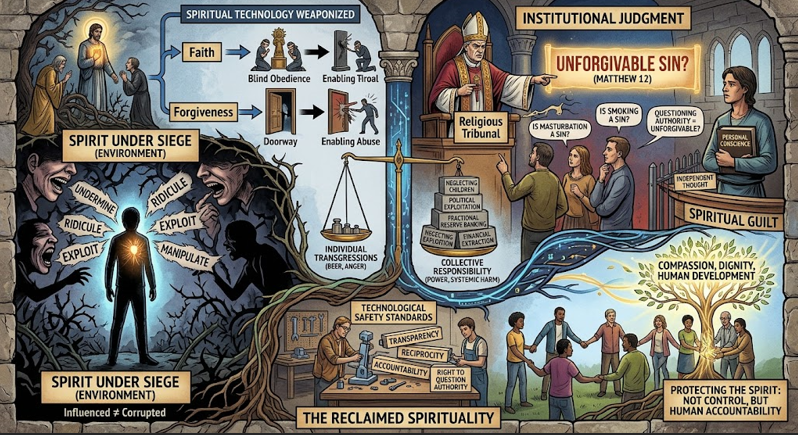
A TPOL Spiritual Technologies workbook on accountability, manipulation and who gets to judge the human spirit.
Many traditions talk about sins against the spirit. Very few define them clearly. This workbook does not tell you what to believe. It gives you a structure for asking better questions: what is the spirit, how can it be damaged, who has the right to judge that damage, and how do we protect it without turning protection into control?
How to use it. Work through the parts in order. Write your answers in the boxes, in your own words. Where the workbook names a religious teaching, it describes how that teaching is commonly understood. Your conscience, not this page, is the judge.
Part 1: What do we mean by spirit?
Before we can talk about crimes against something, we need a working definition. Here is one to test, not to accept blindly:
The spirit is the part of a person that holds attention, conscience, trust, meaning and the capacity to connect with others and with something greater than themselves.
If that is roughly right, then damage to the spirit would look like damage to those capacities: a person who can no longer trust, who has been trained to doubt their own judgement, who is afraid to ask questions, or who has had their compassion used against them.
Exercise 1.1: Your definition
In one or two sentences, how would you define the spirit?
What does a healthy spirit look like in a person you know? What do they do, and what do they not do?
Part 2: The environment the spirit grows in
A person can spend decades around people who undermine their confidence, ridicule their beliefs, exploit their compassion or make them constantly question their own judgement. Over time that changes how they see themselves, other people and the world.
That is why four distinctions matter:
- Being influenced is not the same as being corrupted.
- Being misled is not the same as deliberately deceiving.
- Being hurt is not the same as becoming harmful.
- Struggling to hold your principles is not the same as abandoning them.
Why should a person be condemned for the condition of their spirit without considering the conditions it had to survive?
This does not remove personal responsibility. It makes the examination of responsibility fairer.
Exercise 2.1: Conditions
Which environments shaped your beliefs about yourself and about God, truth or meaning? List the biggest three.
Which of your inherited beliefs did you choose, and which were handed to you?
Exercise 2.2: Apply the four distinctions
Think of a time you were misled, hurt or influenced. Which of the four distinctions applies, and how does it change how you judge that moment?
Part 3: Spirit as technology, and how it gets weaponised
One way to look at spirituality is as a human technology: a set of capacities and practices, including attention, conscience, faith, belonging, ritual, language, compassion and forgiveness. Like any technology, it can empower or be exploited. Writing can educate or deceive. Psychology can support or manipulate. Spiritual principles are no different.
| Spiritual principle | How it can be weaponised |
|---|---|
| Faith | Blind obedience |
| Forgiveness | Enabling repeated abuse |
| Humility | Suppression of individuality |
| Service | Exploitation |
| Love | Emotional manipulation |
| Authority | Control through divine claims |
| Guilt | Permanent indebtedness |
The technology is not the problem. The ethics governing its use are.
Exercise 3.1: Spot the weaponisation
Have you ever seen one of these principles used as a lever against someone, including yourself? Describe it without naming anyone.
What was the signal that the principle had stopped serving the person and started serving someone else?
Part 4: The unforgivable sin and the fear it creates
In Matthew 12, Jesus responds to people who see what he describes as God’s work and attribute it to evil. Many Christian traditions read the “unforgivable sin” there as persistent, wilful rejection of grace, not an accidental remark, a misunderstanding or a moment of anger. Others interpret it differently. Scholars and churches disagree.
Whatever the correct reading, a separate question matters here: what does the teaching do to ordinary people when it is left vague? Someone with limited theological background might:
- Become afraid to question religious authority.
- Mistake an intrusive thought or an angry remark for an unforgivable act.
- Stay silent about experiences they cannot reconcile with their faith.
- Carry guilt or shame for years.
- Depend on someone else to interpret their relationship with God.
Keep three things separate: what the scripture says, how an institution interprets it, and how that interpretation lands on ordinary people.
If divine love is unconditional, how can forgiveness carry an exception that does not account for understanding, intention, circumstance and the chance of reconciliation?
Exercise 4.1: Separate the three layers
Pick one teaching that frightened you or someone you know. What does the source text actually say?
How did the institution or community present it?
What effect did it have on the people hearing it?
Part 5: Tribunals and the question of who judges
There is a difference between a spiritual principle and an institution claiming the authority to enforce it. History offers sobering examples: ecclesiastical tribunals such as the Inquisition investigated heresy, and some proceedings involved coercion and torture, with sentences carried out by secular authorities.
Any body that judges offences against the spirit should be able to answer five questions:
- Who decides what counts as an offence?
- What evidence is required?
- Can the accused challenge the interpretation?
- Is misunderstanding separated from deliberate wrongdoing?
- Who holds the tribunal accountable if it gets it wrong?
A person can be accountable for their actions without another person having the authority to declare the state of their soul.
Exercise 5.1: Run the five questions
Think of a modern group, religious or not, that judges people’s character or loyalty. Answer the five questions about it honestly.
Where does accountability for the judges break down?
Part 6: The invisible rulebook
Is masturbation a crime against the spirit? Smoking? Drinking a beer? Anger? Questioning teaching? Different traditions answer these differently. None of them automatically amounts to the specific offence described in Matthew 12. The trouble starts when three separate things are blurred together:
| Category | What it is |
|---|---|
| Moral teaching | What a tradition considers right or wrong |
| Personal conscience | What an individual believes and understands |
| Blasphemy against the Holy Spirit | The specific theological issue in the Gospels |
You cannot fairly hold people to rules nobody can clearly explain. So if someone says an act is an offence against the spirit, they owe you a definition.
The Definition Test. A claim of “crime against the spirit” is only fair if it states:
- What exactly the act is.
- Why it harms the spirit, and whose.
- What intention is required.
- How misunderstanding differs from deliberate rejection.
- What path to repair and reconciliation exists.
Exercise 6.1: Test a claim
Write down one behaviour you were told harms the spirit. Run it through the Definition Test. Which parts of the test does the claim fail?
Part 7: Crimes at the scale of society
Religious discussion tends to focus on individual behaviour. If the spirit is understood as dignity, development and potential, harms at larger scale deserve at least equal attention. Consider where responsibility sits:
| Who | Responsibility toward | Questions to ask |
|---|---|---|
| A parent | A child’s safety, affection, education, opportunity | What does neglect take from a child’s spirit? |
| A business | Customers and workers | Who carries the cost of its profit? |
| A government | Its population | Does it keep people in poverty, or use fear and division to hold power? |
| A financial institution | The society whose economy it shapes | Who benefits from credit creation, and who carries the risk? |
Take fractional reserve banking as a test case. Banks hold a fraction of deposits in reserve and lend the rest, creating additional bank deposits. Defenders point out that this supports credit, investment and economic activity, and it is not inherently fraudulent. Critics argue it concentrates the benefits of money creation, exposes the public to systemic risk and makes housing depend on private credit. The honest question is not whether banking exists but how it is governed, who benefits, who bears the risk and who is accountable when it fails.
Why do we have elaborate systems for judging individual behaviour, yet struggle to hold accountable the institutions that affect millions of lives?
Exercise 7.1: Scale of harm
Name one institution with power over people’s lives. Using the Definition Test from Part 6, what would a clearly defined ‘crime against the spirit’ by that institution look like?
What accountability would be fair, and who should hold it?
Part 8: Safety standards for spiritual technology
If spiritual practice can empower or manipulate, it deserves something like the safety standards we expect of other powerful technologies. Six starting principles:
| Principle | In practice |
|---|---|
| Informed participation | People know what they are joining, what is asked of them and what it costs. |
| Transparency | Rules, teachings and finances can be seen and examined. |
| Reciprocity | What a leader asks of followers, the leader is also bound by. |
| Accountability | There is an independent route to challenge and correct leaders. |
| The right to question | Questions are treated as part of faith, not a threat to it. |
| The right to leave | Leaving carries no punishment, shunning or threat. |
The risk is that protection itself becomes a mechanism of control. A safety standard that only the authority interprets is not a safety standard.
Exercise 8.1: Audit
Score a group you belong to, or once belonged to, from 0 to 5 on each of the six principles. Write the scores and one line of evidence for each.
Which principle matters most to you, and why?
Part 9: Crimes against your own spirit: rigidity and the will to dominate
Some people will not budge. Not for evidence, not for another person’s pain, not for the truth sitting in front of them. They do not want to be understood. They want to win, and they want everyone else to submit. That is a crime against their own spirit, and it is worth saying plainly.
The spirit lives on attention, conscience, trust and connection, and those only stay alive through use. A person who refuses ever to listen, doubt or revise has switched them off. Their conscience stops being examined and becomes a weapon. Their attention shrinks to defending a position. Every relationship becomes a contest. They are not strong. They are a spirit that has locked itself in a cell and calls the walls principles.
Domination is what a spirit reaches for when it has lost the ability to connect. The person who cannot bend is usually the one most afraid of breaking.
Be exact about what the crime is, though. Refusing to bend to abuse, coercion or a lie is not rigidity. That is integrity. The difference is what the firmness is made of:
| Conviction | Dogmatic rigidity |
|---|---|
| Holds principles but can be tested | Treats every question as an attack |
| Can say “I was wrong” | Cannot admit error in any circumstance |
| Changes its mind when evidence or another person’s pain demands it | Changes nothing, whatever the evidence or the cost to others |
| Wants to be understood | Wants to be obeyed |
| Makes room for others to differ | Treats difference as disloyalty |
| Secure enough to listen | Terrified of what listening might cost |
The tell is simple. Ask what would change this person’s mind. If the honest answer is nothing, you are not dealing with a belief. You are dealing with a wall.
Two things keep this fair. Rigidity is often learned, in environments from Part 2 where bending meant punishment, so it has a history. A history explains the harm. It does not cancel it. And this applies to every belief system, religious or secular. People can be as dogmatic about science, politics, money or their own open-mindedness as anyone defending a creed.
It also connects to Part 3. Authority becomes a weapon when the person holding it cannot be questioned. A leader who will not bend harms followers, but also cuts themselves off from the correction that could keep their own spirit alive.
Exercise 9.1: Wall or conviction?
Think of someone who will not bend. Using the table, which column describes them, and what is your evidence?
What would change their mind? If the answer is nothing, what does that tell you about what they are defending?
Exercise 9.2: Your own edges
Where are you most rigid? Which position do you defend before you have listened?
What fear sits underneath it?
Name one thing you will never bend on. Is it conviction or rigidity? What would an honest test of it look like?
Part 10: Protecting your own spirit
Protecting your spirit does not mean protecting yourself from humanity. It can mean learning that compassion does not require letting others keep diminishing you. Compassion and boundaries can sit together.
- You can forgive someone and still stop giving them access to you.
- You can be humble without erasing yourself.
- You can serve without being used.
- You can respect a tradition and still ask it hard questions.
And the same standards apply to you. Ask what you may be doing to someone else’s spirit through contempt, manipulation or neglect.
Exercise 10.1: Boundaries
Where are you currently allowing your spirit to be diminished? What is one boundary that would protect it without hardening you?
Where might your own behaviour be diminishing someone else? What would repair look like?
Closing: Your declaration
Pull your answers together into a short personal standard for what you will and will not call a crime against the spirit, and what you will require of anyone who judges others in its name.
Exercise 11.1: My standard
I will call something a crime against the spirit when…
I will not accept a judgement of a person’s spirit unless…
The question I am still holding is…
A TPOL Spiritual Technologies workbook. Nothing here is theological, legal or psychological advice. If you are carrying distress from a harmful religious experience, a trusted counsellor or support service can help.
Even Jesus Entered the Realm of the Dead (Spirit Prison)
In Christian teaching, Jesus is understood to have died by crucifixion and risen again. But there is another part of the story that is sometimes overlooked.
The New Testament contains references to Jesus descending to the realm of the dead.
In 1 Peter 3:18–20, we read of Christ proclaiming to spirits in prison. Ephesians 4:8–10 is also associated with the idea of Christ descending before ascending. The Apostles’ Creed expresses this tradition through the words descended into hell.
Different Christian traditions interpret these passages differently. Some understand them as Christ entering the abode of the dead, sometimes called Hades, to proclaim victory or deliverance. Others understand the passage in different theological ways. In Latter-day Saint teaching, this is developed into the explicit belief that Christ visited the spirit world and that the gospel was preached to the dead.
The important point is that, within these traditions, Christ’s journey did not end at the moment of physical death. His ministry is understood to have extended even into the realm of the dead.
This raises an interesting question.
If Jesus was understood to be sinless, why did he have to experience suffering, death and descend into the realm of the dead?
Christian theology offers several explanations: substitutionary atonement, reconciliation with God, victory over death, and solidarity with humanity.
But perhaps there is another question worth considering.
Was Jesus carrying humanity’s sins, or did humanity make him the ultimate scapegoat?
If he willingly accepted suffering on behalf of humanity, what responsibility remained with the people whose actions and behaviour created the suffering in the first place?
When does taking responsibility for others become an act of love, and when does it become an excuse for everyone else to avoid responsibility?
A sacrifice should not become a permanent licence for humanity to keep creating the very suffering it claims to have been saved from.
Jesus may have carried humanity’s burden, but that does not mean humanity should keep placing the same burden upon others.
Redemption should inspire responsibility, not replace it. Compassion should encourage change, not excuse the absence of it.
Perhaps the greatest way to honour such a sacrifice is not to keep asking someone else to carry our sins, but to learn how to stop creating them.
If humanity has been offered redemption, shouldn’t humanity also accept responsibility for what it does with that opportunity?
Jesus doesn’t need humanity to manufacture more shadows and offset it onto him. Humanity needs to take responsibility for the shadows it creates itself.
Im Sure Jesus Would Say. “Carry Your Own Cross” “I Will Help When You Stumble”
Helping someone carry their burden is compassion. Making them permanently responsible for your burden is exploitation.