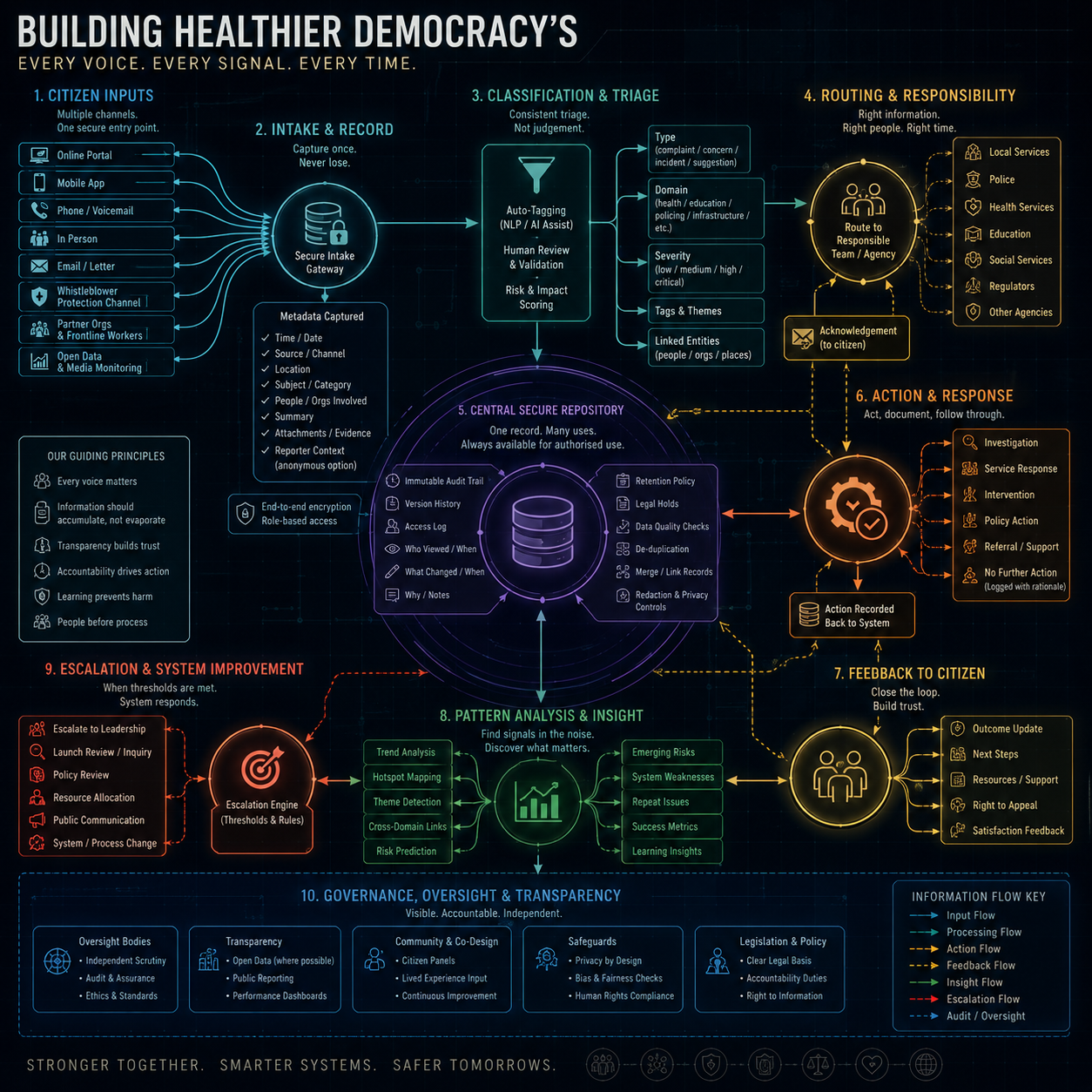
This work is offered freely for the benefit of all people, regardless of nation, culture, religion, or political belief.
Its purpose is simple:
To help build healthier societies through better feedback, stronger accountability, collective learning, and the preservation of knowledge.
Information should accumulate, not evaporate.
Healthy systems listen, remember, learn, and adapt.
If these ideas help any community, institution, or nation become more resilient, more transparent, and more capable of learning from reality, then they have served their purpose.
TPOL · Spiritual Technologies · Systems Series
The Signal Ledger
A framework for structural accountability and the retention of weak signals
Every society runs on signals. A constituent raises a concern. A neighbour reports something that doesn’t sit right. A pattern flickers at the edge of an institution’s vision and is gone before anyone names it. Most of these signals are weak. Most of them, taken alone, prove nothing. And most systems are built to do exactly one thing with a weak signal: assess it, find it wanting, and close the file.
This workbook is about a different design. It rests on a single observation, simple to state and expensive to ignore:
The Signal Ledger is a two-part framework. The first part asks how power can be made answerable in real time rather than in ceremony. The second part asks how a system can learn from every report it receives — even the ones it cannot act on — so that the pattern becomes visible before the tragedy, not after it.
And it is deliberately institution-agnostic. The failure it targets is identical in Westminster, in a police force, on a hospital ward, in a law firm, a bank, a school, and a boardroom: a report arrives, is weighed alone, is found wanting, and is forgotten. Wherever an institution holds power over people who must report upward to it, the Ledger applies.
Part I
The Accountability Layer
Consider how political accountability currently works in practice. A citizen with a concern writes a letter, waits weeks, and receives a templated reply. The questions that do reach the top are performed in a chamber, on a schedule, in a format built for theatre rather than resolution. By the time an issue is “addressed in the House,” the moment that produced it has often passed.
The Accountability Layer replaces ceremony with structure. It has three working parts.
1. The Decision Ledger
Every significant decision is tracked and traceable: who decided, when, on what evidence, and against which alternatives. When something goes wrong, the question “who is responsible?” should be a lookup, not an investigation. Accountability becomes structural rather than dependent on trust, memory, or whoever happens to be holding the file when the music stops.
2. The Constituent Channel
The working example that started this framework: a citizen should be able to raise a point to the Prime Minister through a real-time system — logged, queued, visible, and answered on the record — not held back for a house address session. The channel does not promise that every point gets a personal reply. It promises something more durable: every point enters the ledger, every point is visible, and the pattern of what citizens are raising becomes data the system cannot un-see.
3. The Reciprocity Rule
A system reveals its honesty by whether it applies its own standards to itself. Citizens are expected to keep records, meet deadlines, and answer questions; the institutions that govern them should be held to the same discipline. Much of public frustration with politics is not disagreement over policy — it is the perceived gap between stated principles and actual practice. The Reciprocity Rule closes that gap by design rather than by promise.
Part II
The Signal Layer
Here is the heart of the framework, and the place where the working examples matter most.
The old lifecycle and the new one
Most institutions process a report like this:
If the report cannot be substantiated on its own, the file closes, and the information effectively dies. The Signal Ledger replaces that dead end with a loop:
Nothing is forgotten. Closure of a case is not deletion of a signal. The system archives rather than forgets, aggregates rather than isolates, and looks for convergence rather than demanding certainty from any single report.
Working example: the four reports
A single report arrives. Viewed alone it appears unusual, unlikely, poorly evidenced, and difficult to verify. Under the old lifecycle it is assessed and closed. But step back across years of retained data and a different picture can emerge: multiple people reported similar behaviour; the reports involved the same individuals; the same locations; the same methods; and — critically — they emerged independently of one another.
Four independent reports do not prove the allegation. That distinction is load-bearing. What they do is justify revisiting the assumptions that were made when each report was viewed in isolation. The outlandish becomes a pattern worth investigating — not a verdict.
Working example: how major investigations actually break open
Many of history’s significant investigations follow the same sequence. A new report arrives. Analysts review the historical record. Similar past reports are discovered. Connections become visible. What once looked isolated begins to look systemic. The Signal Ledger does not invent this process — it makes it automatic, so that the archive review happens by design rather than depending on one diligent analyst thinking to look.
The escalation ladder
Information gains meaning through context. The same report carries different weight depending on what stands beside it:
- ×1One report is a report.
- ×5Five similar, independent reports may be a pattern.
- ×50Fifty similar reports may indicate a systemic issue.
Independence is the multiplier that matters. Five unconnected reports describing the same behaviour outweigh fifty copies of a single rumour. The pattern engine weighs convergence from independent sources, not raw volume.
Part II · continued
The Cost of Hindsight
This is where the framework stops being abstract. When a long-running offender is finally caught — when, in the bluntest working example from the conversation that produced this framework, investigators are digging up children’s bodies from somebody’s backyard — the public inquiry that follows asks the same question every time:
And the answer, painfully often, is yes. The harder question is the one the Signal Ledger is built to answer: why weren’t those warning signs recognised as a pattern at the time?
The seven barriers
Inquiry after inquiry, safeguarding review after safeguarding review, the same failure modes recur. Reports were fragmented across agencies. Agencies didn’t share information. Individual reports appeared weak in isolation. No one person held the complete picture. The allegation seemed implausible. Resources were limited. And assumptions were made that later turned out to be wrong.
Notice what is absent from that list: a lack of information. The most painful failures are rarely failures of information. They are failures of connecting it, retaining it, and recognising its significance early enough.
A system that only learns after overwhelming evidence accumulates may learn too late. The cost of ignoring a genuine weak signal can be far greater than the cost of preserving it for future analysis. That asymmetry is the economic argument for the entire framework: retention is cheap; hindsight is catastrophic.
Part III
The Safeguards
A framework that retains everything could become a weapon. The safeguards are not an afterthought; they are what makes the system survivable.
Retention is not accusation
A stored signal carries no presumption of guilt. Four reports justify reassessment — they do not prove an allegation, and the system must say so in its architecture, not just its manners. Due process, evidence standards, and careful investigation remain fully intact. The Ledger changes when professionals look, not what counts as proof.
Citizens report; professionals investigate
The division of labour is firm. Citizens are asked to report concerns, not to investigate them. Investigation belongs to professionals with the powers, training, and resources to do it lawfully. A society of amateur investigators is not the goal; a society whose genuine concerns are never lost is.
Anti-weaponisation
Independence weighting is the first defence: coordinated or copied reports do not climb the ladder. Malicious reporting leaves its own pattern in the Ledger — and a system that detects convergence can equally detect orchestration. The archive cuts both ways, and that is a feature.
Watching the watchers
The Reciprocity Rule applies here with full force. Access to the Ledger is itself logged in the Ledger. Anyone querying the archive leaves a trace subject to the same retention, aggregation, and pattern detection as everything else. Oversight is not bolted on; it is recursive.
Part IV
The Ledger Across Industries
The architecture does not change from sector to sector. What changes is who reports, what converges, and which professional body owns the reassessment. Walk the same lifecycle through seven institutions and watch the same failure — and the same fix — appear in each.
Policing
An officer attracts a complaint. Assessed alone it is one person’s word, unproven, closed. The legacy system then lets that officer transfer forces — and the record fragments with the move. In the Ledger, complaints are retained nationally and clustered by officer, behaviour type, and location. Seven weak complaints across three forces over a decade is not seven closed files; it is one convergence event landing on a professional standards desk with the complete picture attached. Vetting stops being a snapshot and becomes a query against everything the system has ever been told.
The NHS
Healthcare generates signals from every direction — patient complaints, family concerns, staff whistleblowing, incident reports, mortality data — and routes them into separate silos that rarely speak. The clinician whose incidents cluster across wards, shifts, and even hospitals stays invisible precisely because each ward, each trust, each complaint route assesses its own fragment in isolation. The Ledger clusters across all of them: same clinician, similar method, independent sources. And it works in the other direction too — a patient maintaining their own master timeline of treatment, correspondence, and unanswered questions is running a personal signal ledger against the institution. The principle is reciprocal by design.
The legal sector
Law has a forgetting mechanism built into its business model: the confidential settlement. A negligent or predatory practitioner can leave a trail of quietly settled claims, each sealed by an NDA, each invisible to the next client and often to the regulator. The Ledger does not break confidentiality — it retains the fact and shape of each signal even where the content is sealed, so that the regulator sees the cluster forming: same practitioner, same conduct type, five independent claimants. Settlement ends a dispute; it should never again erase a signal.
Financial services
The pattern here has already played out at national scale. Mis-selling scandals are, structurally, millions of weak signals assessed in isolation for years — each customer complaint individually deniable, the systemic practice invisible until the aggregate finally forced itself into view. A Ledger clustering complaints by product, firm, and sales method would have surfaced the convergence in months, not decades. Whistleblowing follows the same logic: the lone insider report that seems implausible gains its true weight only beside the retained reports of insiders who came before.
Education and safeguarding
The sector’s known failure mode even has a name: passing the trash. A staff member leaves under a cloud, the concerns never rise to proof, the reference stays neutral, and the history launders itself with every move to a new school. The Ledger retains the concerns — not as accusations, but as signals — so that three quiet departures from three schools, each individually explicable, become visible as one pattern to the safeguarding professionals entitled to see it. Children should never be the instrument by which an institution finally connects its own dots.
Employers and large organisations
Every HR department runs the legacy lifecycle. A harassment complaint is raised, investigated, unsubstantiated, closed — and when the same individual generates another complaint three years later, the new investigator often starts from zero. Exit interviews, the richest signal source most organisations possess, are routinely collected and discarded. The corporate Ledger retains both: complaints clustered by subject and conduct type, exit-interview themes aggregated by team and manager. The serial problem protected by settlements and staff churn becomes a query result instead of an open secret.
The industry that already proves it
This is not utopian. Aviation has run the Signal Ledger’s core logic for decades. Confidential incident and near-miss reporting systems retain every report — including the trivial, the unproven, and the embarrassing — aggregate them across airlines and borders, and treat convergence as the trigger for action. No single near-miss proves a design flaw; thirty independent ones ground a fleet. Aviation became the safest complex industry on earth not by collecting more information than healthcare or policing, but by refusing to forget any of it. The framework asks every other institution one question: why should your weak signals be treated with less respect than an airline treats a bird strike?
Foundations
The Seven Principles
- 01Accountability should be structural, not dependent on trust.
- 02Archive rather than forget.
- 03Aggregate rather than isolate.
- 04Look for convergence rather than certainty.
- 05Citizens report; professionals investigate.
- 06Institutions answer to the standards they impose — reciprocal accountability.
- 07Build feedback loops so that hindsight is never the only teacher.
Reflect
Think of a failure you have witnessed — in an institution, a workplace, a family. Were the warning signs absent, or were they present and disconnected? Who held a fragment of the picture, and what would it have taken for the fragments to find each other?
Reflect
Where in your own life do you assess and close, when you could assess and retain? What weak signal have you dismissed this year that deserves a place in your own ledger?
The Closing Bow
A society learns more effectively when information accumulates, patterns are recognised, and accountability remains traceable across time. The Signal Ledger does not ask anyone to believe more reports. It asks the system to remember them — so that the signal has more than one chance to be heard, and hindsight is demoted from teacher to auditor.
TPOL · The Signal Ledger · tpol.lifestyle