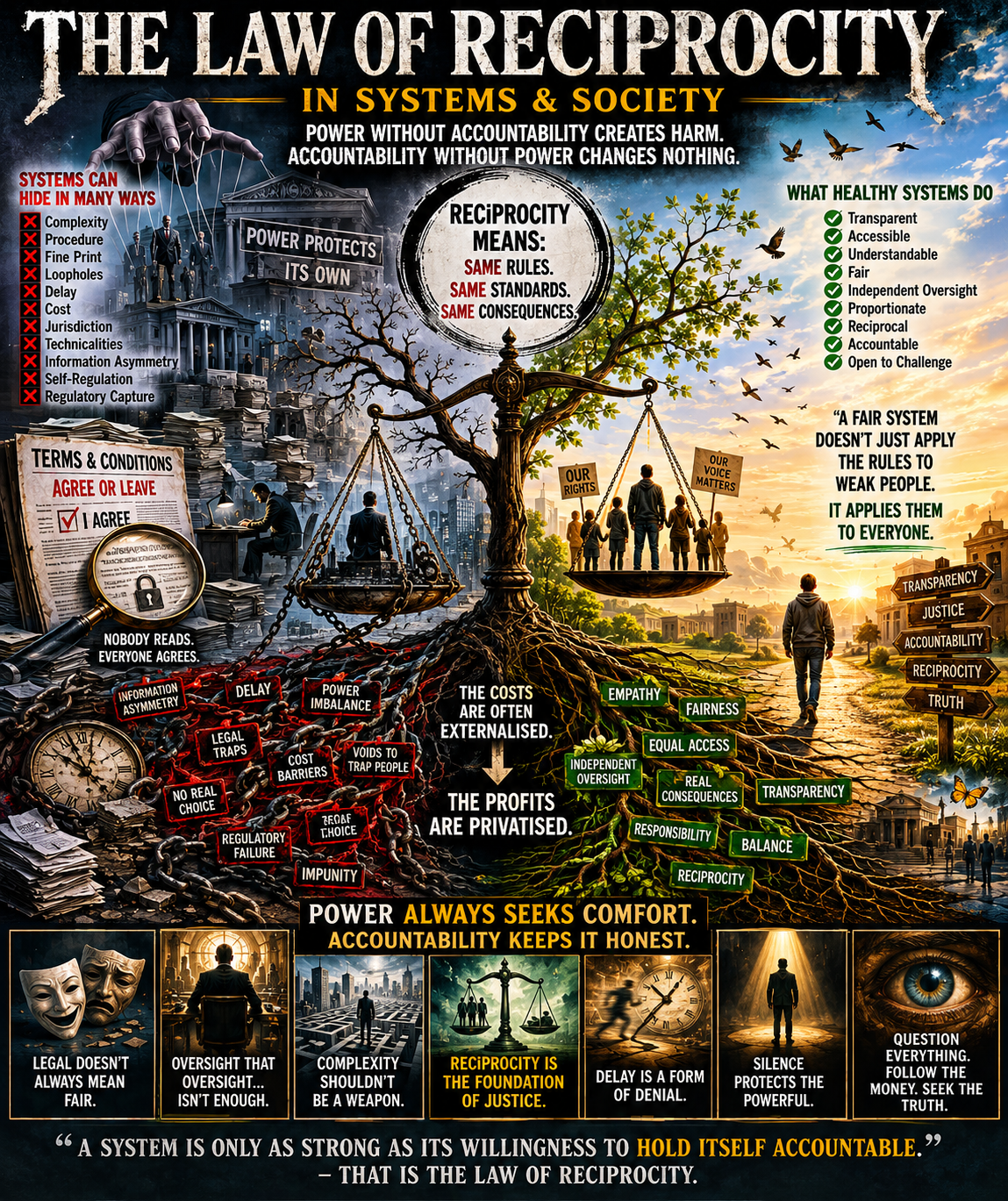
WHO WATCHES THE WATCHERS?
THE LAW OF RECIPROCITY IN SYSTEMS & SOCIETY
A healthy society depends on reciprocity, the principle that power, responsibility, and consequences remain connected.
Ordinary people are expected to follow laws, procedures, contracts, and regulations, often facing immediate consequences when they fail to do so. Yet many powerful institutions operate behind layers of complexity, bureaucracy, legal protections, and procedural barriers that can make meaningful accountability difficult to achieve.
The issue is not that every institution is corrupt. The issue is that accountability mechanisms themselves can become weakened, captured, under-resourced, politically influenced, or legally circumvented.
Complex terms and conditions, regulatory loopholes, fragmented responsibilities, endless procedures, information asymmetries, and costly legal processes can create a gap between theoretical rights and practical access to justice.
A recurring pattern emerges:
The citizen waits.
The patient suffers.
The customer loses time.
The family absorbs the damage.
While institutions often absorb failures as case numbers, complaints, legal costs, or reputational risks.
The costs are externalised onto those with the least power to resist them.
A healthy system internalises the costs of its failures.
An unhealthy system externalises them onto the public.
The central question is not whether corruption exists. The real question is:
Who holds power accountable when accountability mechanisms themselves become compromised?
Who watches the watchers?
Who audits the auditors?
Who regulates the regulators?
The Law of Reciprocity offers a simple principle:
The greater the power, the greater the accountability.
A fair system applies the same standards to everyone, regardless of status, wealth, position, or influence.
Responsibility must flow both ways.
Those who make decisions must bear responsibility for their consequences.
Without reciprocity, systems gradually serve themselves.
With reciprocity, systems serve the people they were created to protect.
That is why the question remains:
Who watches the watchers?
The Law of Reciprocity in Systems & Society
A clear mind sees things as they are. It sees purity where there is purity. It sees corruption where there is corruption. It is attached to neither.
This workbook turns a single observation — that perspective shifts the moment someone is wronged — into a working principle. Not a complaint about the world, but a tool for reading it. Sit with each prompt. Write the answers down. The aim is not agreement; it is discernment.
The Clear Eye, Not the Closed One
It begins with a familiar line: “one who has a pure mind sees everything pure.” True — until someone wrongs you. Then the perspective changes. That shift is not the loss of innocence so much as the arrival of evidence.
The danger sits at both extremes. See everything as pure regardless of evidence, and you miss deception, manipulation, exploitation, and abuse. Swing the other way, and idealism curdles into cynicism. The work is to hold neither.
Purity of mind is not the inability to see darkness. Purity of mind is the ability to see darkness clearly without becoming it.
Two distinctions make this usable. Separate purity from perfection. Separate integrity from innocence. Perfectly pure people are rare; people who try to act with integrity — who keep their word, admit mistakes, and avoid needless harm — are not. They remain flawed, biased, sometimes selfish. That is the realistic ground we work from.
What kind of “pure” do you mean?
When someone says they hardly see anyone as pure anymore, the word is doing a lot of hidden work. Pick the meaning apart — each opens a different conversation.
An impossibly high bar. Almost no one clears it, so this reading guarantees disappointment. Useful to notice when you’re holding people to a standard no one meets — including yourself.
A reachable bar. Plenty of people are honest about who they are and what they want, even when what they want isn’t noble. Authenticity is not the same as goodness — but it is legible, and legibility lets you choose your distance wisely.
Self-interest is near-universal and not inherently corrupt. The question is whether someone pursues their interest openly or disguises it. Hidden incentives, not the existence of incentives, are the problem.
The sharpest test of all. Manipulation is self-interest that operates by concealing itself from you. This is the meaning most worth tracking — because it maps directly onto how systems, not just people, extract from those who can’t see the mechanism.
Imagine two lenses. One makes every example of impurity glow brightly and lets every act of integrity fade into the background. The other does the reverse. After enough betrayals, most people quietly install the first lens and forget they’re wearing it. Which lens are you looking through right now — and what would you have to deliberately notice to test it?
Where the Costs Fall
The deepest objection is rarely “a mistake was made.” It is closer to: the consequences are not borne by the people and institutions creating the harm. The cost is externalised — pushed outward onto whoever has the least power to resist it.
- The citizen waits.
- The patient suffers.
- The customer loses time.
- The claimant carries the burden.
- The family absorbs the damage.
Meanwhile the institution absorbs the same event as a case number, a complaint file, a legal cost, or a reputational line item. The injustice is felt not only because something went wrong, but because the weight of it landed unevenly.
A healthy system internalises the costs of its failures. An unhealthy system externalises them onto the people with the least power to resist.
Picture a decision-maker who must personally absorb every cost their failure creates — the waiting, the lost hours, the damage to a family — felt in their own life, in real time, before they’re allowed to move on. How many failing systems would survive that rule unchanged? The point is not punishment. It is to reveal which failures persist only because the people causing them never feel them.
Power Through Complexity
Power does not always operate through overt force. It operates through complexity, procedure, fine print, bureaucracy, cost barriers, and information asymmetry. A person can hold a right in theory while finding it almost impossible to exercise in practice.
Look at the terms and conditions. They are long, written in language most people won’t realistically read, presented take-it-or-leave-it, and built partly to manage the organisation’s liability. Not every clause is malicious — some exist for genuine regulatory or operational reasons. But when a document runs to hundreds of pages, meaningful informed consent becomes questionable. As consumer advocates put it: if nobody realistically reads, understands, negotiates, or can change the terms, then calling it a freely negotiated agreement is a stretch.
So the better test is rarely “is this legal?” Legality and fairness overlap, but they are not the same. A practice can be perfectly lawful and still leave people trapped, disadvantaged, and unable to meaningfully challenge it.
Does this process genuinely help an ordinary person understand and protect their interests — or does it primarily protect the organisation?
Imagine every contract had to open with one plain sentence: “Here is the thing in this document most likely to harm you, and here is how to avoid it.” Which agreements in your life would change overnight — and what does that tell you about who the current design serves?
When the Watchers Fail
Sometimes the body created to oversee an industry becomes part of the problem rather than the solution. Regulators have, at times, missed warning signs, grown too close to the industries they oversee, failed to enforce existing rules, prioritised institutional reputation over transparency, or acted only after serious harm was already done. When a regulator drifts toward the interests of the regulated rather than the public, it has a name: regulatory capture.
Two claims sit here, and they are worth keeping apart. The first — that regulators can be a source of serious failure — is well evidenced across sectors and countries. The second — that regulators are the root cause of most problems everywhere — is broader and harder to establish, because most failures have many parents: incentives, market structures, politics, bureaucracy, human error, resource limits, and culture.
The systems lens — not the search for individual villains — is what reveals the recurring pattern. It asks five questions, and they travel across healthcare, finance, technology, welfare, housing, and environmental regulation alike:
- What incentives exist?
- Who benefits?
- Who bears the costs?
- Who is accountable?
- What happens when accountability fails?
Seeing enough failure tempts a person toward a single verdict — everything is captured, everything is corrupt. Sometimes that’s accurate in a specific case. Sometimes it blinds you to the places where people are genuinely doing good work inside imperfect systems. Hold the lens; resist the verdict.
Power tends to seek self-preservation. Accountability mechanisms can themselves fail. Therefore accountability mechanisms must also be subject to accountability.
This applies to every centre of power without exception — government department, regulator, corporation, charity, hospital, technology company. The watcher must also be watched.
Take any institution you trust to keep others honest. Now ask: who holds it accountable — and who holds them? Follow the chain until it loops, ends, or disappears. The point at which it disappears is the point worth watching.
Discernment Without Bitterness
Every person carries mixed currents. Few are entirely pure, few entirely corrupt — most are a blend of generosity and self-interest, wisdom and blindness, courage and fear. The same is true of systems. The work is to read the blend accurately, without flattening everything into the same grey.
The challenge is remaining open-hearted without becoming naïve, and becoming discerning without becoming bitter.
Use these to keep the practice alive rather than letting it harden into a worldview. Tick what you’re ready to carry forward.
The Law of Reciprocity
Abundance, Scarcity & The Circulation of Value
A reflective inquiry into how value moves — or fails to move — through people, communities, institutions, economies, and ecosystems. The principle is institution-agnostic: it applies wherever something receives trust, money, labour, authority, or sacrifice and owes a return.
Central Question:
If every healthy living system depends upon circulation, what happens when value accumulates faster than it returns?
01 • The Core Principle
Concept
Reciprocity is the principle that whatever receives from a system also bears responsibility toward the system that sustains it. Healthy systems flow. Blood flows, water flows, nutrients flow, information flows, affection flows, resources flow, communities flow. When things become rigid, stagnant, or locked up, problems emerge.
Tension
This is not an argument about any single institution. It is a framework for self-correcting systems. The same question is asked of all of them: what comes back, to whom, and how do we see it?
Imagine a forest where every tree absorbed nutrients but none returned leaves, shade, moisture, or seeds. How long would the ecosystem remain healthy? Now hold that image against any institution you know.
Reflection
Where in your life do you see healthy reciprocity?
Where do you see extraction without sufficient return?
02 • The Many Names for “Holding”
Different frameworks read the same blockage in different language — but they tend to converge on one idea: what is held too tightly stops doing its work.
The Witch / Energy-Worker
The blockage isn’t money — it’s energy. Emotional, creative, sexual, grief, anger, fear, love, attention. The pattern is always the same: the energy wants to move, and you’re trying to freeze it.
The Taoist
What is forced becomes brittle. What flows remains alive.
The Systems Thinker
Resilience comes from circulation, not accumulation.
The Economist
What looks like scarcity is often a distribution problem — abundance that has stopped moving, not abundance that has disappeared.
If abundance exists but remains held rather than circulated, is the problem a lack of resources or a blockage in their flow?
Which framing lands for you, and what is it you might be holding?
03 • The Reciprocity Test
Five questions you can ask of any institution
- What do you receive?
- What do you retain?
- What do you reinvest?
- What do you return?
- How do we verify it?
It applies equally to churches, charities, governments, corporations, universities, NGOs, political parties, the benefits system, the courts, the legal profession, and entire industries — gaming, film, tech, finance. The test does not change; only the subject does.
Pick one institution that affects your life. Run it through the five questions.
04 • Through Different Lenses
Religious Lens
If sacrifice is requested, what stewardship and transparency are owed in return? (One case among many — not the whole story.)
Charitable Lens
If resources are received in the name of service, how is impact demonstrated, and how much of the gain returns to the mission rather than the payroll?
Welfare / The Dole
A safety net is a return flow funded by the public. Is it designed to restore people to participation, or to manage them at the lowest cost while flows concentrate elsewhere?
Legal Lens — Courts & Solicitors
Justice is a public trust. When access depends on what you can pay, does the system return justice to the people, or sell it back to them?
Corporate Lens
Profit is not the problem. Extraction without reinvestment is. Growth that weakens the ecosystem that created it is not sustainable growth.
Industry Lens — Gaming, Film, Tech
These run on attention, talent, and goodwill. What returns to the creators, players, and audiences who generate the value — and what is captured upstream?
Political Lens
Do not tell me there is no money while resources concentrate elsewhere. Show me the flows, not the narratives.
Ecological Lens
Nature thrives through cycles of return. A regenerative system reinvests what it takes.
Which lens feels most relevant to your current thinking, and why?
05 • Statements — A Boundary in Every Direction
These are not accusations. They are the same principle, spoken to each receiver: I reject systems that require sacrifice without reciprocity, extraction without stewardship, or surrender without relationship.
Write your own statement — to whoever you most need to say it to.
06 • Extraction vs Regeneration
The Breakdown
Contribution → Accumulation → Concentration → Depletion → Instability
The Perpetual Abundance Cycle
Contribution → Stewardship → Growth → Reinvestment → Stronger Community → More Abundance → (repeat)
Take an institution, business, family, or community. At which stage does its cycle currently stall?
07 • Who Watches the Watchers?
Concept
Power, trust, authority, and resources create responsibilities. Accountability is not punishment; it is feedback.
The Universal Form
Every institution that receives trust, labour, money, authority, or sacrifice should demonstrate a transparent return flow of value to the people and purposes from which those resources originated. The real question becomes: how do we design systems where every receiver is also accountable as a giver, and where growth circulates rather than accumulating behind opaque walls?
What forms of accountability strengthen trust — and which become merely performative?
08 • Synthesis Framework
Five Principles of Reciprocal Systems
- Receive Responsibly — treat contribution as an obligation, not a windfall.
- Steward Wisely — hold enough for stability; resist the drift into accumulation.
- Grow Sustainably — let investment serve the mission, never replace it.
- Return Generously — recycle a fixed share of any increase back into the source.
- Regenerate Continuously — disclose openly, so trust compounds alongside capacity.
09 • The Universal Application
This is not a metaphor that stretches to fit. It is a conservation law: any system with inflows and outflows either circulates or silts up. The same five questions apply, unchanged, to all of these — only the subject moves:
- Religion & faith organisations
- Charities & non-profits
- Government & public services
- Politics & political parties
- Banking & finance
- Investment funds & asset management
- Insurance
- Healthcare & hospitals
- Mental health services
- Education & universities
- Social care
- Housing associations
- Real estate & development
- Agriculture & farming
- Forestry & land management
- Food production & distribution
- Water utilities
- Energy & power generation
- Mining & extractive industries
- Manufacturing
- Supply chains & logistics
- Retail & consumer goods
- Technology & AI
- Telecommunications
- Media & journalism
- Entertainment & sport
- Environmental organisations
- Community organisations
- Cooperatives & mutuals
- Trade associations
- International development
- Philanthropic foundations
- Public infrastructure
- Transportation
- Defence & security
- Family systems
- Local communities
- Online platforms
- Professional bodies
- Any body that receives resources, trust, authority, labour, donations, taxes, attention, or influence
The framework is not speculative. Some sectors have already hardened it into standards — transparency regimes for extractive revenue, accountability frameworks for supply chains, solvency disclosure in insurance, capital reporting in banking. Each was reinvented locally, usually after a failure forced it. The Reciprocity Test is simply the single principle underneath them all.
10 • The Fifth Question Does the Work
Four questions are cheap. One is expensive.
Received, retained, reinvested, returned — any institution can answer these in a glossy report. The whole framework lives or dies on the fifth: how is it verified?
Self-reported verification is theatre. Independent verification is costly, capturable, and the first thing defunded when budgets tighten. Almost every transparency regime that failed, failed here — not because nobody asked the first four questions, but because nobody could check the answers. When you test any institution, spend most of your attention on question five. If the return flow cannot be independently seen, assume it is not happening.
11 • Important Reflections
Name one institution you depend on. What does it actually return to you — and could you prove it to someone who doubted you?
Where, in that institution, does contribution quietly become accumulation? At which exact stage does the cycle stall?
Run the five questions on your own life. What do you receive, retain, reinvest, return — and how would anyone verify it? Where are you asking of others what you do not yet do yourself?
Is there a flow you are holding too tightly — energy, money, grief, forgiveness, attention — and what is the cost of keeping it frozen?
If you could install one verification mechanism into a system you care about — one that made the return flow impossible to fake — what would it be, and who would resist it?
Final Writing Space
How would society, institutions, communities, and personal relationships change if reciprocity became a guiding design principle rather than an occasional moral expectation?
What commitments emerge for you from this inquiry?
A Note on Stance:
Being open-minded does not mean accepting every claim — it means being willing to examine every claim. This inquiry holds many lenses at once and reserves the right to question, test, and reject what does not hold up. Open-minded enough to listen; not so open-minded as to surrender one’s judgement.
Closing Reflection:
Whatever receives must also nourish the source from which it receives. Where circulation thrives, abundance grows. Where circulation stops, systems begin to consume their own foundations.