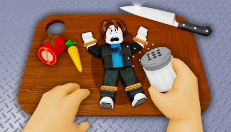
There is a Roblox experience for kids called Mad Chefs. Its own description says players can cook other players into dishes, while customers try to avoid being cooked themselves.
And it is games like this that sets off alarm bells for many.
The disturbing part isn’t simply that a game contains dark humour. It’s the way the premise is packaged: colourful food, silly characters, cooking mechanics and comedy wrapped around the idea of turning other people into food.
The cannibalistic theme is real in the game’s premise. Whether the game is psychologically harmful to children is a separate question, and we shouldn’t assume that playing it makes a child more likely to harm anyone. Context, age, repetition and what the game rewards all matter.

But this connects directly to the question we’ve been developing about games and moral learning:
- What is being normalised? Other players become ingredients rather than people within the game’s fictional world.
- What is being rewarded? Does success depend on capturing, cooking or consuming other players?
- How is the harm framed? As something frightening, morally consequential, or simply funny?
- What does the child learn about the boundary between a person and an object? Not necessarily a real-world belief, but a distinction worth examining in the design.
A child can understand that fictional events aren’t real. Humour can also help people explore frightening ideas safely. So the presence of cannibalism in fiction isn’t, by itself, proof of harmful intent or impact.

The stronger criticism is about design responsibility. When a platform used by children hosts this kind of content, it is reasonable to ask whether the presentation, age guidance and safeguards are appropriate. Roblox’s popularity doesn’t automatically make every experience suitable for every child.
And the wider point stands: we should examine not only what a game looks like on the surface, but what it asks players to do, what it makes entertaining, and what it rewards.

A cheerful presentation doesn’t automatically make a dark premise harmless. Equally, a dark premise doesn’t automatically make a game harmful. But we do have to ask what is being normalised in these environments and how much of this so called gameplay is priming the mind for the harsher reality of tribalism in the world????
Im going to say it plainly: if this is our kids’ curriculum, then the next wave of society will have some fucking big problems to contend with.
The bridge here is the rules of a world, and what happens when different worlds meet inside it.
The UK is a particularly interesting country because its identity has been shaped by successive layers of migration, conquest, trade, empire and cultural exchange. And this process is happening in different ways across many other nations too.
The Roblox example is a small, understandable example of a much larger question. A game (of Life) creates an environment, sets rules, rewards certain actions and establishes what is considered normal. Children enter that environment and learn how it works.
Now scale that up.
A family has norms. A school has norms. A game has norms. A religion has norms. A nation has norms. International society has norms. Each has its own authority, boundaries, expectations and ideas about acceptable behaviour.
When these systems meet, their rules don’t always agree.
The question becomes: what happens when different kingdoms share one world but disagree about the rules governing it?
Here, kingdoms means cultural and political systems, not necessarily literal monarchies. And global norms aren’t automatically neutral or universally accepted. Some are negotiated through international institutions; others are contested, interpreted differently or enforced unevenly.
1. Kingdoms colliding
A kingdom doesn’t literally mean a monarchy. It can mean an entire world of meaning: its language, religion, laws, customs, history, values and assumptions about how life should work.
When these worlds meet, they don’t simply sit alongside one another. They can compete, conflict, borrow from each other, blend or transform.
2. Realities overlapping
Two people can inhabit the same street while understanding the world through very different inherited frameworks.
One may understand duty through family. Another through religion. Another through individual freedom. Another through collective responsibility.
These realities are not necessarily separate physical universes. They’re different interpretive worlds occupying the same shared reality.
The challenge is learning how to coexist without requiring everyone to become identical.
3. Solar systems merging

A solar system has its own gravitational structure. A galaxy has another. When galaxies interact, their existing arrangements change, and new structures can emerge over time.
Human societies can behave similarly as a metaphor: migration, technology, trade, communication and intermarriage bring previously distant cultural worlds into sustained contact.
But the outcome isn’t predetermined. Some things merge, some remain distinct, some disappear, and others emerge that neither culture could have anticipated alone.
The crucial question is whether the merging produces a richer shared world or a struggle for one system to dominate all the others.
And this connects directly to our discussion about power.
Who gets to define the shared reality? Whose customs become the default? Who must adapt? Who is permitted to retain their identity? And what happens when the rules of one cultural world conflict with the dignity or freedom of another?
Perhaps the goal isn’t one kingdom swallowing every other kingdom.
Perhaps it’s learning to build a shared world in which different worlds can coexist, contribute and change without having to surrender everything that makes them distinct.
One question I’d leave open is this:
When two worlds meet, what deserves to be preserved, what needs to change, and who gets a say in deciding the difference?
Rather than asking which culture is good or bad, investigate how each system handles the same tensions.
| Question | What to investigate |
|---|---|
| Individual and collective | When does personal freedom give way to community needs? |
| Authority and consent | What legitimises leadership, and how can it be challenged? |
| Order and dissent | How are protest, criticism and disagreement treated? |
| Tradition and change | What is preserved, and who gets to decide? |
| Security and freedom | Which restrictions are justified, and what limits apply? |
| Justice and accountability | Are powerful people and ordinary people held to comparable standards? |
| Prosperity and dignity | Who benefits from economic success, and who bears its costs? |
| Global rules | Are shared standards applied consistently to allies and adversaries? |