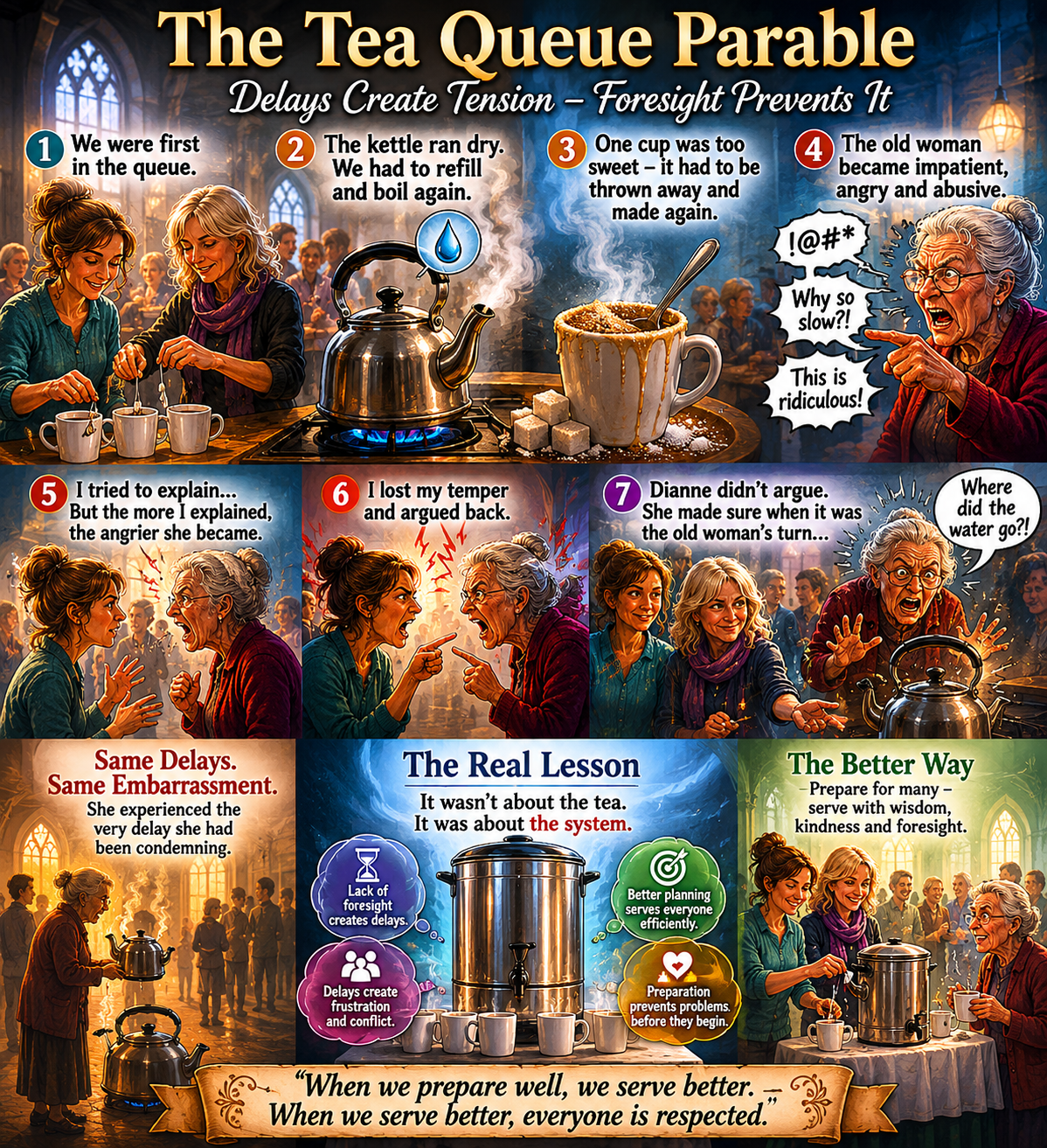
The Kettle and the Queue
A Workbook on Systems, Pressure, and the Architecture of Conflict
There was a church hall where tea was being served. A queue had formed, and two people — call them the Dreamer and the Companion — found themselves first in line.
They needed to make three cups. They placed the tea bags in the cups and began to pour, but the kettle ran dry before the cups were filled. They stopped. They refilled the kettle. They waited for it to boil.
Already, there was a delay.
When the water was ready they continued, but one of the cups had been made with far too much sugar — undrinkably sweet. It had to be thrown away and made again from scratch. More time. More waiting. More eyes on them from the queue.
An elderly woman waiting behind them grew first irritated, then hostile. She began making sharp, cutting comments. The Dreamer felt the pressure build and tried to explain — the kettle had run dry, one cup had gone wrong, they were doing their best. But the more they explained, the angrier the woman became. Eventually, the Dreamer lost their temper and argued back.
Finally, the three cups were ready. The Dreamer and the Companion walked away.
What happened next was quiet, and it was deliberate.
The Companion said nothing to the woman. Made no defence. Offered no explanation. Instead, when it was the old woman’s turn, the water simply disappeared from the kettle just as she needed it. She was forced to refill it. Forced to wait for the boil. Forced to stand in exactly the position she had condemned.
She experienced the delay. She experienced the inconvenience. She experienced the small humiliation — not through argument, but through circumstance.
And afterward, the Dreamer’s thoughts moved away from the woman entirely. What stayed with them was the design of the thing. Why were they using a kettle at all? Why not a large urn, filled beforehand, ready for many? If the vessel had been sized for the task — if someone had thought ahead about the number of people who would need to be served — there would have been no delay. No frustration. No argument. The old woman would have had her tea before her anger had a chance to form.
The story didn’t end with who was right. It ended with a question about the system that made being right or wrong necessary in the first place.
Carries the need to explain. Believes that if the other person understands, the anger will dissolve. Discovers instead that explanation can become fuel.
Carries strategic silence. Does not argue. Does not explain. Engineers the experience instead. The lesson arrives through circumstances, not words.
Carries impatience. Blames the people in front of her for a delay that the system created. Never questions the kettle. Only questions the people holding it.
“What looks like a people problem is often a design problem waiting to be noticed.”
The Kettle and the Queue · TPOLMost interpersonal conflict has a structural cause upstream. The argument was not about the tea. It was about a bottleneck that the design of the space produced reliably, every time a queue formed.
When someone is committed to being angry, explanation does not resolve — it escalates. Words give them more surface to push against. Sometimes the most disarming response is no response at all.
The Companion did not convince the woman of anything. But the woman was taught something by standing in the same delay she had condemned. Lived experience bypasses the arguments the mind constructs against incoming ideas.
The large urn is not a luxury. It is what it looks like when someone has genuinely considered the people who will need to be served. Poor systems are not neutral — they are a quiet absence of foresight, paid for by those at the back of the queue.
Where in your life are you currently holding a kettle that is too small for the queue?
Think about your work, your relationships, your routines. Where are you using a small vessel for a large demand — and blaming yourself or others when the pressure builds?
When has explanation made things worse for you rather than better?
Recall a moment when you tried to justify, clarify, or reason with someone who was already committed to their position. What drove the need to explain? What would have happened if you had stayed silent instead?
Have you ever blamed a person for something that was actually a system failure?
The old woman blamed the people at the front of the queue. But the kettle was not their fault. Think of a time you directed frustration at an individual who was, in reality, caught in the same badly designed system you were.
What is the difference between justice and engineering a lesson?
The Companion’s act was silent, deliberate, and effective. Was it vindictive? Was it wise? Was it both? Where do you draw the line between ensuring someone experiences the consequences of their behaviour, and simple revenge?
What systems in your life were designed without you in mind?
Consider the institutions, workplaces, relationships, or routines you operate within. Which of them were built for a different number, a different kind of person, or a different era — and have you been adapting yourself to fit them rather than questioning the design?
Imagine you are responsible for the church hall. The argument has happened, the queue has suffered, the tea has been made badly. You have been watching.
You have the power to change one thing before next week. Not the people. Not their attitudes. Just the infrastructure. What do you change, and what does that tell you about where power actually sits in most systems?
Now apply this to a real situation in your own life. If you could not change the people involved but could only change the structure they operate within — what would you build, remove, or redesign?
The old woman in the story is never given a reason for her impatience. She arrives already carrying something. Perhaps she has been waiting for longer than just this queue. Perhaps she has been waiting, in different forms, for years.
Write two sentences that could be true of her life — two things that might explain, without excusing, why she responded the way she did. Now ask yourself: who in your own life might have those two sentences written about them?
Does understanding the pressure someone is under change how you respond to the way they direct it?
Think of the worst argument or breakdown in a relationship, a workplace, or a community you have been part of. Describe it in one sentence.
Now remove all the people from the picture. What was the system behind it? What was the equivalent of the too-small kettle? The missing urn? The queue no one planned for?
If the structural problem had been solved beforehand, would the conflict have happened at all?
There are moments when staying silent is not passivity — it is precision. The Companion did not lose. They did not submit. They simply chose a different tool than words.
Think of a situation where you are currently explaining yourself to someone who is not listening, or defending yourself to someone who is already committed to their verdict. What would happen if you stopped? Not to give up — but to let circumstances do what your words cannot?
What would silence protect you from in this moment? What would it allow to arrive on its own?
- I have identified one system in my life that is too small for the demand placed on it.
- I have noticed where I have been blaming people for what is actually a structural or design problem.
- I have identified a situation where I am over-explaining to someone who is not in a position to receive it.
- I have considered what the Companion’s response looks like in my own life — not revenge, but allowing experience to teach what argument cannot.
- I have asked what I am carrying internally that makes me respond the way I do when pressure builds.
- I have identified one system I could redesign — even in a small way — to reduce the friction that creates conflict.
- I understand that foresight is a form of care, and I can name one act of foresight I will take this week.
Your Key Insight
When you are ready, use the space below to write the single most important thing this workbook surfaced for you. One sentence. The clearest version of what you now see that you did not see before.
Then press the button below to generate a summary statement you can carry with you.
“The dream begins with conflict but ends with architecture. Not who caused the problem — but what arrangement would prevent the problem from arising again.”
The Kettle and the Queue · TPOL