

The North Star, The Dog Star
& The Clean Garden
Navigation, Responsibility & the Ethics of Moving Through Other People’s Worlds
Two Stars. One Sky. Different Questions.
Human beings have always looked upward and projected meaning onto the sky. Long before maps or instruments, the night sky was the only reliable guide — and different cultures chose different stars to follow.
This workbook is not about astronomy. It is about a distinction that runs quietly through almost every significant relationship, conflict, and misunderstanding you will ever encounter: the difference between how you navigate and how someone else navigates — and what happens when neither of you realises you’re following a different star.
And then — once you understand navigation — what it means to move responsibly through spaces that belong to other people.
The North Star asks: Where are you going?
The Dog Star asks: What is alive in you right now?
The Garden asks: What did you leave behind when you passed through?
Teaching One
The North Star Orientation
The North Star navigator lives by direction. There is a destination, a principle, a mission — something that doesn’t move. Everything gets measured against it. The consistency is not stubbornness; it is integrity in the original sense — the quality of remaining whole.
For this person, decisions that serve the direction are kept. Decisions that drift are corrected. The fixed point is not external authority — it is the self in alignment with its deepest orientation.
Constancy. You can be trusted to remain oriented. When storms come, you don’t abandon the direction — you recalibrate around it. Relationships and projects built on that reliability have genuine foundation.
The North Star personality can mistake their orientation for the only valid orientation. When someone else doesn’t seem to be moving toward the same fixed point, it reads as drift or lack of integrity — when in fact they are navigating by a different instrument entirely.
Teaching Two
The Dog Star Orientation
The Dog Star navigator lives by vitality. Not the fixed destination but the quality of the experience in motion. Sirius doesn’t stay put — it rises and sets, it blazes when it appears. The Dog Star person is drawn toward what is most alive: most present, most electric, most real.
This is not absence of direction. It is a different relationship with direction. Rather than a fixed north, there is an internal barometer: am I alive in this? The path emerges through engagement, not pre-planning.
Presence. Adaptability. The capacity to find what matters in a situation without needing a predetermined map. The Dog Star person often finds what was actually needed, rather than what was originally planned for — because they were paying attention to what was alive.
Sirius sets. What blazes can also fade. Without some relationship to constancy, the Dog Star life can accumulate brilliant beginnings and difficult middles. And when a North Star person watches the Dog Star person move, they can mistake vitality for chaos — when in fact it is a completely coherent navigation system, just not theirs.
Teaching Three
The Hidden Assumption
Almost every significant conflict between these two orientations begins not in the difference itself, but in the assumption that there is no difference.
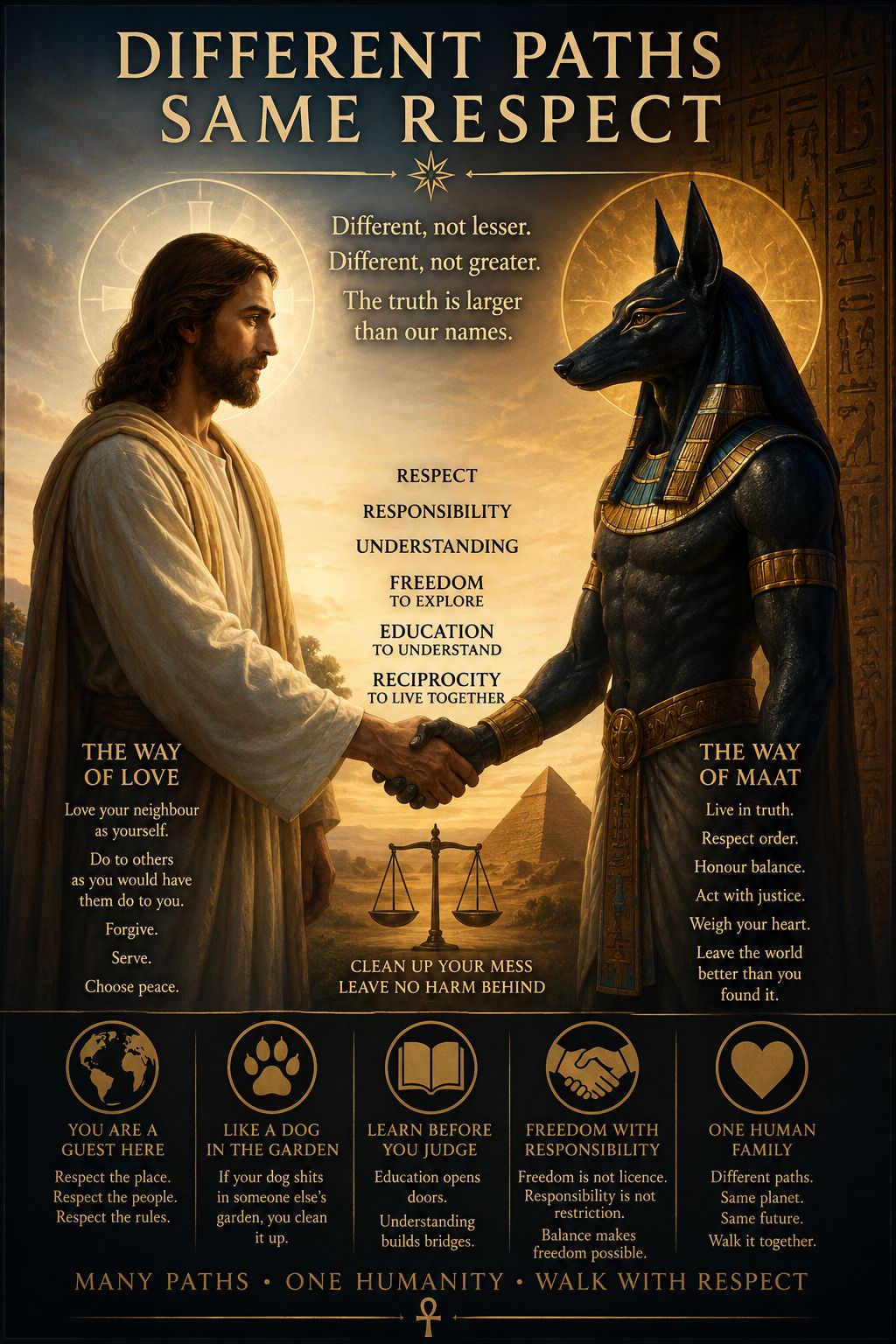
Different, not lesser.
Different, not greater.
The sky holds both.
Mirror Worlds
Opposites are often mirrors. What feels most foreign in another person can be the quality your own path most needs — not to replace your orientation, but to complete it. The North Star without any Dog Star becomes rigidity. The Dog Star without any North Star becomes dispersal.
The North Star person accuses the Dog Star person of having no principles, no consistency, no direction. The Dog Star person accuses the North Star person of being rigid, dead inside, unable to feel what is actually happening. Both accusations contain a grain of truth about the other’s shadow. Neither is a fair description of their core.
The North Star person offers the Dog Star person something to orient around when everything feels like it’s moving too fast. The Dog Star person offers the North Star person the reminder that the journey is also the destination — that aliveness is not the enemy of direction. The difficulty is that neither gift is welcomed when it arrives as correction.
Sovereignty here means: I navigate by my star without requiring you to navigate by the same one. I can hold my fixed point and let you hold your vitality. I don’t need to convert you. The path is mine to walk. Yours is yours. The sky is large enough for both stars.
Integration is not becoming the other type. The oak doesn’t become the river. But the oak can learn something from the river about flexibility. What becomes available, over time, is the capacity to navigate by both stars depending on what the terrain requires — without losing your primary orientation.
The Dog in the Garden
Every navigation style eventually arrives somewhere. You cross a threshold — into a culture, a community, a relationship, a home — and that space already has its own order. Its own customs. Its own people who live there.
Here is a simple image. Your dog wanders into another person’s garden and leaves a mess. You notice. What do you do?
You clean up your mess.
The principle is immediate and almost universally understood: you take responsibility for what belongs to you. You do not leave the consequences of your movement for someone else to manage. This is not submission. This is not weakness. It is the most basic form of respect — the acknowledgement that other people live here too.
The dog is not malicious. It is simply moving freely without awareness of consequence. Most harm done across cultures, communities, and relationships is not malicious either. It is the harm of not noticing — of assuming that freedom of movement carries no responsibility for what it disturbs.
Awareness is what changes that. Not guilt. Awareness.
Teaching Six
The Mirror Principle
One of the oldest ethical principles can be expressed through a mirror. Before acting in a space that isn’t yours, ask: would I appreciate receiving the same treatment in my own space?
The mirror does not eliminate differences. People remain unique. Cultures remain unique. Communities remain unique. The mirror simply reminds us that actions have a receiving end — and the person on that receiving end has their own experience of what it means to be visited, crossed, or moved through.
Respect is not submission. You do not have to agree with every custom of every space you enter. But there is a difference between quietly holding your own values and actively attempting to replace someone else’s with them.
Teaching Seven
The Open Gate
Most people who cross a threshold — into a new culture, a new community, a new relationship — do not arrive to conquer. They arrive curious. They want to learn. To understand. To experience life beyond the boundaries of their own familiar world.
That curiosity is a gift. It is also a responsibility. An open gate is an invitation — not a removal of the garden’s right to exist on its own terms.
Understanding is not surrender.
Understanding is understanding.
You can learn what a culture values without adopting it wholesale. You can appreciate how a community functions without requiring it to function the way yours does. The purpose of crossing a threshold is not agreement. It is encounter — genuine, reciprocal, curious encounter that leaves both parties changed in some small way, but neither diminished.
Can a person remain loyal to their own values while still respecting another community’s customs? Where is the line between adaptation and self-betrayal?
This is not a question with a universal answer. It is a question each person must answer honestly in each specific situation — which is exactly why it is worth asking rather than assuming.
Teaching Eight
Freedom & Responsibility
Freedom without responsibility creates disorder. Responsibility without freedom creates resentment. Healthy movement through the world — across cultures, communities, relationships — continually negotiates the space between them.
Respect travels both ways.
The gate that opens for you should open for others.
The garden you tend should be one you’d be glad for others to tend when they pass through yours.
The Bridge
How Navigation & Responsibility Connect
Part One and Part Two are the same teaching from two angles. How you navigate is deeply personal — your star, your instrument, your relationship with direction or vitality. But navigation always happens somewhere. It always passes through spaces that other people inhabit.
The North Star person who enters someone else’s garden and attempts to redirect its layout toward their fixed point is not respecting — they are projecting. The Dog Star person who blazes through a community with no awareness of what they disturb is not exploring — they are imposing their aliveness onto a space with its own rhythms.
Framework
The Five Principles
Reflection
Self-Inquiry
Take your time. There are no correct answers.
1. Which navigation orientation do you recognise most in yourself — North Star or Dog Star? Where does each one show up in your life?
2. Think of a significant conflict. Looking back — were you and the other person navigating by different stars? What did each of you mistake the other’s orientation for?
3. Think of a time you moved through a space — a culture, community, relationship — that wasn’t yours. What did you leave behind? Was there a mess you didn’t clean up?
4. Where have you treated your navigation style as a universal standard — and brought it into someone else’s space as if it belonged there?
5. What cultures, communities, or people have taught you something you could not have learned from a distance? What did that encounter ask of you?
6. What does sovereignty look like here — for you, specifically? How do you remain yourself, respect other spaces, and hold both at the same time?
Integration
Your Navigation & Responsibility Statement
When you are ready, generate a closing statement drawn from both parts of this lesson.
Your integration statement
Each statement draws from both the navigation and responsibility teachings. Each generation is unique.
Integration Checklist
Before You Move Forward
Know your star.
Navigate your way.
Clean up your mess.
Leave the garden better than you found it.
The sky is large enough. The gate is open.
Different, not lesser. Different, not greater.
The Middle Path
Walking Between Mirror Worlds Without Becoming Captive To Either
Introduction
The Middle Path is often misunderstood.
Many assume it means compromise.
Others assume it means weakness.
Others imagine it means refusing to choose.
Yet the deeper meaning is something else entirely.
The Middle Path is not the absence of direction.
It is the refusal to become possessed by either extreme.
The Middle Path is the Roman road between the mirror worlds.
🙂 | (:
It does not belong to the left.
It does not belong to the right.
It remains a place of movement, awareness, learning, and choice.
The Trap Of The Mirrors
Human beings often become trapped by reflections.
We identify with one side.
We oppose the other.
We become emotionally invested in defending our reflection.
The mirror then becomes a prison.
What beliefs do you defend most strongly?
What would happen if you stood between opposing viewpoints instead of inside one of them?
Attraction & Repulsion
Much of human behaviour operates through two forces:
- Attraction
- Repulsion
We chase what we desire.
We flee what we fear.
We organise entire lives around these two movements.
Yet another possibility exists.
Neither chasing.
Neither fleeing.
Simply seeing.
The Middle Path does not require emotional numbness.
It requires freedom from compulsion.
Reflection Questions
What do you currently chase?
What do you currently avoid?
What would happen if you stopped organising your life around both?
The North Star & The Dog Star
Some navigate by direction.
Some navigate by aliveness.
The North Star asks:
Where are you going?
The Dog Star asks:
What is alive within you?
The Middle Path asks:
Must everyone navigate the same way?
Not everyone seeks purpose.
Not everyone seeks adventure.
Not everyone seeks transcendence.
Not everyone seeks stability.
The Middle Path recognises:
Different does not mean lesser.
Different does not mean greater.
Respect & Boundaries
The Middle Path is not lawlessness.
It does not mean anything goes.
Freedom without responsibility becomes disorder.
Responsibility without freedom becomes oppression.
The Middle Path seeks balance.
If your dog shits in somebody else’s garden, clean it up.
The principle is larger than the example.
Take responsibility for your impact.
Respect the spaces you enter.
When travelling:
- Learn before judging.
- Observe before imposing.
- Respect before demanding.
- Understand before concluding.
Projection & The Mirror
One of the great discoveries of adulthood is realising:
Not everything I see belongs to the other person.
Some belongs to me.
My hopes.
My fears.
My expectations.
My stories.
The mirror reveals projection.
The Middle Path allows projection to soften.
Reflection Questions
What assumptions have you projected onto others?
What assumptions have others projected onto you?
How did those projections affect relationships?
The Appointment
There is a difference between waiting forever and waiting patiently.
One freezes life.
The other allows life to continue.
Waiting for silence is not the same as waiting for an appointment.
The Middle Path does not demand endless waiting.
Nor does it demand reckless movement.
It simply remains available to what arrives next.
The Middle Path Framework
Not chasing.
Not fleeing.
Not forcing.
Not surrendering yourself.
Not imposing your path onto others.
Not abandoning your own path either.
Walk your road.
Allow others to walk theirs.
Meet respectfully where paths cross.
Final Integration Exercise
What extreme am I moving away from?
What does the Middle Path mean in my life right now?
What am I no longer willing to chase?
What part of myself am I committed to remaining?
What lesson do I bow to with gratitude?
The Middle Path • Between The Mirrors • Freedom Without Compulsion