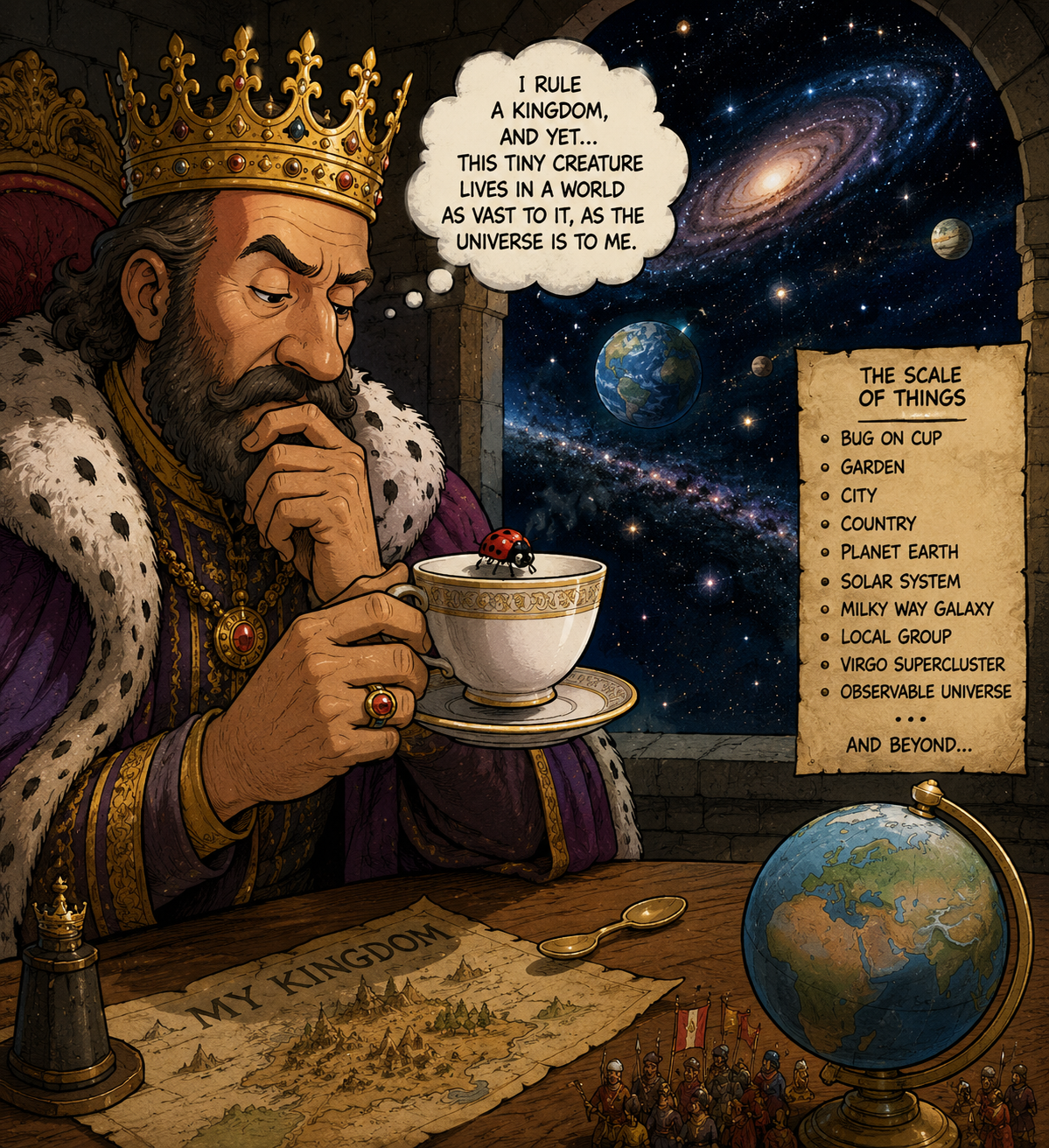
The Bug, The King & The Stars
A Full Teaching on Scale, Importance & How We See the World
This workbook emerged from a real moment: a bug landing on a table after grass was cut. Most people would see a small event. TPOL asks a different question.
What if the size of an event depends entirely on the scale from which it is viewed?
By the end of this teaching, you will not just understand scale as a concept. You will be able to use it as a tool — to change how you see problems, relationships, power, meaning, and your own life.
The garden thought itself forgotten.
The city scarcely knew it existed.
The Earth carried them both.
Section 01 · The Opening Question
What Is Scale?
Scale is not size. Scale is the frame from which you observe something.
A single note of music sounds lonely. Inside a symphony, the same note is essential. Nothing about the note changed. The scale of listening changed.
The same is true of events, problems, people, and places. What appears enormous at one scale dissolves at another. What appears invisible at one scale becomes the entire story at another.
The Core Teaching
Most disagreements about reality are not disagreements about facts. They are disagreements about scale.
The insect, the king, the gardener, the astronomer, and the historian may all describe the same event accurately — and arrive at completely different meanings — because each is observing from a different frame.
This is not a flaw in perception. It is the nature of reality. The question is whether you know which scale you are operating from.
Opening Thought Experiment: The Bug’s Universe
You are the bug. You have just landed on the table.
To you, the garden is not a garden. It is an entire continent. The grass you just navigated is a dense, vertical forest. The table edge is a sheer cliff. The mower that passed ten minutes ago was not a machine — it was a geological event. The world restructured itself. Entire forests were destroyed.
Now step back. You are yourself again, watching the bug.
Consider:
- What does the bug know that you cannot access?
- What do you know that the bug cannot access?
- Who is seeing reality more accurately?
- Is there a scale from which both of you are equally limited?
A Note on Completeness
Neither you nor the bug is wrong. You are both incomplete. This is the first principle of scale: every frame reveals and every frame conceals. There is no observational position that sees everything. The task is not to find the correct scale. The task is to learn to move between them.
Section 02 · Power & The Failure of Scale
The King’s Mistake
The powerless often believe they are smaller than they are.
Both mistakes come from the same place.
One of the most consistent patterns across human history is the confusion of social power with cosmic scale. A person who commands many people begins to believe they occupy a larger position in reality than they actually do.
This is the king’s mistake. It is not unique to kings.
Thought Experiment: The Crown & The Ladybird
A ruler sits at a great table. He has signed laws today. He has commanded armies. He governs the lives of millions. He wears a crown that represents centuries of lineage.
A ladybird lands on the rim of his teacup.
The ruler thinks about border disputes, trade agreements, and succession.
The ladybird thinks about surface temperature, whether this place is safe, and whether there is food nearby.
Now consider these questions carefully:
- Which of them is engaging with the more important reality?
- What would the ladybird teach the king if it could speak?
- What would the king teach the ladybird if it could listen?
- Is there any scale from which their concerns become equally valid?
- Is there any scale from which both of their concerns become equally small?
What The King Cannot See
What The Ladybird Cannot See
The Scale Trap
When a person operates only from one scale for long enough, they forget that other scales exist. The king forgets the ladybird’s reality is real. The ladybird cannot conceive of the kingdom.
The trap is not ignorance. The trap is the belief that your scale is the correct one.
Describe a situation in your own life where you were operating from only one scale — and what happened when the scale shifted:
Scale Exercise: Power Mapping
Think of someone in your life who holds more institutional power than you. Now think of someone who holds less.
For each person, write one thing that their scale of power prevents them from seeing — and one thing that their scale reveals to them that others cannot access.
Notice whether your own position changes how you completed this exercise.
Section 03 · The Method of Consequence
Follow The Line
The Line is not only a railway corridor in north Liverpool. It is a method of perception.
To follow the line means to trace consequence. To ask: if this, then what? And then what? And then what? Until the thing you started with connects to everything else.
Follow it far enough.
Everything becomes the same story.
Thought Experiment: Two Lines, One Story
Follow the first line:
Bug → Grass → Soil → Water → Rain → Cloud → Ocean → Weather System → Planet → Sun → Galaxy → Universe
Now follow the second line:
Self → Family → Community → City → Nation → Civilisation → Humanity → Earth → Solar System → Universe
Questions:
- At what point do these two lines begin to describe the same thing?
- What does it mean that the bug and you share the same eventual destination?
- If you traced your own life as a line — where does it connect to something larger than yourself?
Your Own Line
Choose something from your current life that feels contained, small, or stuck. It could be a problem, a relationship, a decision, or even an object.
Now trace it outward. What connects to it? What does it connect to? Where does it eventually arrive?
Notice whether the thing still feels the same size by the time you finish writing.
Section 04 · The Scale Ladder
Moving Through Levels
Most people spend their entire lives operating from two or three scales. They move between self, family, and perhaps work or city. Occasionally something forces them to a larger or smaller frame — illness, loss, wonder, travel, or crisis.
The Scale Ladder is a deliberate practice. It asks you to move up and down through levels of reality as an act of perception training.
The Ladder
Thought Experiment: The Museum of What Matters
You are the curator of a museum that exists at the end of time. You may keep only one object from the history of Earth to represent everything that ever mattered.
Your collection contains:
- A crown from a great empire
- A Victorian railway bridge, covered in moss
- A ladybird in amber, perfectly preserved
- The first human footprint on the moon
- A child’s drawing of a garden
- A teacup with a small chip on the rim
- A single strand of mycorrhizal fungus connecting two oak trees
Work through the following:
- Which do you choose, and why?
- Now repeat the exercise from the perspective of a ladybird. What would she choose?
- Now repeat it from the perspective of the planet. What does Earth consider most worth preserving?
- Now from the perspective of the universe itself — a reality 13.8 billion years old. Does the question even make sense at that scale?
Scale Ladder Practice
Take any current problem, worry, or question in your life. Place it at the bottom of the ladder (Level 01 — The Bug) and describe it from there. Then slowly climb. At each level, write one sentence about how the problem appears from that scale.
You do not need to resolve anything. You are only training the ability to move.
At which level does the problem stop existing? At which level does it begin to look like something else entirely?
Section 05 · Hidden Importance
The Thing You Called Insignificant
Insignificance is always a statement about scale, not about the thing itself.
When the North Liverpool Extension Line was closed in 1972, it was declared surplus. Redundant. Empty. For 54 years, it was largely invisible to the institutions that owned it.
In those same 54 years, without permission, without funding, without a plan, it became a mature urban woodland. A species-rich wildflower grassland. A wetland. A bat colony inside Victorian bridge recesses. A living mycorrhizal network threading oak roots together underground. A place where children collected frogs. A place held in community memory across generations.
The corridor did not know it was insignificant. It simply continued becoming what it was.
Thought Experiment: The Corridor Speaks
If the North Liverpool Extension Line could describe itself — not as planners and councils saw it, but as it actually experienced the 54 years of closure — what would it say?
Consider:
- What did it witness over those decades?
- What arrived without invitation?
- What did it become without anyone deciding it should?
- What would it want the people of north Liverpool to know about themselves?
The Invisibility Exercise
Think of something in your own life — a place, a relationship, a practice, a part of yourself — that has been declared surplus. Redundant. Not worth attending to. Overlooked by others or by yourself.
Now ask: what has it been doing in the absence of attention? What has grown there without permission?
Thought Experiment: Recognition vs Development
There is a crucial distinction between recognition and development. Development imposes a new vision on something. Recognition sees what is already there and names it.
Consider:
- Can you think of a moment in your life where someone developed you — imposed a vision of what you should be — rather than recognising what you already were?
- Can you think of a moment where someone saw something in you that you had not yet seen yourself, and named it? How did that feel different?
- What in your current life might be asking to be recognised rather than developed?
Section 06 · Synthesis & Application
The Wisdom of Scale
Wisdom is not knowing the answer. Wisdom is the ability to move between scales without losing sight of the whole.
A person trapped at one scale — however large or small — is limited in the same way. The king who can only think in kingdoms. The bug who can only think in grass blades. The philosopher who can only think in abstractions. The pragmatist who cannot lift above the immediate.
The practice this workbook is building is fluency. The ability to move deliberately. To zoom out when you are overwhelmed. To zoom in when you have become too abstract. To hold multiple scales simultaneously when the situation asks for it.
Thought Experiment: The Letter
Write a letter from the bug to the king.
The bug has been observing the king from the teacup rim for several minutes. It has seen what the king cannot see about himself. It has things to say.
The bug is not inferior. It is not asking permission. It is not intimidated by the crown. It is simply speaking from its scale — which is as real as any other.
The Final Reflection
The bug was not insignificant.
The king was not insignificant.
The garden was not insignificant.
The stars were not insignificant.
Each was large enough to itself.
This is not a comforting thought. It is a demanding one. If everything is large enough to itself, then nothing can be dismissed. The corridor matters. The wetland matters. The community memory matters. The ladybird on the teacup matters. Your overlooked places matter. Your overlooked self matters.
Taking this seriously changes how you move through the world.
Final question: If wisdom is the ability to change scale without losing sight of the whole — what has this teaching changed about how you see your life, your community, or your world?
The bug is not humble.
These are the words of creatures comparing.
Everything is large enough to itself.
This workbook is part of the TPOL Journeys series. It may be returned to. Scale is not a conclusion — it is a practice.