Sent To Sefton Council – I’m making this public information so the world can cherry-pick the ideas.
Since IP Thieft is the dish of the day, i will make it a free-for-all banquet – Eat your heart out folks.
THIS IS FOR THE BENEFIT OF THE WORLD, NOT JUST A LOCAL COUNCIL
PROJECT 1: THE LINE — North Liverpool Extension Line Community Regeneration
Overview
The Line is a proposal to transform a disused Victorian railway corridor — the North Liverpool Extension Line, opened 1879, closed 1972 — into a permanently community-owned active travel route, wildlife corridor, organic farm, heritage experience, and family destination. The corridor runs seven miles from Bootle to Aintree through Seaforth, Litherland, and Maghull. It has been in continuous informal community use for 54 years since closure, and in that time has developed mature urban woodland, species-rich wildflower grassland, natural wetland, and intact Victorian railway infrastructure entirely without human intervention.
The project is originated by David Moylan — a north Liverpool resident with deep personal connection to the corridor, having grown up alongside it, and returned to it throughout his adult life. The concept originated on 16th March 2026, triggered by a photograph taken beneath a Victorian railway bridge showing dumped waste beneath 54 years of wild growth. That image became the founding document of everything that followed.
The Philosophy: Recognition, Not Development
The core philosophical statement of The Line is expressed clearly in its definitive proposal document:
“This is not a development project. This is recognition.”
This is not rhetorical positioning. It is the structural principle that governs every design decision, every land management choice, and every community engagement strategy in the proposal. The North Liverpool Extension Line has been becoming itself for 147 years. The Line does not impose a vision onto the land — it recognises what the land has already become and creates the conditions for that becoming to be safely accessible, permanently protected, and economically self-sustaining.
The philosophy draws on what the document calls “a genealogy of places rather than people.” Where traditional heritage projects trace human lineage, The Line traces ecological lineage: birch seeded first, then elder, then hawthorn, then wildflowers found the south-facing embankments, then frogs found the marshy drainage, then bats found the bridge recesses, then mycorrhizal networks began threading through the soil connecting tree families to each other underground. This is understood not as decay following closure, but as succession — a 54-year process of ecological self-organisation that constitutes one of the most significant unrealised community assets in the Liverpool City Region.
The human dimension of this philosophy is equally explicit. The children of north Liverpool never stopped using this corridor. They climbed the cutting faces, hid in the bridge recesses, collected frogs from the marshy sections, ran to watch the trains from the embankments. The community memory of the corridor is 54 years deep and still living. The Line does not bring something new to north Liverpool — it gives what is already here a proper, safe, permanent home.
The founding tension the project resolves is between wildness and access: how do you open a space that has been becoming itself for half a century without destroying the very quality that makes it worth opening? The answer is the principle of organising chaos, not erasing it — working with the existing rewilded environment, preserving its character while shaping it into a space that is accessible, resilient, and meaningful for future generations.
Harmonising Nature with Productive Output
The Line’s approach to productive output flows directly from its ecological philosophy rather than being imposed upon it. Every productive element in the project is designed to work with the existing natural systems, not against them.
The Farm as Land Preparation System
The organic farm at The Hub — the project’s main family destination at Mile 3.5 — is not designed as an agricultural imposition on the corridor. It is designed as a continuation of the natural succession process that has already been underway for 54 years. Rare breed Tamworth pigs are the first workers after MSRU clearance: their natural rooting behaviour breaks compacted soil, aerates and fertilises it. Heritage breed chickens follow the pigs, scratching, eating weed seeds and grubs, preparing the ground further. Vegetables grow in what the animals leave behind. The kitchen processes the harvest. The food goes to the café, to local schools, and to food banks along the route. Nothing leaves the loop.
This is summarised in the project’s own framing: “The land that was cleared feeds the community that cleared it. The waste that was recovered funds the food that is grown. Nothing leaves the loop.”
The Wildflower Embankments and the Apiary
The south-facing embankments of the corridor contain species-rich grassland that has never been ploughed or fertilised — 54 years undisturbed. The Line manages these as traditional hay meadows. Community beekeeping operates directly on these embankments, with Line Farm honey labelled with the exact section of embankment where the bees fed — described in the proposal as “the most hyperlocal food product imaginable.” The productive output (honey, hay, wildflower seed) is thus a direct extension of the ecological asset, not a replacement for it.
The Wetland
The marshy drainage area — referred to as “The Frog Place” — where generations of children collected frogs is preserved and developed as a managed wetland. Breeding frogs and toads are confirmed. Frogspawn appears in February. The extraordinary juvenile frog emergence happens in June. A Great Crested Newt survey is underway. Rather than draining this area for productive use, The Line frames it as a productive ecological asset in its own right: birdwatching hires, guided wetland tours, pond dipping, and community education are all revenue-generating activities that require the wetland to remain wild.
The Community Forest
The Line proposes native planting of oak, ash, field maple, wild cherry, rowan, and hazel coppice along the corridor — described explicitly as “north Liverpool’s own forest. Not Delamere. Not Formby. Theirs.” The productive output here is measured across a 50-year horizon: a maturing urban forest that sequesters carbon, provides timber coppice, supports biodiversity, and creates the kind of landscape infrastructure that cannot be bought or built quickly. It is planted for people who are not yet born.
The Heritage Orchard
Apple, pear, plum, and damson trees in a wildflower meadow setting. Blossom in April — timed to coincide with Grand National week and the 70,000+ visitors the project anticipates connecting to the corridor via the Aintree Terminal. Apple Day in October. Surplus fruit to the food bank. The orchard is simultaneously a productive food system, a heritage conservation project, a visitor attraction, and a food bank supply chain — all within the same planting.
The Self-Funding Model
The project’s financial philosophy is as distinctive as its ecological philosophy. Phase 1 clearance is delivered through the Mobile Site-Recovery and Repurposing Unit (MSRU) — a community-led waste recovery system that bills councils for remediation while generating revenue from recovered materials. The MSRU clears the corridor at no net cost to the community. All surplus funds the community directly.
The revenue model at full operation distributes surplus as follows: 40% to a community fund allocated by resident vote; 35% reinvested into operations; 25% as a labour premium ensuring workers earn above minimum wage. The explicit rationale for the labour premium is that the surplus comes from the workers’ own community’s land.
Total project cost across all five phases is estimated at £5.2M–£9.3M — less than 10% of Liverpool’s European Capital of Culture spend in 2008. Unlike an events programme, The Line generates ongoing revenue and is held permanently in community ownership, legally unable to be sold, developed, or removed from community control through its Community Benefit Society structure.
The Visitor Economy and Strategic Connections
The Line connects two world-class sporting venues: Aintree Racecourse (Grand National, 70,000+ day visitors) at the northern terminal and the new Everton FC stadium at Bramley-Moore Dock (52,000 capacity) at the potential southern extension. The strategic framing is explicit: rather than post-race visitors dispersing into traffic queues, they walk from the racecourse gates directly into the woodland corridor. All visitor economy is retained in north Liverpool communities.
The 7-mile corridor is envisioned as a commercial corridor with 9 distinct stops, each a destination: Aintree Terminal Cluster, Wildlife Gateway, Bridge Stop, Meadow Café Stop, The Hub, Wetland Stop, History and Food Mile, Ancient Woodland Stop, Bootle Terminal. Every stop generates revenue. All revenue stays local.
The Warren and The Crossing Point
The most distinctive heritage feature of the project is The Warren — a curated experience built within the Victorian railway bridge infrastructure where the old diesel line crosses above the active Merseyrail electric line. High-brightness LED screens are set flush beneath toughened laminated glass along the passage floor, each activating as visitors approach, each displaying a different era of Liverpool’s history from 1879 to the present. Sound rises from below — the same direction sound always came from in this corridor, from the trains in the cutting below.
The final panel is not archive footage. It is live. The Merseyrail Northern Line runs 4.2 metres directly below the walking surface at The Crossing Point. Visitors feel the vibration before they see the train. The teal Merseyrail train passes beneath their feet at full operational speed. Gone in four seconds. As the proposal states: “There is nowhere else in the country like this.”
PROJECT 2: THE MSRU — Mobile Site-Recovery and Repurposing Unit
Overview
The MSRU is a van-scale mobile waste processing and site remediation unit — the operational engine that makes The Line financially viable and replicable. It is designed to be deployed on contaminated or waste-laden sites, bill the relevant authority (council, housing association, landowner) for remediation services, and simultaneously recover value from the materials removed.
The unit processes multiple waste streams simultaneously, generating revenue from each:
- Stream 01 — Mixed metals: Ferrous and non-ferrous metal recovery and sale
- Stream 02 — Timber: Usable timber recovered, processed, repurposed
- Stream 03 — Aggregate: Hardcore, rubble, and stone processed for reuse
- Stream 04 — Green waste: Chipped and composted on-site or removed
- Stream 05 — Tyres: Shredded into rubber crumb — which becomes the flooring material inside The Warren at The Crossing Point. Tyres recovered from this corridor become the surface visitors walk on inside it.
- Stream 06 — Electrical/WEEE: Recovered and routed to appropriate processing
The financial model per deployment generates a council remediation fee of £400–£1,400, material recovery revenue of £315–£1,860, and a base case net surplus of approximately +£1,120 per deployment. Surplus distribution follows the same 40/35/25 community model as The Line.
The Philosophy: Closing the Loop
The MSRU’s philosophical foundation is the same closed-loop principle that runs through The Line. The waste that has been dumped on the corridor — the very waste that prompted the founding photograph — is not simply removed. It is processed, recovered, and returned to the community as value. The rubber crumb from shredded tyres becomes accessible flooring. The recovered timber becomes structural material. The aggregate becomes pathway substrate. The green waste becomes compost for the farm.
This is not waste management. It is material recognition — the same philosophical move that The Line makes with the ecology of the corridor. What looks like waste is actually resource in the wrong relationship. The MSRU is the tool that corrects the relationship.
The MSRU is also designed to be replicable beyond The Line corridor. Once the community benefit society structure is established and the operational model is proven on the North Liverpool Extension Line, the unit can be deployed on other contaminated sites across the region — generating revenue that flows back into The Line’s community fund while delivering remediation services to other communities. The Dave Network model (named in the proposal after the community ethic of people who quietly do the right thing without recognition) is the social infrastructure for this expansion.
The Operational Integration
The MSRU and The Line are not separate projects that happen to share a geography. They are a single integrated system in which the clearance mechanism funds the destination, the waste from the destination becomes the infrastructure of the destination, and the revenue from the destination funds further clearance. Phase 1 MSRU deployment on the Hawthorne Road to Orrell Lane section (the safest section of the corridor, with natural containment, existing desire paths, dense community edge, and lower engineering complexity) generates the surplus that funds Phase 2 path network construction. The path network generates visitor footfall. Visitor footfall generates farm, café, and railway revenue. Farm revenue funds food bank supply. Food bank supply generates community trust. Community trust generates share offer participation. Share offer participation generates community ownership. Community ownership generates permanence.
The cycle is the project. The MSRU is where the cycle begins.
All content above is drawn directly from the uploaded project documents: The Line Definitive Proposal (TL-FP-001 v5.0), The Line Executive Summary (TL-ES-001 v1.0), The Line Philosophy (TL-PHIL-001), The Line Project Brief (TL-PB-001), and the MSRU/MPPU Full Project Briefing. Originated by David Moylan, North Liverpool, March 2026.
PROJECT 3: THE MPPU / MPPU-N From Waste to Power · From Weapons to Watts · From Extraction to Community
This is a three-layer integrated community energy system originating in North Liverpool, built on a single philosophical principle: resources extracted from communities should be returned to them as power, revenue, and independence.
Layer 1 — The MSRU (Mobile Salvage and Recycling Unit) is the operational entry point. It deploys along The Line corridor to collect, sort, and process waste streams — timber, metals, food waste, green waste, used cooking oil, textiles — creating ~43 direct jobs and generating revenue from recycled commodity sales. Non-recyclable organic material becomes fuel feedstock for Layer 2. The MSRU is also the corridor clearance engine for The Line project.
Layer 2 — The MPPU (Mobile Power Production Unit) is a container-scale distributed energy system that converts local waste into electricity and heat via biomass gasification, anaerobic digestion, biodiesel generation, and solar-battery hybrid. A 40ft container delivers 200–300kW. A multi-container array delivers 2–3MW. The community microgrid operates in both grid-connected and island mode. Surplus revenue distributes 40% to community fund, 35% reinvestment, 25% labour premium.
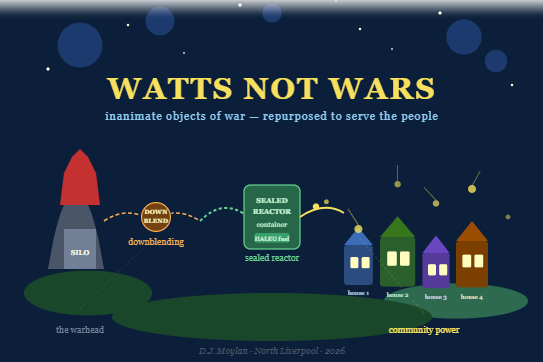
Layer 3 — The MPPU-N (Nuclear Conversion Edition) is the long-term vision: converting decommissioned nuclear weapons material (HEU downblended to HALEU) into fuel for community-scale microreactors. The precedent is Megatons to Megawatts (1993–2013), which converted ~20,000 Russian warheads into ~10% of US electricity for two decades. The MPPU-N uses a three-tier portability architecture: a fixed conversion facility at an existing licensed site; a crane-deployable 1–10MW microreactor for The Hub; and a vehicle-mounted 1–50kW RTG unit for off-grid deployment. A 2MW unit would generate £2–3M annual community revenue.
The system creates ~138 direct jobs across all layers, achieves full energy independence for The Line, and is designed to be licensed and replicated across all 339 UK local authorities. North Liverpool is the proof of concept.
The philosophy in one line: “Inanimate objects of war — repurposed to serve the people. Not people repurposed to serve the system.”
https://drive.google.com/drive/folders/1xEZ4YTkGL3bee2sFgwovrSGFIEEVNWpm?usp=sharing